1
• Cost!
• Ressources available at quantum-music.ca
With its parametric design, each band can be adjusted in terms of
frequency, bandwidth and Q factor to give as much control possible
to shape the sound spectrum.
1.2
Linear phase
For the untrained ear, a non-linear phase EQ, which is pretty much
the standard way to design EQs, doesn’t sound much di↵erent from a
linear phase one. However, for experienced studio engineers who crave
for sound purity and don’t want any coloration, or for hobbyists who
want the most precise equalization, linear-phase EQs provide a more
subtle control. Where minimum-phase or analog EQ’s add frequency
smearing to the sound, linear-phase EQ’s keep a constant “timing”
of all frequencies, which is great for making a frequency band louder
or quieter without changing other aspects of its relationship with the
music around it.
To put it into numbers, a first order filter minimum-phase EQ (meaning analog hardware or digital IIR filters with 6dB/octave slope)
adds/subtracts 90 degrees of phase shift over a two octaves region
around the center frequency for each 6dB of boost/cut. For steeper
slopes, the filter order goes up and so does the phase shift, up to a
point where it goes beyond 360 degrees and really becomes a delay,
but only on a portion of the frequency spectrum. And because the
brain is particularly sensitive to this, it actually uses the phase di↵erence in audio signals to create the 3D image of sound, messing with
phase means messing with the spacial perception of music. Now this
doesn’t mean this sounds bad, it may even be something you look for
in the mix, that’s what adding reverb does. It simply means that if
you already have a good mix, you may want to keep it as true to the
original as possible while performing some corrections.
When applying equalization using a well-designed EQ, the frequency
response should look similar in terms of magnitude, no matter if the
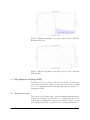
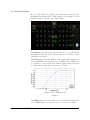
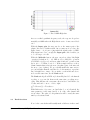
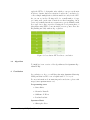
EQ has linear phase or not. As you can see on Figures 1 and 2 ,
both filters have the same cuto↵ frequency of 10.8kHz (blue line),
though with a slightly di↵erent response in the cuto↵ region. , which
is keeping the phase intact all across the audio spectrum. As you can
see on Figures 1 and 2 (green line), the phase response in the passband
region is linear for the FIR and nonlinear for the IIR. Whether this
is an advantage from an audio point of view, there have been lenghty
discussions about this, but from a purely mathematical point of view,
there’s no contest that linear phase EQs provide a “cleaner” signal.
Quantum Matering LPEQ User Manual
4