1
2
Background
2.1 Robot specications
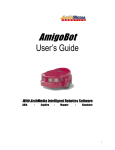
The target robot for this project is a Pioneer P3DX mobile robot (Figure 2)
[10], capable of driving forward and backwards, turning, and detecting obstacles using ultrasound sonars, in eight dierent directions in front of and to the
sides of the robot. It also keeps track of its current position relative its startup
position, using odometry calculations from wheel movement. In addition, a
camera is available and to be used to provide additional detection of humans.
The camera is an AXIS 207MW Network Camera [2], mounted on the robot and
accessed through a local ethernet connection. It has the capability of providing high-resolution JPEG images of 1280x1024 pixels at 12 frames per second,
through an ethernet network connection.
Figure 2: The Pioneer P3DX robot, with the AXIS 207MW Network Camera
mounted on the front.
Sonar input is achieved through bouncing ultrasound o the environment. Each
of the eight sonars on the robot continuosly return the distance to the closest
obstacle, in the direction of that sonar. The directions are static relative the
robot. The distance detection range is up to 5000 mm, and the detection rate
is about 25 Hz. Figure 3 shows the sonar setup on the robot. Since the used
robot only have sonars in front of it, moving backwards can be dangerous, if a
dynamic environment is to be expected.
The robot is controlled by an onboard computer, running the software controlling the robot. It has a single-core Pentium III processor, operating at 850 MHz,
and 256 MB of RAM, the computation power which must be taken into account
when determining what methods are viable to use in controlling the robot. The
control program interacts with the robot instruments using the ARIA API [1],
Advanced Robotics Interface for Applications, provided with the robot. It is
6