1
Section 8
Specifications
General
Specifications for the TidalGuard™ Sp Monitor, are listed for informational purposes only, and are subject
to change without notice.
Capnograph
•
•
•
•
•
•
•
•
•
Principle of Operation: Non-Dispersive Infrared (NDIR) absorption, dual wavelength ratiometricsingle beam optics
Sensor Type: “Mainstream” (no gas sample drawn from breathing circuit)
Initialization Time: Capnogram in 15 seconds, full specifications in 60 seconds.
Response Time: 60 ms
Gas Compensation - Room Air, O2 > 60%, N20 > 60%: Operator selectable in configuration
screen.
Barometric Pressure Compensation: Automatic (range 400-800 mmHg)
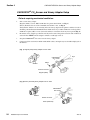
CAPNOSTAT® CO2 Sensor and Airway Adapter:
Weight: Less than 18 g without cable
Sensor Size: 1.3 x 1.67 x .85 inches (3.30 x 4.24 x 2.16 cm), 6 foot cable (1.83 m)
Construction: Durable high performance plastic, ultra-flexible cable
Shock Resistant: CAPNOSTAT® CO2 sensor withstands a 6 foot drop to a tile floor
Regular (Adult) Airway Adapter: Less than 5 cc deadspace, meets ANSI Z-79
Exotic (Neonatal) Airway Adapter: Less than ½ cc deadspace, meets ANSI Z-79
EtCO2 Section (Mainstream)
•
•
•
•
•
•
•
Range 0-150 mmHg, CO2 partial pressure
Accuracy*: 0-40 mmHg ±2 mmHg, 41-70 mmHg 5% of reading, 70-150 mmHg ±8% of reading.
Warm-up Time: Operational in 15 seconds, 1 minute to full specifications
Step Response Time: 60 ms, regular (adult); less than 50 ms, exotic (neonatal)
Averaging Time: 1 breath, 10 seconds (default), 20 seconds, instantaneous
Display Resolution: 0-25, 0-50, and 0-150 mmHg in 31 pixels
Alerts: User selectable alert limits for EtCO2.
*Allows for halogenated anesthetic agents which may be present at normal clinical levels. The presence of desfluane in the
exhaled breath beyond normal levels (5-6%) may positively bias carbon dioxide values by up to an additional 2-3 mmHg.
Maintained up to 70 breaths per minute.
Rev. B
TidalGuard Sp User’s Manual
43