1
Applications
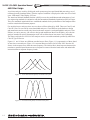
equalizer wouldn't be very useful...let alone musical. The SA-3051/SA-3052 shows you what is going on
in-between the bands of the equalizer and the effects of the controls away from their band-centers. Because of the interaction, you can still deal with problems that aren't conveniently centered on a particular
control by splitting the difference between two adjacent controls.
Regardless of which equalizer you're using, an overall guiding principle is: "Less is Better." With good
components to start with, all that should be needed is gentle, gradual shaping. Avoid large amounts of
boost or cut as well as sharp discontinuities in the overall curve.
Once you're finished, you'll want to add a controlled amount of high-frequency rolloff. Why? Because
"ruler-flat" speakers sound unnaturally bright to most ears. Ordinarily we hear most sounds at a distance.
This causes high-frequency loss because of the friction between the sound wave and the air, as well as
other losses due to absorption caused by walls and other surfaces. As a starting point, try 1 to 3 dB per
octave, starting somewhere between 1 and 8 kHz. Experiment; let your ears be your guide and the
SA-3051/SA-3052 be your compass.
Setting Up Home Theaters
There are three main areas of adjustment when optimizing a home theater sound system. They are:
1. Placement of speakers.
2. The acoustic environment of the room.
3. The system electronics.
Work on items 1 and 2 before fine tuning with the electronics. Here are some tips to get the most out of
your speaker placement and acoustic environment.
Speaker Placement
We (and every speaker manufacturer we’ve ever talked to) can’t over-emphasize the importance of proper
speaker placement. Some speakers require very particular placement in relation to the back and side
walls; all speakers demand careful placement in relation to your home theater’s characteristics. Start by
consulting the speaker’s owner’s manual and don’t be afraid to experiment...a lot. Pull the speakers out
from the walls. Toe them in. Move them closer or further apart. The variation in imaging and response
that different placement can make is astonishing. Especially with the subwoofer.
The Acoustic Environment
Every room affects speakers differently. Reflective and absorbent surfaces, room shape and volume, even
placement of furniture can significantly change a speaker’s sound. It is very helpful to use the SA-3051/52
while investigating various possibilities. Hint...For the best sound imaging, make certain that the front
stage midrange and tweeter speakers are near eye level.
Home Theater/THX Equalization Procedure
1. Have The Right Equipment
To properly equalize a home theater system you should have the following:
• The AudioControl Industrial SA-3051/52
• A Room Equalizer (AudioControl makes a few of these)
• Pink Noise Test Disk (optional)
• Microphone Stand
• Masking Tape
2. Know Your Room
Equalization of the home theater should be done for the entire seating area as opposed to one specific location. Too often a system will be calibrated for a single listening position only to have people in the other
listening positions suffer. Select at least three positions that will be indicative of where the audience will
be sitting. Mark these with masking tape and note these in your documentation for future reference.
5-2