1
RAAP Introductory Astronomy Activity:
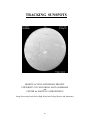
Monitoring the Variations in Magnitude of SS Cygni
Jatila van der Veen, Adolfo Camarillo High School /UCSB Remote Access Astronomy Project
Data for this lab supplied by Mark Parker, UCSB Remote Access Astronomy Project
This lab may be reproduced for use in a classroom in any form, however none of the RAAP materials may ever be
reproduced for publication without the written consent of the authors.
BEFORE STARTING THIS LAB:
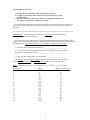
You will need to be sure the images are loaded into your C:\IMAGINE-32\IMAGES\STARS directory,
or some other appropriately named directory. The data sets are labeled SSCY'.FTS, and can be
downloaded from the Remote Access Astronomy Project world wide web home page:
http://www.deepspace.ucsb.edu, under the Interactive Astronomy Arcade page.
Background Info:
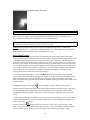
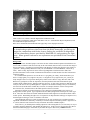
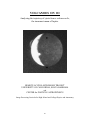
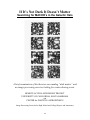
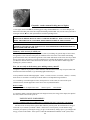
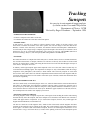
SS Cygni is a famous “dwarf nova” in the constellation Cygnus, according to Burnham’s Celestial
Handbook. It exhibits variations in its light output which are sudden; its light curve, while periodic, is not
smooth and regular. It has been called a “cataclysmic variable” because it gives the appearance of suddenly
exploding several times a year, varying between 12th and 8th visual magnitude.
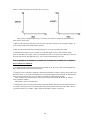
The light curve of SS Cygni exhibits a wide maximum of about 18 days duration, and a narrower
maximum of about 8 days duration. These maxima most often occur alternately, although occasionally two
of the same type of maximum will occur successively. The average interval between major outbursts,
according to Burnham’s, is about 51 days. This intriguing variable was first discovered in 1896 at the
Harvard Observatory in Cambridge, Massachusetts by Miss L. D. Wells, one of the many women who were
employed there around the turn of the century.
From observations made at Mt. Wilson in 1956, it became apparent that SS Cygni is a binary; the
primary is a yellowish dwarf star, of spectral class similar to our Sun, while the secondary is a hot bluish
star which, it is believed, may be related to the white dwarfs.
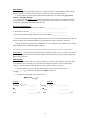
Various studies of SS Cygni indicate the following information about this unusual binary system:
Star A: radius is around .9R(
Star B: radius is around .1R(
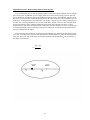
Orbital period (P): around .276 days; Separation of their centers (r): about 1.23 solar radii
Proper motion: 0.12”
Distance: 90 to 100 light years
Pre-lab questions:
1. If the total visual magnitude of SS Cygni varies between 8th and 12th magnitudes, by how much does
the total light output vary?
2. Compute the total mass of the SS Cygni binary system: we will do this in MKS units, then convert to
solar masses.
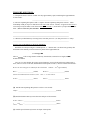
First convert the total separation to METERS: 1 solar radius is 6.96 x 10⁸ m
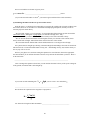
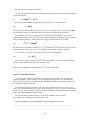
The average separation of SS Cygni A and B is 1.23 R( = _____________________meters
Next convert the period into seconds:
.276 days x 24 hours/day x 3600 seconds/hour = _________________________seconds
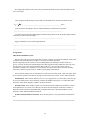
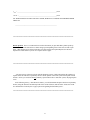
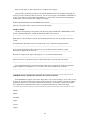
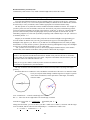
Now we can use Kepler’s third law to find the total mass of the system:
46