1
Chapter 5
5. Assignment iteration
5.1. Introduction
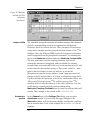
Assignment iteration is a least-squares procedure that optimizes
shifts and coupling constants to produce a fit between observed and
calculated peak positions (and possibly intensities). To set up an
assignment iteration, first set up a normal simulation, as described in
the previous chapter. After this, mark some or all shifts and coupling
constants for optimization by assigning names to them, and supply
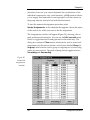
observed peak positions corresponding to some or all of the
calculated peaks. Your initial guess of NMR parameters needs to be
fairly good, or it will be impossible to establish these
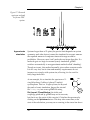
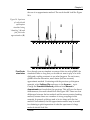
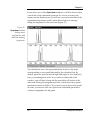
correspondences. Peak positions can be supplied in two ways: by
pointing at them with the mouse ("mouse assignment") or by typing
in the values ("numerical assignment").
5.2. Iteration variables
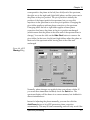
You can use names to link shifts, linewidths and coupling constants
and to mark them for iteration. Linking parameters is a way of telling
gNMR that two or more parameters should actually be considered as
a single numeric value: any change to one set of linked parameters
will change every value in the set. You can use linking to enforce
symmetry restrictions. For example, after you have linked the shifts
of two nuclei, they will always have the same shift. Variable names
can be up to 8 characters long. Leading and trailing spaces are
ignored, but names should not contain embedded spaces: " a " is
OK but "a b" is not. There are no other restrictions. To link
parameters, you must use exactly the same case: "J" and "j" are
considered different.
You can only link parameters of the same type: a shift can only be
linked to other shifts, a coupling to other couplings, etc. Even if you
use the same name for a shift and a coupling, they will be treated as
distinct variables; the error analysis will show the same name twice,
which can be confusing. You can link parameters of different
Assignment iteration
83