1
Introduction
problem, the corresponding POST error code will give you
information about the cause of the problem.
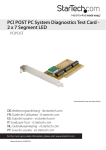
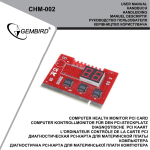
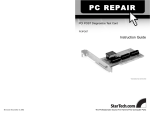
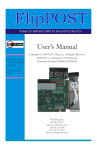
QuickPCI POST Diagnostic Card
With the QuickPCI POST Card, you now have an efficient, high
quality and easy to operate diagnostic card at your disposal.
This was designed for the PCI bus system, which has become
standard and even enables you to diagnose "dead" PC's
quickly. "Dead PC's" are no longer a problem with the
QuickPCI POST Card, and neither are those time consuming
intermittent power supply problems. Do you want to know
more about the ATX timing or the PCI? Simply get plugged in.
QuickPCI POST Card also comes with a 6 months manufacture
warranty.
PCI Interface
As for the interface of the PCI bus, the QuickPCI POST Card
was designed with a fast and programmable PLD-chip, which
takes over decoding and monitoring of various bus signals. A
special consideration during development was not only high
functionality but also the future reliability of the design.
Bus Tension Control
To control the PCI bus tension, QuickPCI POST Card offers a
variety of ways. Four LED's show the existing voltage +5V,
+12V, -12V and 3.3 Volt.
Reset and Clock Signal Monitoring
To monitor the bus signal and reset line (PCI clock) the clock
signal is under continuous monitoring of its two possible states
("0" logical low and "1" logical high). Simpler diagnostic boards
often only check the first cycle of the clock and reset signal.
QuickPCI POST Card shows the actual states of clock and reset
signals using LED's. By using the PCI reset signal, any PC
hardware device (chipset, cpu, graphics controller, and etc.) is
reset to a defined state. A hardware failure on the main board
or an add on card can cause the reset signal to stick to its
active state. This event is called "Reset Loop" and prevents the
PC system from booting. Reset Loops can be detected by
watching the reset LED status.
Power On Self Test (POST) Display
QuickPCI POST Card features a 2-digit-hexadecimal-display.
The extra bright display can even be read easily in dim light
and features the monitoring of I/O Port address 80h, which is
used in sequence from BIOS of PC booting to out put of POST
codes. If the BIOS failed to boot, possibly due to a hard ware
http://www.qpci.com
5
http://www.qpci.com
6