1
1. Introduction
Thank you for purchasing the Korg EXB-MOSS DSP
synthesizer board. In order to enjoy long and troublefree use, please read this manual carefully and use the
EXB-MOSS correctly.
Before you use this product, you must read the
“Safety Precautions” listed in the beginning of
the Parameter Guide.
This manual explains the Bank F parameters
that are added when the EXB-MOSS is
installed. For details on the parameters other
than Bank F, refer to the TRITON’s Parameter
Guide and Basic Guide etc.
4
Features of the EXB-MOSS
The EXB-MOSS is an option board containing a
MOSS (Multi-Oscillator Synthesis System) tone
generator with six-voice polyphony.
The MOSS tone generator is a physical modeling tone
generator that uses Sondius-XG* technology.
When the EXB-MOSS is installed into the TRITON,
you will be able to use the 128 MOSS tone generator
programs in program bank F.
Bank F is dedicated to MOSS tone generator
programs. Bank F programs can be selected for a
timbre/track in Combination, Song, and Song Play
modes. You can also create combinations or songs
that combine bank F programs with other programs
from banks A–E or G.
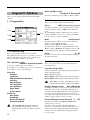
Broadly speaking, a MOSS tone generator program
consists of voice, EG, LFO, effect, and control
sections.
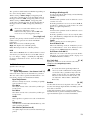
The voice section contains an oscillator and a filter.
— The oscillator provides two oscillators (1 and 2),
which can use thirteen different oscillator algorithms,
including Standard, Ring Modulation, VPM, Resonance, Organ Model, and Electric Piano Model. The
oscillator also provides a sub oscillator and a noise
generator.
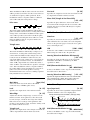
— The filter provides five types of filters (two filter
systems), including a Human Voice Filter that lets you
simultaneously set two center frequencies, and a Dual
Band Pass Filter that lets you simulate the body
resonances of a violin or guitar.
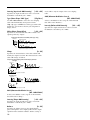
Five EG units and four LFO units can be used to
modulate this voice section in order to create timevarying movement of pitch, tone, and volume.
* This product was developed under license of
physical modeling tone generator patents (http://
www.sondius-xg.com) owned by Stanford University
USA and Yamaha Corporation.