1
flux estimates of the standards derived from spectral templates. The stability of the calibration is monitored by
observing a network of secondary standards every twelve hours. The secondary calibrators are in the Ecliptic
plane and are paired with Spitzer downlinks to improve scheduling efficiency. It is likely that the amount of
time allocated to IRAC calibrations (currently 14% of the total IRAC campaign) will be reduced due to the high
degree of stability that IRAC displays.
The BCDs are absolutely calibrated in units of surface brightness (MJy/sr). The BCDs are FITS files
consisting of the calibrated data for one (64 for subarray mode) image per IRAC array. Each BCD has a header
consisting of useful instrument telemetry pertaining to the data collection, astrometry assembled from the PCS
telemetry and keywords that can be used to trace the calibrations applied to the image data. Complete details
of the BCD headers are available in the IRAC Data Handbook.
3.1. Post-BCD Pipeline
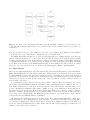
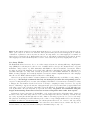
The second set of data products are the browse quality data (BQDs). The BQDs consist of mosaics of the BCDs
from each IRAC channel and source lists in each band. Radhit detection, artifact masking and astrometric
refinement are performed on the input BCDs before mosaicing and extracting sources from the image stack.
Recently, a tool has been developed which will allow the observer to estimate a point response function (PRF)
directly from their data if the published PRFs are not sufficient. The mosaicer, source extractor and PRF
estimator are publically available through the SSC website. For the current generation of the post-BCD pipeline,
only the automated mosaics are valid; therefore, the source lists are not distributed at present.
4. DISCUSSION OF DATA QUALITY AND ARTIFACTS
A variety of data artifacts remain in the pipeline processed IRAC images. Most of the artifacts are related to
or are enhanced by bright sources; that is, sources for which the fluence is a significant fraction of the detector
well depth. The residual artifacts are both electronic and/or optical in nature. The SSC is currently developing
corrective algorithms for most of the artifacts. It is hoped that tools will be provided to the user community to
correct the BCDs for some of the artifacts by the end of 2004. Modifications to the SSC pipeline will happen
at a slower pace due to the stringent testing and version control required for operations software. Many of the
artifacts can be mitigated by well designed observations. Most of the optical artifacts can be masked in well
dithered observations. Using HDR mode, the short frames will provide some data which is not affected by the
electronic artifacts produced by bright sources.
4.1. Photometric Stability
To date, the on-orbit stability of IRAC is excellent. The measured temporal variation in the flat field is < 2%.
The repeatability of the measured flux for any given calibrator is 1-2% and 2-3% for the flux scaling derived
from the network of calibration stars. We conservatively estimate the absolute calibration to be good to 10%.
4.2. Electronic Artifacts
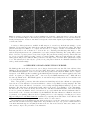
Electronic artifacts include saturation, latent images, multiplexer bleed (muxbleed), and column pulldown. Well
dithered observations will be robust against latent images. Muxbleed and column pulldown are functions of the
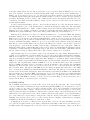
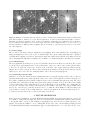
source fluence. Figure 6 displays examples of muxbleed and column pulldown. Using HDR mode for observations
of bright source fields will provide some data for the affected regions.
4.2.1. Saturation
Saturated pixels manifest themselves in IRAC data in two ways. Pixels which saturate in the signal reads of the
Fowler sampling will have DN values & 40000. These pixels are flagged by the BCD pipeline. More insidious are
pixels which saturate in the pedestal reads. These pixels have resulting values of . 2000 DN and are difficult to
differentiate from unsaturated data. The pedestal saturated pixels are always due to sources of very high fluence
and produce holes in the observed PSFs of the brightest sources. The holes can be easily corrected in HDR data
by replacing the saturated pixels with the corresponding short frame pixels. Very recently, a more general tool
for detecting holes in all BCD data has been created.