1
GAISLER
19
LEON3 / LEON3-FT
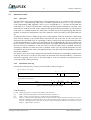
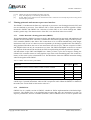
[19]:
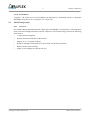
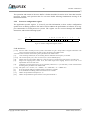
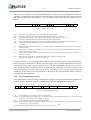
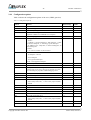
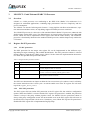
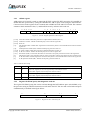
Local ram (LR). Set if local scratch pad ram is implemented.
[18:16]: Line size (LSIZE). Indicated the size (words) of each cache line. Line size = 2LSZ
[15:12]: Local ram size (LRSZ). Indicates the size (Kbytes) of the implemented local scratch pad ram. Local ram size =
2LRSZ
[11:4]: Local ram start address. Indicates the 8 most significant bits of the local ram start address.
[3]:
MMU present. This bit is set to ‘1’ if an MMU is present.
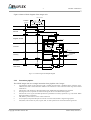
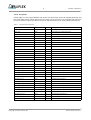
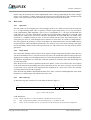
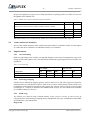
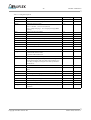
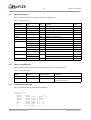
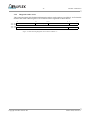
All cache registers are accessed through load/store operations to the alternate address space (LDA/
STA), using ASI = 2. The table below shows the register addresses:
Table 6. ASI 2 (system registers) address map
Address
Register
0x00
Cache control register
0x04
Reserved
0x08
Instruction cache configuration register
0x0C
Data cache configuration register
2.5.9
Software consideration
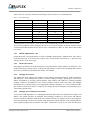
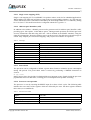
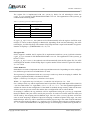
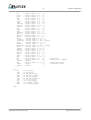
After reset, the caches are disabled and the cache control register (CCR) is 0. Before the caches may
be enabled, a flush operation must be performed to initialized (clear) the tags and valid bits. A suitable
assembly sequence could be:
flush
set 0x81000f, %g1
sta%g1, [%g0] 2
2.6
Memory management unit
A SPARC V8 reference MMU (SRMMU) can optionally be enabled in the LEON3 configuartion. For
details on the SRMMU operation, see the SPARC V8 manual.
2.6.1
MMU/Cache operation
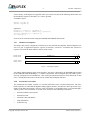
When the MMU is disabled, the MMU is bypassed and the caches operate with physical address mapping. When the MMU is enabled, the caches tags store the virtual address and also include an 8-bit
context field. Both the tag address and context field must match to generate a cache hit.
If cache snooping is desired when the MMU is enabled, bit 2 of the dsnoop generic must be set. This
will also store the physical address in each cache tag, which is then used for snooping. The size of
each data cache way has to be smaller or equal to the MMU page size, which typically is 4 Kbyte (see
below). This is necessary to avoid aliasing in the cache since the virtual tags are indexed with a virtual
offset while the physical tags are indexed with a physical offset. Physical tags and snoop support is
needed for SMP systems using the MMU (linux-2.6).
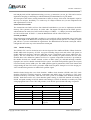
Because the cache is virtually tagged, no extra clock cycles are needed in case of a cache load hit. In
case of a cache miss or store hit (write-through cache), 2 extra clock cycles are used to generate the
physical address if there is a TLB hit. If there is a TLB miss the page table must be traversed, resulting
in up to four AMBA read accesses and one possible writeback operation. If a combined TLB is used
by the instruction cache, the translation is stalled until the TLB is free. If fast TLB operation is
selected (tlb_type = 2), the TLB will be accessed simultaneously with tag access, saving 2 clocks on
Copyright Aeroflex Gaisler AB
March 2010, Version 1.1