1
38
Graphing Technology Guide: TI-92
5.11 Differentiation
sin 4 x
sin 4x
in a convenient
. Plot the graph of f (x) =
x
x
viewing rectangle that contains the point where the function appears to intersect the line x = 0 (because you want the
sin 4 x
limit as x → 0). Your graph should lend support to the conclusion that lim
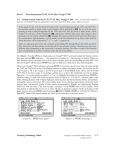
= 4. (Figure 5.95)
x →0
x
2x −1
2x −1
= 2 is reasonable, evaluate the function f (x) =
To test whether the conclusion that lim
for several large
x →∞ x + 1
x +1
positive values of x (since you want the limit as x → ∞). For example, evaluate f (100), f(1000), and f(10,000).
2x −1
Another way to test the reasonableness of this result is to examine the graph of f (x) =
in a viewing rectangle
x +1
that extends over large values of x. See, as in Figure 5.96 (where the viewing rectangle extends horizontally from 0
2x −1
for y1 and 2 for y2.
to 90), whether the graph is asymptotic to the horizontal line y = 2. Enter
x +1
5.11.1 Limits: Suppose you need to find this limit: lim
x →0
Figure 5.95: Checking lim
x →0
sin 4 x
=4
x
Figure 5.96: Checking lim
x →∞
2x −1
=2
x +1
5.11.2 Numerical Derivatives: The derivative of a function f at x can be defined as the limit of the slopes of secant
f ( x + ∆x ) − f ( x − ∆ x )
f ( x + ∆x) − f ( x − ∆x)
lines, so f ′( x) = lim
. And for small values of ∆x, the expression
gives
∆x → 0
2∆x
2∆x
a good approximation to the limit.
Figure 5.97: Using nDeriv(
The TI-92 has a function , nDeriv(, which is available in the Calculus sub-menu of the MATH menu, that will
f ( x + ∆x) − f ( x − ∆x)
calculate the symmetric difference,
. So, to find a numerical approximation to f ´(2.5) when
2∆x
f(x) = x3 and with ∆x = 0.001, go to the Home screen and press 2nd MATH A[Calculus] A[nDeriv(] X ∧ 3 , X) 2nd
| X = 2.5 ENTER as shown in Figure 5.97. The format of this command is nDeriv(expression, variable, ∆x),
Copyright © Houghton Mifflin Company. All rights reserved.