1
10
Auto Engine Repair
This chapter provides a quick review of the operating
principles of a four-stroke-cycle, piston engine. The
interaction of basic engine components are discussed.
Related systems—cooling, lubrication, fuel, computer
control, and other systems—are explained. This review
will prepare you for later text chapters that discuss these
topics in much more detail.
This chapter uses words and illustrations to construct
a basic, one-cylinder engine. You will see how each part is
installed in the basic engine and learn how that part
performs an important function. Then, near the end of the
chapter, the systems that supplement engine operation and
protect the engine from damage are reviewed.
If you have completed an introductory course that
covered engine operation, you should still read through
this chapter to refresh your memory. If you are not familiar
with the operation of an engine, study this chapter carefully. This will let you catch up with the students that have
already had some training in engines.
Chapter 1
Review of Engine Operation
11
K The connecting rod connects the piston to the crankshaft.
Automotive Engine
An engine is the source of power for moving the vehicle and operating the other systems. Sometimes termed the
power plant, it burns a fuel (usually gasoline or diesel fuel)
to produce heat, expansion of gasses, pressure, and resulting part movement.
Since a vehicle’s engine burns fuel inside of itself, it is
termed an internal combustion engine. As you will learn,
the arrangement of an engine’s parts allows it to harness
the energy of the burning fuel.
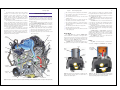
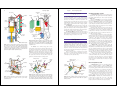
Figure 1-1 illustrates the major parts of a modern,
multi-cylinder engine. Study them as they are introduced:
K The block is the supporting structure for the engine.
K The piston slides up and down in the block.
K The piston rings seal the space between the block and
sides of the piston.
Camshaft
Intake
manifold
Valve spring
K The crankshaft converts the up and down action of
the piston into rotary motion.
K The cylinder head fits over the top of the block and
holds the valves.
K The valves open and close to control fuel entry into
and exhaust exit from the combustion chamber.
K The combustion chamber is a cavity formed above
the piston and below the cylinder head for containing
the burning fuel.
K The camshaft opens the valves at the proper time.
K The valve springs close the valves.
K The timing belt or chain turns the camshaft at one-half
of the engine speed.
Engine Block
The engine block, also called the cylinder block,
forms the framework or “backbone” of an engine. This is
because many of the other components of an engine fasten
to the block. Cast from iron or aluminum, the block is the
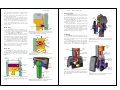
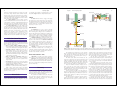
largest part of an engine. Figure 1-2 shows a cutaway view
of a basic engine block. Note the part names.
A cylinder is a large hole machined through the top of
the engine block. The piston fits into the cylinder. During
engine operation, the cylinder, also called the cylinder
bore, guides the piston as it slides up and down. The cylinder is slightly larger than the piston to produce a clearance
(space) between the two parts.
Main caps are bolted to the bottom of the block. They
hold the crankshaft in place and form the bottom half of
the main bore.
The main bore is a series of holes machined from the
front to the rear of the block. The crankshaft fits into these
holes. With the engine running, the crankshaft spins or
rotates in the main bore.
The deck is a flat surface machined on the top of the
block for the cylinder head. The head is bolted to the deck.
Coolant and oil passages in the deck align with openings
in the cylinder head.
Coolant passages, or water jackets, surround the
cylinders and combustion chamber. They are hollow areas
inside the block and head for coolant. Coolant circulated
through the water jackets removes the heat generated by
the fuel burning in the cylinders.
The crankcase is the lower area of the block. The
crankshaft spins inside the crankcase.
Piston
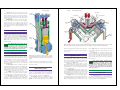
The piston converts the pressure of combustion into
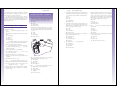
movement. See Figure 1-3. Combustion is the burning of
Deck
Valve
Cylinder
head
Water
jacket
Piston slides
up and down
in cylinder
Cylinder
Timing
chains
Cylinder
block
Crankcase
Main
bore
Block
Combustion
chamber
Exhaust
manifold
Crankshaft
pulley
Piston
Crankshaft
Oil pan
Piston rings
Connecting rod
Figure 1-1. Study the general location of parts in an engine.This will help you while reviewing the operation of an engine in this chapter. (Ford)
Main caps
Main bolts
Figure 1-2. The block is the framework for holding the other
engine components. Note the parts of the block. This is a
simplified, one-cylinder engine.
Figure 1-3. The piston fits into a cylinder bored through the
block. The piston slides up and down during engine operation
acting as a pumping and power-producing element.