1
Donated by John & Susan Hansen - For Personal Use Only
ELECTRICAL
SYSTEM
Section I
Page 4
L-L1NE MOTOR TRUCK SERVICE MANUAL
setting of the gap is either difficult or impos
sible, the spark plug is not fit for further effi
cient engine service even if cleaned.
D. Preliminary Examination:
If the spark plug in question exhibits insu
lator cracks, worn electrodes or other obviously
unsatisfactory conditions, the spark plug does
not warrant further attention and should be dis
carded.
Cleaning And Adjusting
A. Remove Gaskets:
Regardless of the condition of the old gas
kets, they should be removed from the spark
plug before cleaning. If new replacement gas
kets are available the old ones should be dis
carded.
.B. Degrease {If Necessary}:
Before abrasive cleaning. any spark plugs
which have oily deposits on the firing end or the
outside of the spark plug should be degreased
by brushing with gasoline, naptha or other suit
able solvent which will dry quickly by wiping
with a cloth or by air blast. Failure to do this
with oil fouled spark plugs will result in pack
ing of the cleaner abrasive inside the firing end
of the spark plug.
C. Apply Abrasive Blast:
Place the spark p,lug in the rubber cleaner
adapter ofthe correct size. Hold the spark plug
at the terminal end and while applying the abra
sive blast, "wobble" the top of the spark plug in
a circle. By this method the abrasive will be
able to properly clean the insulator tip and the
electrodes. Three seconds time should be suf
ficient to clean most spark plugs. However,
the extent of cleaning time should be limited to
only that which is necessary to clean off the
deposits on the insulator nose. Prolonged use
of the abrasive blast will wear away the insu
lator causing irreparable rlamage to the spark
plug. Visual inspection will indicate when the
spark plug has been properly cleaned. Loose
abrasive remaining inside the firing end should
be removed by the use of the "air blast" jet on
the cleaner. Do not use picks, screwdrivers.
etc. to remove deposits inside the firing .end of
the spark plug.
D. Clean Threads:
Remove loose abrasive or other foreign
material from the spark plug threads by means
of a wire brush (a stiff tooth brush is also sat
isfactory) to complete the job of cleaning.
E. Dress Spark Plug Gaps:
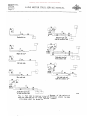
Before actually setting the gap of a cleaned
spark plug it is highly desirable to pass a thin
point file or nail file between the sparking areas
of the center and ground electrodes. This helps
to produce flat, parallel surfaces which resist
growth better than sharp or uneven areas, and
facilitates more accurate gap gauging.
F. Reset Spark Plug Gaps:
Reset all gaps by moving the ground (or
side) electrode only. Do not touch the center
electrode as insulator tip fracture may result.
Bend the ground electrode towards the cen
ter electrode.
Use a good feeler gauge to measure the
clearances between the electrodes. Refer to
specifications for correct gap settings.
A very slight drag should be felt when the
feeler gauge passes between the electrodes.
The spark plug is now ready for testing.
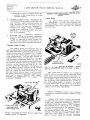
SUITABLE SPARK PLUG CLEANING EQUIP
MENT IS AVAILABLE UNDER SE-1634 AND
SE-l637. BOTH ITEMS ARE ABRASIVE
TYPE CLEANERS.