1
STEPS User Manual
3. Using STEPS for stepped-amplitude testing
The stepped-amplitude testing is a measurement method in which we measure system response and
distortion as a function of the excitation signal amplitude. The excitation signal is the sine or two-sine
signal with a user-defined frequency. The amplitude of the excitation signal is changing from lowest to
highest value in a predefined number of measurement steps.
In stepped-amplitude mode, STEPS can measure and graphically show three functions:
1) Distortion vs. amplitude (harmonic and intermodulation distortions as a function of signal
amplitude).
2) Linearity function (system output or system gain as a function of the input excitation
amplitude) .
3) Loudspeaker displacement/distortion (combined measurement of displacement with optical
laser device and distortion with microphone)
4) Loudspeaker distortion limited maximum SPL (in user defined frequency range)
First two type of measurements are primary targeted to measurements of power amplifiers, audio
compressors and automatic gain control systems, while third type of measurement is for measurement
of loudspeaker response.
3.1 Distortion vs. Amplitude Testing
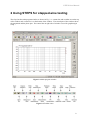
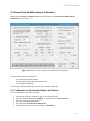
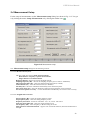
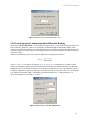
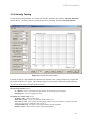
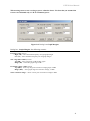
For the Distortion vs. amplitude, testing the user interface is given in the window ‘Distortion vs.
amplitude’ (shown in Fig. 3.1). This window is opened by the menu command ‘Record->Distortion
vs. amplitude’.
Figure 3.1 Distortion vs. amplitude window
38