1
Celestia User’s Guide
3 of 40
Introduction to Celestia
Many of us have looked up at the stars on a dark night and wondered what it would be like to launch ourselves
into space and soar among the stars. What do the astronauts of the Space Shuttle really see when they look down
upon our beautiful Earth turning slowly below? What wonders might we encounter if we could visit Saturn
alongside the Cassini spacecraft and sail right through its rings? If you have ever wondered about these things
and would like to find out the answers, we of the Celestia community are happy to introduce you to Celestia!
Celestia is a free real-time space simulation that lets you visually experience our universe in three dimensions.
Celestia was the initial inspiration and creation of Mr. Chris Laurel, a Seattle, WA computer programmer who in
2001, decided to write a free software program to be made available to everyone on the world-wide-web that
would place you in control of a virtual reality world of the Solar System. His vision and dedication gave birth to a
program that is unlike any other space simulation program in existence. Celestia doesn't confine you to the
surface of the Earth as many other programs do. Instead, Chris created a dynamic capability to travel throughout
the Solar System and anywhere else in space, at any speed, at any moment of time and in any direction you
choose. If you wish, you can fly via your own “hyperdrive” spacecraft to visit stars within the spiral arms of the
Milky Way beyond the confines of our Sun. You can even travel completely out of the Milky Way galaxy and
view it from deep space.
When Celestia version 1.0 first appeared available for download on the Internet, space enthusiasts all over the
world discovered and quickly realized the potential of this beautiful program. Within a year, many talented
people worldwide joined Chris in a collaborative volunteer effort to make Celestia into not only a good graphical
space simulation but into a great one, capable of producing a meticulously accurate virtual world of space rivaling
the visual quality seen only in Hollywood films.
They have succeeded. As of this writing, over 1600 members of the public are part of the Celestia forum
community. Over 2.2 million people have downloaded the program for use at home or school. The list grows
daily and includes talented graphic artists, computer programmers, astronomers, astrophysicists, planetarium
directors, animators, engineers, teachers, students, professionals from scores of occupations and ordinary citizens
in over 25 countries around the world.
We invite you to join the Celestia forum at
http://www.shatters.net/forum/profile.php?mode=register.
Celestia is available free of charge for Windows, Linux, and Mac OS X from
http://www.shatters.net/celestia/download.html. Hopefully, you’ve already downloaded Celestia and are ready to
install it and experience the beauty of space. Here is just a taste of what you will be able to encounter:
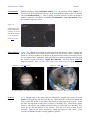
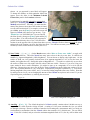
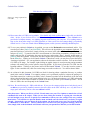
Hover over each of the nine planets in our Solar System as they rotate slowly below you. See clouds
actually drift by (where applicable). Look carefully and you may see mountains, canyons and craters on
the planet surfaces with shadows being cast by them as the Sun sets low on the horizon.
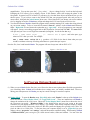
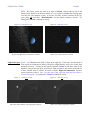
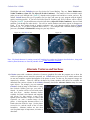
Take a spin down to the Earth’s surface at a lazy speed or at thousands of miles/km per hour in your own
spacecraft. Skim over the oceans of Earth as you actually fly below the clouds. See the sky turn a pale
blue and eventually, transform into the crimson color of a sunset. Soar back into space in time to see the
lights come on in the cities of Earth and glow an eerie white as the dark side of Earth turns below you.
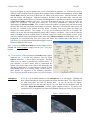
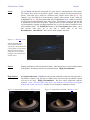
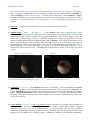
Position yourself above the giant gas world of Jupiter and watch as its large moons drift across the face of
the planet, casting eclipse shadows on its banded clouds and Great Red Spot.
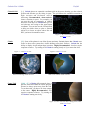
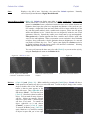
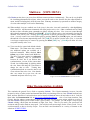
Hover far beyond Saturn, speed up time and count its many moons revolving around its magnificent
ringed body like pearls swirling on an invisible necklace. Watch as one moon eclipses another.
Follow along with the spacecraft Cassini as it makes a dramatic rendezvous with Saturn in 2004. Be
there to see the Huygens probe detach from Cassini and drop down to mysterious Titan in January 2005.