Download Emerson Y693 Data Sheet
Transcript
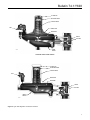
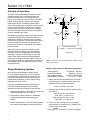
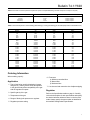
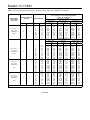
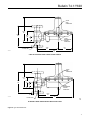
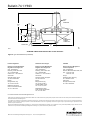
Bulletin 74.1:Y693 Table 2. Type Y693 Regulator Construction Materials MATERIAL PART name Aluminum Lower Casing Version Steel or Stainless Steel Lower Casing Version Body Cast iron WCB steel or Stainless steel Body Gasket Composition Composition Union Nut ---- Steel or Stainless steel Spring case Aluminum Aluminum, WCB steel or Stainless steel Lower casing Aluminum WCB steel or Stainless steel Orifice and bias spring Stainless steel Stainless steel Pusher post and stem Aluminum Stainless steel Lever assembly Steel Stainless steel Diaphragm Nitrile (NBR) or Fluorocarbon (FKM) Nitrile (NBR) or Fluorocarbon (FKM) Control spring, spring seat and split ring Plated steel Plated steel Diaphragm plate Aluminum and Steel Aluminum and Steel Disk and O-rings Nitrile (NBR) and Stainless steel, Fluorocarbon (FKM) and Stainless steel, PTFE and Stainless steel N itrile (NBR) and Stainless steel or Fluorocarbon (FKM) and Stainless steel or PTFE and Stainless steel 4. From Table 6, at 0.5 in. w.c. / 1 mbar set pressure and 40 psig inlet pressure, a Type Y693 will flow 8880 SCFH / 238 Nm3/h nitrogen. This satisfies the 5729 SCFH / 154 Nm3/h requirements. Capacity Information Table 6 gives typical nitrogen regulating capacities at selected inlet pressures and outlet pressure settings. Flows are in scfh (60°F and 14.7 psia) of 0.97 specific gravity nitrogen. For gases of other specific gravities, multiply the given capacity of nitrogen by 0.985, and divide by the square root of the appropriate specific gravity of the gas required. Then, if capacity is desired in normal cubic meters per hours at 0°C and 1.01325 bar, multiply scfh by 0.0268. To determine wide-open flow capacities for relief sizing, use the following formula: Q = 520 GT CgP1SIN 3417 C1 P P1 DEG where, Cg = gas sizing coefficient from Specifications table C1 = Cg / Cv or 33 from the Specifications table G = gas specific gravity (air = 1.0) P1abs = inlet pressure, psia (add 14.7 psi to gauge inlet pressure to obtain absolute inlet pressure) Q = flow rate, scfh Installation The regulator may be installed in any position as long as the flow through the body is in the direction indicated by the flow arrow attached to the body. Install the regulator as close as possible to the blanketed vessel using a straight run of pipe the same size or larger as the regulator body. Position the body and/or diaphragm spring case so it will not collect moisture or debris into the screened vent and also be self draining (as shown in Figure 3). If a block valve is required, install a full flow valve between the regulator and the blanketed vessel. Attach a downstream pressure control line to the female connection in the lower spring case. The female pressure connection is a 1/2 NPT in the steel or Stainless steel lower spring case and a 3/4 NPT for the aluminum lower spring case. Connect the other end of the control line to the vessel. To allow for self‑drainage, install the control line at an angle so that any liquid material will drain away from the regulator. See Figure 4 for the location of the external control line connection. External dimensions and connections are shown in Figure 4. T = absolute temperature in °R of gas at inlet (°F + 460) 5