1
MERLIN LEGEND Communications System Release 7.0
Pocket Reference 555-670-116
Release 6.1 Enhancements (August 1998)
■
■
■
■
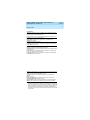
Group Calling Enhancements
A calling group can have a single non-local member that is
defined by the Uniform Dial Plan and exists on another MERLIN
LEGEND Communications System connected by a tandem
trunk to the local system. If a calling group contains a non-local
member, the non-local member must be the only member in the
calling group. See the Network Reference for details.
A calling group containing a single non-local member can be
used for the same purposes as a calling group containing local
extensions, including:
— Night Service. Night Service coverage can be provided
across a private network to a centralized Automated
Attendant, a non-local calling group, a QCC queue, a DLC,
or any individual extension on the remote system, such as a
night bell.
— Group Coverage. Group Coverage can be provided across
a private network to a VMS, a non-local calling group, a QCC
queue, a DLC, or any individual extension on the remote
system.
— Calling Group Overflow Coverage. Calling group overflow
coverage can be provided by a centralized VMS, a non-local
calling group, a QCC queue, a DLC, or any individual
extension on the remote system.
— Calls Directed to Another System. Lines connected to
remote systems can be answered by any extension
programmed to answer the call, such as a centralized
Automated Attendant or a system operator (QCC or DLC).
Transfer Redirect
When an Automated Attendant transfers a call to a non-local
extension, the transferring MERLIN LEGEND System monitors
the call to ensure that it is answered. If the non-local extension
is not available, or the call is not answered within the transfer
redirect timeout period (fixed at 32 seconds), the call stops
ringing at the non-local destination and is redirected to the
extension on the same system as the Automated Attendant that
is programmed to receive redirected calls. This redirect
extension can be a QCC queue, a calling group, or an individual
extension.
Direct Station Selector
Now users can press a Direct Station Selector (DSS) button for
a non-local extension to make or transfer calls to that extension.
No busy indication, however, is displayed by the DSS for nonlocal extensions.
Call Forwarding
The Forward feature now can be used to send calls to non-local
extensions across the private network.
Issue 1
April 1999
5