1
Data Areas for Communication between the C7 OP and the C7 CPU
8.11 Notes on Optimization
Decisive Factors
The construction of the user data area described in Section 8.3 and the
configured polling times in the area pointers are significant factors for the
actual reachable update times. The update time is the polling time plus the
transfer time plus the processing time.
To reach an optimal update time, the following points should be observed
during the configuration:
S Configure the individual data areas as large as necessary, but as small as
possible.
S Define the data areas which belong together contiguously. The actual
update time improves if you configure one large area as opposed to
several small areas.
S The total performance is unnecessarily compromised if the polling times
are too small. Set the polling time according to the changing speed of the
process values. The change in temperature of an oven for example, is
significantly more sluggish than the change of rotary speed in an
electrical drive.
The approximate value for the polling time is around 1 second.
S Avoid cyclic transfer of the user data area (Polling time 0). Instead, use
the control jobs to allow event-controlled transfer of user data areas only
if necessary.
S Place the variables of a message or a screen without gaps in one data
area.
S In order that changes in the C7 CPU are recognized by the C7 OP, they
must at least be impending during the actual polling time.
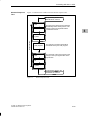
Screens
If, in the case of bit-triggered trends, the communication bit is set in the trend
transfer area, the C7 OP updates all those trends every time whose bit is set
in this area. Thereafter it resets the bit. If the bit is reset immediately in the
program, the C7 OP is busy the whole time updating the trends. Operation of
the C7 OP is then virtually no longer possible.
C7-626 / C7-626 DP Control Systems
C79000-G7076-C627-01
8-27
8