1
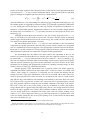
interaction effects [10]. We already established that anyons do not exist in 3d and higher. So
2d is truly a special situation for quantum statistics. The second comment is that, even in this 3d
universe, 2d is not just a mathematical figment, but a physical reality, thanks to the GaAs/AlGaAs
heterointerface. Finally, the inherently topological origin (all that matters is the Aharonov-Bohm
winding number, not the precise path) of anyons is interesting in the context of qc. If a qubit could
be encoded topologically—that is, by using the winding number—then the information would be
intrinsically robust against decoherence: small local interactions with the environment would not
change the number of times particles have been moved in complete loops around each other.
2.2.3
Integer and fractional quantum Hall effects
Having met anyons, we now turn to a less abstract concept: the Hall effect. The treatment of
the integer and fractional Hall effects I present here is designed to lead straight to the 5/2 state.
Störmer’s Nobel lecture [24] is a masterpiece, and I recommend it as a more general introduction
to both the iqhe and the fqhe.
Classically, the Hall effect predicts a simple linear relationship between the Hall resistance,
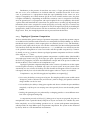
Rxy and the magnetic field: Rxy = B/ne, where n is the electron density and e is the charge of an
electron. The basic observation of the quantum Hall effects (both integer and fractional) is that at
certain rational values of ν = Bn he , Rxy gets “stuck” at ν over finite regions in B (as the density n is
held constant); that is, plateaus develop in the Hall resistance.
Integer Quantum Hall Effect
To explain the iqhe we need to remember that in a magnetic field the continuous energy spectrum of the 2deg breaks up into discretely spaced, highly degenerate allowed energy levels
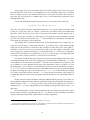
En = (n + 1/2)h̄ωc called Landau levels. At finite temperature, the Landau levels broaden slightly
into a very narrow energy band [25]. When the chemical potential lies within one of these bands,
the material is metallic; that is, the electron wave functions are not localized and transport can
occur throughout the sample with some finite conductivity3 . Away from these extended Landau
level states, any real material will have localized states (due to slight local variations in electron
density caused by tiny local variations in the 2d potential landscape). When the chemical potential is in the region of the localized states, varying the number of electrons only adds or subtracts
localized states which carry no current, so the current remains fixed at the full Landau level value.
Therefore, when the chemical potential is between Landau levels, the system is incompressible.
In a semiclassical picture, the Landau levels correspond to electrons moving in circular
orbits of quantized size, due to the Lorentz force. In a bulk region of the 2deg, the circular orbits
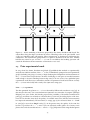
cause the electrons to be localized. But within a magnetic length ` B = (h̄/eB)1/2 of the edge,
the orbits will skip off the edge potential and form quasi-1d channels. One channel forms for
each occupied Landau level. A fully quantum mechanical treatment yields the same result [27,
28]. Either way, when the quantum Hall fluid is incompressible, all the current will flow around
the edges of the sample in 1d edge channels in a direction (clockwise or counterclockwise) set
by the magnetic field. Since each edge can only support current flowing in one direction4 , and
since the edges are spatially well separated, backscattering is not possible and the longitudinal
3 The existence of extended states in 2d is not allowed by scaling localization at zero magnetic field, but is now the
generally accepted picture for the quantum Hall effects [25–27], which occur at substantial fields. The exact fate of the
extended states as the field decreases towards zero does not seem to be completely settled in the literature.
4 In
the hierarchical picture of fractional edge channels [29] the picture is more complicated but the result is the same.
7