1
3590EXT, CPWE series indicators
E-CHECK_03 _12.05_EN_U
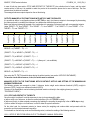
1) the ―WEIGHED PACK‖ message appears depending on the selected visualization (see section ―MODIFICATION
OF THE DISPLAYED DATA‖);
2) a RESTART impulse is required to restart: the operator must remove manually the weight.
3) Once the RESTART impulse is given, the instrument executes the autozero at start-up, as described in section
―POWER SUPPLY & START-UP‖.
NOTA: The instrument carries out the autozero at start-up if the function is enabled and the weight on the scale is within the
percentage set in the << Auto 0 >> step (TECH.MAN.REF.).
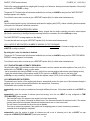
13.6 MANAGEMENT OF CADENCE PHOTOCELL AND BELT
It is possible to manage a cadence photo cell, which gives the possibility to stop the cadence belt each time that the
foreseen cadence is not respected.
This function allows to avoid that, during the weighing of a package, the next pack arrives on the weighing belt,
compromising the weigh under way.
From the moment in which the cadence photo cell (IN.3) is obscured, if the instrument is in weigh acquisition, in execution
of the belt automatic zero or the weighing belt is stopped, the cadence belt is stopped (off).
The cadence belt is re-enabled only after the instrument has acquired the weigh, has finished executing the automatic zero
or the weighing belt has been re-enabled.
It is also possible to set a delay time between the two packs (<< 2.PAC >> step); in this case, if the cadence photo cell is
obscured by a pack, and, within the configured time, it is obscured by another pack, the instrument stops the cadence belt
and maintains it in this status until the delay time between the two packs has passed. By setting a time of 0 sec., this control
is not executed.
Therefore, take care not to obscure accidentally the cadence photocell during the weighing.
When a pack is in weighing and the delay time between the two packs ends, the next pack is positioned on the belt,
regardless of whether the first pack is in positioning or in weighing. Therefore one has to set properly the weight time
<< T.M.PES >>.
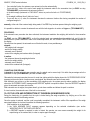
13.7 ALARM OUTPUT MANAGEMENT
There are 6 cases which determine the conditions for the alarm activation:
- Weight out of tolerance (only if the manual expulsion has been selected), with << TST.TOL >> step enabled.
- The number of weighs out of tolerance has reached the value set in the << n.W.STOP >> step
- Weight unstable for a time greater than the value set in step << T.M.PES >> (only if the weighing at halt is selected) .
- Pack not weighed at the restart of the belts (after the lock from downstream which took place before the end of the
weigh).
- Weight greater than the maximum Capacity + 9d or less than -100d, for a time greater than the value configured in
step << W.UN.OV >> (only with time greater than 0).
EMERGENCY / MOTOR LOCK input (IN6) active for a time greater than the value configured in step
<< BLK.MOT >>.
The impulse duration is set in << ALARM >> step.
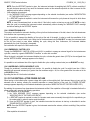
14. PRINTOUTS
The instrument is fitted with different print functions, which may be used while weighing, and of 30 print formats, in other
words, 30 different memory storages, each of which contain a programmable printout.
The print executed by these functions depends on the print format linked to it; see the following section for the linkages.
The format linking function allows to execute various printouts, by changing the linked format each time.
The available functions are:
SIMPLE PRINTOUT:
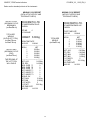
- Programmable printout Through the PRINT key F5 key one prints the linked format, without executing the totalisation.
45