1
or endurance, but awareness. Humans don’t have to be taught to walk or run, because those abilities come
naturally to us land-based creatures – but no one learns to swim well without at least some instruction.
Swimming well seems difficult because millions of years of adaptation to life on terra firma, ruled by the
laws of gravity, have made it exceedingly difficult to move easily in a fluid environment, ruled by the laws of
hydrodynamics. Humans in water are like fish out of water. A handful of us manage to muddle through with
extraordinary effort, but swimming well and efficiently has always been harder than it needs to be.
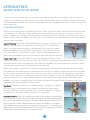
The crowning irony, of course, is that while we’re struggling mightily to become a skilled swimmer, an accomplished swimmer makes it all look impossibly smooth and easy. Anyone watching beautiful swimmers instinctively appreciates what they do. And when we do observe the world’s best swimmers – both dolphins and
Olympic swimmers – we see the same qualities: grace, economy, and flow.
This natural ease, universal among sea creatures, is rare among humans, as the water-frothing lappers at
any health club pool graphically illustrate. It’s probably this stark contrast between fish gliding through an
aquarium, and our fellow humans churning up pools, that makes skill more impressive to us than raw power
ever could be. The serenity and grace of a middle-aged swimmer who can flow – like water itself – up and
down the lane, seems a more elegant accomplishment than the power-oriented speed of youthful competitors. And that elegant swimmer could be you, whatever your age. For while most of us have little chance of
recapturing the power and athleticism that world records require, the grace and skill of that older swimmer
– who may be very much like ourselves – are within our grasp.
Ask Don Walsh, a Total Immersion teacher who decided to dedicate himself to stroke mastery at age 49,
then swam 28.5-miles around Manhattan at age 50 and 52. Today, Walsh is stopped regularly at his health
club by envious fellow swimmers, curious about how he learned to swim so beautifully. “There are plenty of
faster and more physically impressive people around here,” he relates, “but it’s my smoothness that seems to
fascinate everyone.”
Or take Mark Seides, a Total Immersion workshop alum, who resolved to improve his stroke after watching 72year-old Ben Reynolds glide up and down the pool one day. “There was this older guy swimming alongside me
and I’d never seen anyone look so smooth and relaxed in the water. I asked him where he learned to swim like
that and when he told me Total Immersion, I knew I wanted to learn the same thing.” And he did.
GOING TO FISH SCHOOL
So what can we learn by watching fish? First, of course, is that they move through the water much more
easily than we do. Faster, too. While the fastest human swimmers travel only about 5 mph at full throttle,
some fish have been clocked at over 50 mph. It not only looks easy, it is easy. Dolphins swim 10 times faster
than the fastest humans using a third less power.
They’re not “gifted,” they just know what all fish know: how to avoid drag, how to simply slip through the water.
Being slippery is far more important than being powerful because when you’re trying to move through water –
which is a thousand times denser than air – the water acts like a virtual wall. The harder you pull and kick, the
harder the water resists you. Small wonder we find smooth, relaxed, swimmers so fascinating. How can they
get so far, so attractively, on so little energy?
THREE MISTAKES EVERY HUMAN SWIMMER MAKES
To swim better tomorrow, you must understand what’s holding you back today. Chances are, you’ve thought
there was something wrong with you because:
3