1
B. On Line Calibration
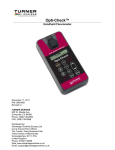
You will need to periodically check the Little Dipper’s reading against a hand held tester (OPTI-CHECK-1 or
OPTI-CHECK-2). If the readings do not match:
1. Remove the Little Dipper and insure the glass surface is clean and free of any bubbles or
fouling.
2. Replace sensor and turn flow back on. Wait for the reading to stabilize and adjust 20mA trimpot
on sensor for small (10-20%) reading adjustments.
3. If reading is off greater than 20% use the calibration tee place sensor in a known concentration
sample to check reading. Adjust 20mA trim pot as needed.
!
WARNING: A quarter to one turn is the typical maximum adjustment needed. Do not exceed.
IV.Maintenance
The Little Dipper fluorometer is designed for light industrial monitoring applications that require continuous
measurements. It provides maximum performance and solid state reliability with minimal maintenance.
A maintenance check should be made once per month to ensure the optical window is free from any
chemical or biological fouling. Frequency of maintenance checks are dependent on the fouling rate of the
system being monitored. Systems that have a higher fouling rate might require more frequent maintenance
checks.
A. Visual Inspection and Cleaning
To visually check if the optical window has been fouled:
1. Remove the Little Dipper from the mounting tee.
2. If there is any noticeable fouling, use a soft bristle brush and soapy water to clean the optical
window.
3. If the fouled window is unable to be cleaned with soapy water and the soft bristle brush, make a
10% HCL solution and use that solution, in place of the soapy water, with the soft bristle brush to
clean the window. (Note: Hydrochloric acid is a hazardous material and should be handled
only by qualified personnel)
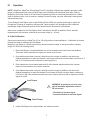
4. Once the optical window has been cleaned, re-install the mounting tee back onto the Little
Dipper (Note: see section II.A. on how to properly install the mounting tee)
B. Maintenance Check Using Standard Solutions
You may also check if the unit is responding correctly simply by placing the sensor in a known standard in a
calibration tee.
1. Make a standard solution (solution of known concentration of the fluorophore being measured)
that is less than the maximum concentration set for the Little Dipper
2. Place sensor in calibration tee filled with standard.
3. If the readings vary by more than 5% of the known value of the solution’s concentration, see
section IV.A. for visual inspection and cleaning
Maintenance checks are important and will ensure the Little Dipper is continuing to provide maximum
performance and measurement reliability.
8