1
McDSP CompressorBank
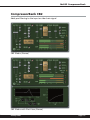
Compressor
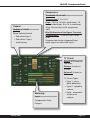
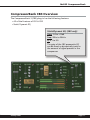
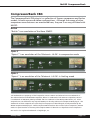
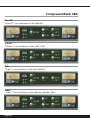
The compression section of CompressorBank is comprised of 4 controls Threshold, Compression, Knee, and Bite (Bi-directional Intelligent Transient
Enhancement).
• Threshold: the signal level above which the compressor is engaged. Audio
below this level will not be compressed. Audio above this level will be
compressed by the amount the signal is above the threshold level.
• Compression: the amount of compression, also known as the compression
ratio. As audio exceeds the threshold level, it is compressed by an amount
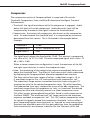
determined from this control. This is illustrated in the example below:
Example:
Threshold =
-12 dB
Compression =
4.0 (4:1 compression ratio)
Signal Level =
0 dB
The signal level is above the threshold by 12 dB. This amount is compressed
at a ratio of 4:1, to 12 / 4 = 3 dB. The new compressed signal level is then -12
dB + 3 dB = -9 dB.
When a stereo compression configuration is used, the maximum of the left
and right input channels is used as the compressor input.
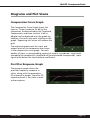
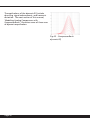
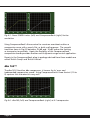
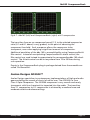
• Knee: the smoothing of the compression response immediately below and
above the threshold level. The effect of the knee control is best understood
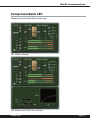
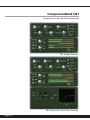
by displaying the CompressorBank alternate expanded user interface.
The Knee control has three ranges of values - undershoot range is -10 to
0, overshoot range for 0 to +10, and overshoot with compression ‘tail’.
The undershoot range creates a smoothed transition from unity gain (1:1
compression ratio) to the selected compression ratio. This effect emulates
the trademarked ‘over easy’ compression curves of the dbx compressors. The
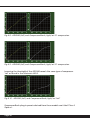
overshoot range allows the compressor to ‘miss’, or ‘overshoot’ the desired
compression ratio and ultimately recover to a linear compression curve.
This effect creates pumping/breathing effects found in such compressors as
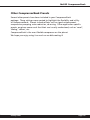
the Neve 33609C. The overshoot and ‘tail’ range continues the overshoot
response, and adds a compression ‘tail’. This ‘tail’ reduces compression ratios
for signals that greatly exceed the compression threshold. Such an effect
gives compressed signals more ‘presence’ or ‘top-end’ as some strong signal
transients are allowed to pass with less gain reduction from the compressor.
Such characteristics are common in devices like the Teletronix LA2A and
mcdsp.com
Page 37