1
other ‘opto-compressors’.
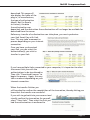
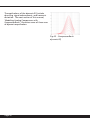
It is important to note how these three variations of knee control transition
smoothly from one to the other. New and unprecedented compression
techniques are available only in CompressorBank. The user can choose
different knee shapes, even changing compression paradigms (from a dbx 165
to a Neve 33609), in a single continuous control change.
• Bite: the Bi-directional Intelligent Transient Enhancement control gives
the compressor…well…more ‘bite’. As this control is increased, fast signal
changes (transients) are allowed to pass through the compressor while the
overall compression amount is the same. The transients of a compressed
signal will become less compressed as more ‘bite’ is applied. This control is
useful in emulating the response of analog compressors.
Attack and Release
Compressors use a circuit to track the signal changes over time as they exceed
the threshold control level. Such circuits have time constants (attack and release)
to articulate the response of the circuit to signal changes (hence the term ‘time
constant’ circuit, or TC circuit). These circuits, in conjunction with the compressor
controls, shape the overall sound of the compressor. CompressorBank is unique
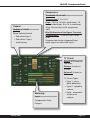
because it gives the user multiple variations on these circuits. The Time-Constant
(TC) Circuit section of CompressorBank is comprised of 4 controls: Attack, Release,
Release2, and TC Circuit Type.
• Attack: the rate at which the compressor responds to signals as they rise
above the threshold. A fast attack can track, even sample-by-sample, the
changes in the signal data. Note that such a fast setting can introduce
unwanted ‘gain cogging’ (in analog or digital domains!) as the compressor
response sounds erratic as it changes with every signal nuance.
• Release: the rate at which the compressor responds to signals as they fall back
to and below the threshold level. A fast release can track, almost sampleby-sample, the changes in the signal data. Note that such a fast setting can
introduce unwanted ‘gain cogging’ (in analog or digital domains!) as the
compressor response sounds erratic as it changes with every signal nuance.
• Release2: the secondary rate at which the compressor responds to signals as
they fall back to and below the threshold level. This secondary release control
is available only in the Type-2 TC circuit, and is used to ‘fine tune’ the overall
release response. Note that when using Release and Release2 concurrently,
the overall release time is faster than indicated by either release control.
Setting Release2 to its maximum release time of 5.0 seconds makes its effect
Page 38