1
Censoring and Sample Selection
16-3
and so on. Sample clustering for the estimated asymptotic covariance matrix may be requested with
; Cluster = specification
as usual.
16.2.2 Results for the Tobit Model
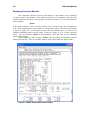
You may request the display of ordinary least squares results by adding
; OLS
to the command. These will be suppressed if you do not include this request. The OLS values will
be used as the starting values for the iterations. Maximum likelihood estimates are presented in full.
Note that unlike most of the discrete choice models, there is no restricted log likelihood presented.
The maximum likelihood estimates for a model that contains only a constant term are no less
complicated than one with covariates, and there is no closed form solution for the (β,σ) parameter
pair for this model. For a general test of the joint significance of all the variables in the model, we
suggest the standard trio of Neyman-Pearson tests, which can be carried out as follows: First set up
the Rhs variables in the model.
NAMELIST
CALC
TOBIT
CALC
; xvars = the x variables in the model, without the constant term $
; kx = Col(xvars) $
; Lhs = y ; Rhs = one $
; l0 = logl $
This command will produce the Lagrange multiplier statistic.
TOBIT
TOBIT
; Lhs = y ; Rhs = xvars,one ; Start = kx_0,b,s ; Maxit = 0 $
; Lhs = y ; Rhs = xvars,one $
Compute the likelihood ratio statistic.
CALC
; List ; lr = 2*(logl - l0) ; 1 - Chi(lr,kx) $
This computes a Wald statistic.
MATRIX
CALC
; beta = b(1:kx) ; vb = varb(1:kx,1:kx)
; List ; Wald = beta’<vb>beta $
; List ; 1 - Chi(wald,kx) $
Retained output from the model includes
Matrices:
b, varb
Scalars:
s
ybar, sy, kreg
nreg
nonlimts
= estimated σ
= number of coefficients,
= number of observations
= number of nonlimit observations in estimating sample