1
Reference
Driver Manual
CC-Link ♦ ProLinx Gateway
CC-Link version 1.10 Local Station & Intelligent Device
Unlike Cyclic Data transfers, which are controlled by the CC-Link Master alone
and which happen at a timed, periodic, polling rate, Transient Messages are
controlled by the originating station, which could be a Master Station, a Local
Station, or an Intelligent Device Station. Transient Messages are non-periodic,
that is, they are not scheduled to happen at a regular interval, like Cyclic Data
transfers do. Transient Messages are sent only when "triggered" by a logical
event. In the ProLinx gateway, the logical event that will trigger a Transient
Message is when a non-zero value is stored into a gateway database register
designated as the Trigger Register in the Transient Message configuration.
When a Trigger Register is set to a non-zero value, the ProLinx firmware will
create and transmit a Transient Message that is based on the Command
configuration contained in the configuration file that was downloaded to the
gateway. Once the Transient Message has been sent, the firmware will set the
Trigger Register value back to zero to indicate the trigger was received and acted
upon.
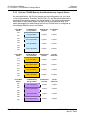
Trigger Registers can be any valid user memory database address, from 0 to
9999 (10,000 register database). This address range includes the CC-Link Cyclic
Data area, the Special Status Data areas (SB and SW), the Network Data area,
and the Transient Data area. This means that any address in the gateway's
database may be monitored for the appearance of a non-zero value as a way to
trigger execution of a Transient Message. Therefore, care must be taken when
choosing a Trigger Register to be sure it will contain non-zero values only when
its associated Transient Message needs to be triggered to prevent inadvertent
message transmission and avoid overloading the network with Transient
Messages.
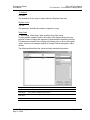
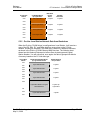
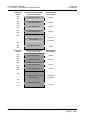
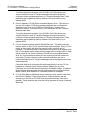
5.5.2 CCLINK Transient Data Message Memory Areas
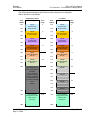
To fully understand all the Transient Message options, you must first understand
the different memory areas that may be accessed using Transient Messages.
There are four primary memory areas to consider:
1
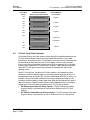
ProLinx Gateway Memory Database Area - This area is the total 10,000 word
(10,000 16-bit registers) of physical memory that is available on the gateway.
All of this memory area is generally available to whatever other
communications protocol driver is installed on the ProLinx gateway along with
the CCLINK protocol driver, such as the DFNT EtherNet/IP driver or the
MNET Modbus TCP/IP driver. This entire memory database area can also be
used as the source or destination address for the Internal Address parameter
of Transient Message commands.
This area includes the memory addresses assigned for use by the CCLINK
driver and directly accessible by the CC-Link network Master; so, care must
me taken with setting the Internal Address parameter of Transient Message
commands so that you do not overwrite CCLINK data areas with Transient
Message Data unless you intend to do so.
ProSoft Technology, Inc.
May 21, 2009
Page 83 of 98