1
Aug. 12, 2010
US 2010/0203888 A1
a cellular telephone With data messaging capabilities, a Wire
component and has been available since about 1992 While
GPRS, a data component that has been combined or overlaid
less Intemet appliance, or a data communication device, as
With GSM, has been available only since about 1999. These
examples.
tWo networks are noW common throughout the World and
[0029] Where mobile station 115 is enabled for tWo-Way
communication, it Will incorporate a communication sub
system 211, including both a receiver 212 and a transmitter
have some of the fastest deployment rates of any voice and
data netWorks. Such combined voice and data netWorks also
include modern Code Division Multiple Access (CDMA)
netWorks and third-generation (3G) netWorks like Enhanced
Data-rates for Global Evolution (EDGE) and Universal
preferably embedded or internal, antenna elements 216 and
Mobile Telecommunications Systems (UMTS), currently
under development.
such as a digital signal processor (DSP) 220. As Will be
apparent to those skilled in the ?eld of communications, the
[0025]
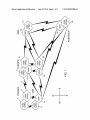
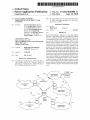
In FIG. 1, there are ?ve GSM only netWorks 10, 14,
16, 22, 26 and eight GSM/GPRS combined netWorks 2, 4, 8,
12, 18, 20, 24, 28, shoWn in various parts ofthe World. At any
point in time, a given country might have one or more GSM
and/ or GSM/GPRS netWorks. Each netWork operator makes
?nancial and practical decisions as to When it shouldpurchase
and implement GPRS functionality onto an existing GSM
netWork. Therefore, a user of a GSM phone or a GPRS
capable mobile station might enter a given country and be
214, as Well as associated components such as one or more,
218, local oscillators (LOs) 213, and a processing module
particular design of the communication subsystem 211 Will
be dependent upon the communication netWork in Which the
device is intended to operate. For example, mobile station 115
may include a communication subsystem 211 designed to
operate Within the MobitexTM mobile communication system,
the DataTACTM mobile communication system, or a GPRS
netWork.
[0030] NetWork access requirements Will also vary depend
ing upon the type of netWork 219. For example, in the Mobi
tex and DataTAC netWorks, mobile station 115 is registered
faced With netWorks that support either GSM only or com
bined GSM/GPRS.
on the netWork using a unique identi?cation number associ
[0026] These netWorks implement interconnections to each
other to support roaming betWeen countries and to support
billing and roaming noti?cations betWeen netWorks.
Although shoWn as separate physical netWorks in FIG. 1, the
netWork access is associated With a subscriber or user of
thirteen netWorks (?ve GSM and eight GSM/GPRS) inter
station Will not be fully functional. Local or non-netWork
communication functions, as Well as legally required func
tions (if any) such as “911” emergency calling, may be avail
able, but mobile station 115 Will be unable to carry out any
other functions involving communications over the netWork
219. The SIM interface 244 is normally similar to a card-slot
connect to form a total of four netWorksithree GSM/GPRS
netWorks 1, 2, and N, and one GSM netWork 1. A GSM
netWork could connect to one or more other GSM netWorks,
one or more GSM/GPRS netWorks, or both. A GSM/GPRS
netWork could similarly connect With other GSM/GPRS net
Works, GSM netWorks, or both GPRS/GSM netWorks and
GSM netWorks. NetWorks in Canada, shoWn as GSM/GPRSl
2 and GSM/GPRS2 4, respectively connect With GSM/
GPRSl 12 and GSM1 14 shoWn in the USA. GSM/GPRS2 4
also connects With GSM/GPRSl 8 shoWn in the England area
via communication link 6. NetWork GSM1 14 from the USA
also connects With GSM1 10 shoWn in the middle of Europe.
Other netWorks 16 through 28 are similarly interconnected as
shoWn. These interconnections form the basis of tra?ic move
ment and roaming support betWeen the netWorks.
[0027]
As a mobile station enters a given country or com
munication netWork coverage area, it may be capable of com
municating With one or more Wireless GSM or GSM/GPRS
netWorks to receive data and voice signals. In England, for
example, there are currently four GSM or GSM/GPRS net
Works deployed and available for mobile stations to connect
With. Normally, cellular telephones or mobile stations sold in
England Will only Work With one netWork. HoWever, mobile
stations entering England from France might have tWo or
three netWorks to select from. Selection of a particular net
ated With each mobile station. In GPRS netWorks, hoWever,
mobile station 115.A GPRS mobile station therefore requires
a subscriber identity module (SIM) card in order to operate on
a GPRS netWork. Without a valid SIM card, a GPRS mobile
into Which a SIM card can be inserted and removed. The SIM
card can have approximately 64K of memory and hold many
key con?guration, identi?cation, and subscriber related infor
mation 250. The O-PPLMN, the U-PPLMN, and the forbid
den PLMN (FPLMN) are initially received from the SIM card
250. Reference to the PPLMN hereinafter Will generally
apply to both the O-PPLMN and U-PPLMN.
[0031] When required netWork registration or activation
procedures have been completed, mobile station 115 may
send and receive communication signals over the netWork
219. Signals received by antenna 216 through communica
tion netWork 219 are input to receiver 212, Which may per
form such common receiver functions as signal ampli?cation,
frequency doWn conversion, ?ltering, channel selection and
the like, and in the example system shoWn in FIG. 2, analog to
digital (A/D) conversion. A/D conversion of a received signal
alloWs more complex communication functions such as
demodulation and decoding to be performed in the DSP 220.
In a similar manner, signals to be transmitted are processed,
including modulation and encoding for example, by DSP 220
and input to transmitter 214 for digital to analog conversion,
Work is currently performed by a mobile station randomly,
frequency up conversion, ?ltering, ampli?cation and trans
based on the strongest received signal at the time of arrival
mission over the communication netWork 219 via antenna
into the country.
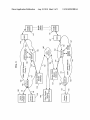
[0028] Turning noW to FIG. 2, a block diagram is shoWn of
218. DSP 220 not only processes communication signals, but
also provides for receiver and transmitter control. For
a cellular mobile station, Which is one type of mobile com
munication device. Mobile station 115 is preferably a tWo
Way Wireless communication device having at least voice and
receiver 212 and transmitter 214 may be adaptively controlled
example, the gains applied to communication signals in
through automatic gain control algorithms implemented in
data communication capabilities. Mobile station 115 prefer
ably has the capability to communicate With other computer
DSP 220.
systems on the Internet. Depending on the exact functionality
provided, the mobile device may be referred to as a data
messaging device, a tWo-Way pager, a Wireless e-mail device,
cessor 238 Which controls the overall operation of the device.
[0032]
Mobile station 115 preferably includes a micropro
Communication functions, including at least data and voice
communications, are performed through communication