1
SAS Global Forum 2009
Systems Architecture
STEP 8 – SCALABLE SERVER
You may start out with just one or two team members using an application that is processing a small set of data.
However, with dynamic business demands, this can grow into a larger group with a large set of data. The ability to
scale to meet the computing demands in a dynamic environment is key to your success. Cloud Computing can scale
with increasing number of application servers that can be added or removed depending on the need. This can be
accomplished on the server by implementing VM (virtual machines) and/or the dynamic control of assigning the
number of application servers used to serve the application.
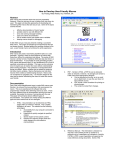
In this example, an application is managed by Websas which dynamically assigns different numbers of application
servers to a specific application. The number of application servers is described as a number in square brackets.
Each application server handles the request on a different TCP socket port. This allows dynamic communication on
different ports so there are no conflicts between the application servers. In this example, the application ClinicalSMS
is described in abbreviated form as:
clinicalsms [3] 5025-5030
This means that the application ClinicalSMS has been provided with three application servers which use TCP ports
5025 through 5030. When the users place a request from their browser, it will distribute the load upon three separate
servers running the same application. Each application server is communicating through its own TCP socket to
prevent communication collisions. This can easily be reconfigured to be: clinicalsms [30] which means that it will use
30 distinct application servers handling all the requests for this application for a large set of users.
figure 12 – A dynamic set of application servers can be assigned to each application served to changing set of users.
The flexibility for an administrator to dynamically add or remove applications depending on demand is essential in
optimizing a Cloud Computing application. This allows the application to scale to the changing user demands of the
application.
CONCLUSION
The more complex software becomes, ironically, the more simple the user machines need to be to run them. This is
because the goal is to simplify the usage and management requirements so that the user can access sophisticated
software from any computer with an internet access. The growth of web technologies driven by ecommerce and
social network technologies accompanied by economic constraints has acted as a catalyst for implementing solutions
on Cloud Computing. The steps needed to implement a successful solution with this Cloud Computing environment
requires changes in how software is implemented both on the client computer and also on the server. The foundation
for changes on the client machine has already taken shape due to ecommerce and social technologies. The
challenge remains for complex solutions such as SAS to adjust and adapt on the server side to function as a service
within Cloud Computing.
11