1
2
INTRODUCTION
UPC is in charge of performing simulations and feasibility studies for this lowcost, high-capacity hybrid communications system where optical fibre is used as
the transmission channel.
The results described in this Master Thesis will add to the UPC collaboration
within the Accordance project.
The goal in this Master Thesis is to study the basis of OFDM systems applied to
fibre optic networks, both from an analytical point of view and from a simulation
software environment, using the Virtual Photonics Inc. (VPI) software.
The starting point will be the main theoretical concepts that distinguish OFDM
from other modulations, making special emphasis in the peculiarities of its
implementation in optical fibre systems. Then, the main optical OFDM
characteristics are studied and simulated through built-in demonstrations
available at VPI software.
These demos provide a convenient way to study some basic features of OFDM
optical transmission systems, but their use is limited to specific scenarios.
In order to obtain a flexible platform for tests and exploration of optical OFDM
systems a new setup will be built by exploiting the VPI Cosimulation
functionality, which allows the use of other simulation software to operate as
specific modules within VPI.
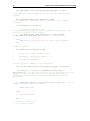
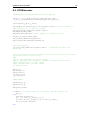
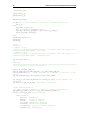
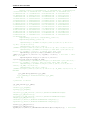
Thus, in this Master Thesis two VPI modules have been created based on
Matlab programs to perform the OFDM modulator and demodulator inside the
VPI optical OFDM transmission system simulation setup.
While VPI’s built-in demonstrations are quite rigid in terms of configuring
different simulation setups, the use of the Matlab code in the customized
simulations allows the user to perform different configurations for the
transmission scenario which are impossible to obtain from the demos.
The document is organized as follows: In Chapter I, the basic concepts of
OFDM are described, so it can be understood how an OFDM system works and
which is the role of each of its parts. After that, the most typical optical
configurations in which OFDM can be implemented are listed in Chapter II,
giving emphasis to those related with the simulations performed in the last part.
In Chapter III, the basic parameters of VPI software are introduced, and the
required steps to create a new simulation are described. Moreover, two optical
OFDM demonstration scenarios provided by VPI are analyzed in detail, so it
can be seen how the concepts explained in the previous chapters are applied to
a simulation environment.