1
UM0406
Glossary
Appendix C
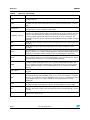
Table 6.
Glossary
Glossary
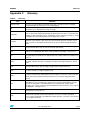
Term
Definition
Debug module
An microcontroller hardware peripheral that is able to manage instruction stepping,
complex breakpoints and abort for in-circuit debugging.
DIL
Dual in-line. A type of device package with two rows of pins for thru-hole mounting.
Sometimes also called DIP (Dual In-line Package).
EEPROM
Electrically erasable programmable read-only memory. A non-volatile type of memory
that can be erased and reprogrammed by program instructions. Since no special power
supplies or ultra-violet light source is needed, the contents of this kind of memory can be
changed without removing the MCU from the application system.
Footprint
The dimensions of the location of a component on a printed circuit board or in a socket. It
depends on the number of pins, their size, type and positioning. The footprint of each
microcontroller is specified in the datasheet in the section titled Package Mechanical
Data.
I2C
Inter-integrated circuit. A protocol for a bus that can be connected to multiple integrated
circuits and that allows any one of them to initiate data transfer.
ICD
In-circuit debugging. The capability to debug an application on a FLASH device using onchip resources (Debug Module, MTC), made possible by the SWIM or ICC protocol.
ICP
In-circuit programming. The capability to program to microcontroller Flash memory while
the target device is installed on an application board, made possible by the SWIM or ICC
protocol.
LQFP
Low-profile quad flat package. A family of integrated circuit packages for surface
mounted assembly. This type of package has a square, flat shape and pins on all four
sides.
LVD
Low voltage detection. A microcontroller feature that allows you to simulate what occurs
when the MCU detects that the supply voltage is below a given threshold.
MCU
A microcontroller is a complete computer system, including a CPU, memory, a clock
oscillator and I/O on a single integrated circuit.
MEB
Main emulation board. One of three emulation boards that make up the STice. The MEB
contains communication and emulation resources that are common to a microcontroller
family. This board provides the link between the Host PC and the Target Emulation
Board.
OTP
One time programmable. Also referred to as OTPROM (One Time Programmable ReadOnly Memory). A non-volatile type of memory that can be programmed but cannot be
erased. An OTP ROM is an EPROM MCU that is packaged in an opaque plastic
package—it is called a one-time programmable MCU because there is no way to expose
the EPROM to a UV light source.
PC
Program counter. The CPU register that holds the address of the next instruction or
operand that the CPU will use.
PEB
Peripheral emulation board. An optional printed circuit board that connects to a Target
Emulation Board (TEB) and provides emulation resources for certain specialized
microcontroller peripherals. The PEB, like the TEB, allows the connection of the emulator
to your application board.
Doc ID 13332 Rev 3
23/26