1
Royal Haskoning
Triwaco User's Manual
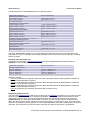
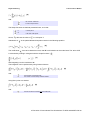
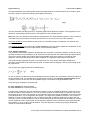
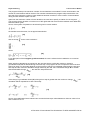
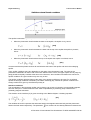
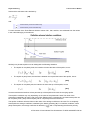
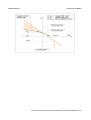
The aquifer's transmissivity is computed with the following assumptions:
When the piezometric head is below the base of the aquifer, the aquifer is dry, hence:
[22a]
When the piezometric head is between the base and the top of the aquifer the aquifer is phreatic,
hence:
[22b]
When the piezometric head is above the top of the aquifer the aquifer is confined, hence:
[22c]
It is assumed that the phreatic surface will not fall below the base of the aquifer and reach the underlying
aquifer.
Thus, aquifer conditions may vary depending on the value of the piezometric head. The value of the
piezometric head differs for each node of the Finite Element Grid. Hence, the upper aquifer can be partly dry,
partly phreatic and partly confined at the same time. Moreover, when transient calculations are carried out,
aquifer conditions at a given location may also vary in time.
The aquifer conditions will also influence the value of the storage coefficient to be used. For a confined
aquifer the storage coefficient is defined by the elastic storativity ('S'), whereas for phreatic conditions the
storage coefficient is given by the effective porosity 'n'.
Interface conditions
The groundwater in the lowermost aquifer can be flowing over a body of a heavier, but supposedly stagnant,
fluid. For example: in coastal areas the fresh water is separated by a (relatively) sharp interface from
(relatively) stagnant salt water.
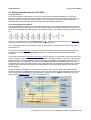
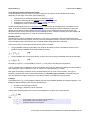
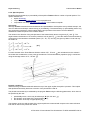
The elevation of the interface (Hi) is given according to the 'Badon-Ghyben / Herzberg' equation:
[23]
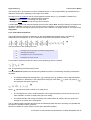
The variables 'hs' and 'h' represent the salt-water head in the stagnant salt-water body and the piezometric
head in the fresh water respectively. The parameter ' ' is a measure for the density differences between the
5 Execution of Groundwater Flow Simulations: FLAIRS and MODFLOW-28