1
FPGA Implementation of a Hybrid On-line Process Monitoring in PC Based RT Systems
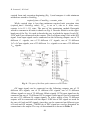
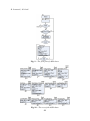
When Command Code is 0000, FSM moves to Start Process state. In this
state FSM loads the counter with Cmax value from CmaxReg (LCmax=1) and
enables counter to start counting down (CmdReg=1xx). For 0001 Command
Code FSM is in Pause state. Here, FSM disables counter by writing 0xx to
CmdReg. In End Process state (Command Code=0010) counter is disabled and
the value of TCmin bit is stored to StatusReg. If TCmin=1 RTS knows that task
was executed faster than minimum required time for correct task execution.
When in Start Measuring Time state (0011), FSM resets the counter (Rc=1) and
enables its counting down. Continue state (0100) is opposite with Pause state.
Here, FSM enables previously disabled counter. Similarly, Stop Measuring
Time (0101) state is opposite with Start Measuring Time. Here, counter is
disabled and its current state is loaded to DataRegRead (LoadDataRegR=1)
register through DataOut bus (OEc=1). From here, it is available to RTS. In
Load Counter state (0110) data is loaded from DataIn bus to counter, in
LoadRegMax (0111) from DataIn to CmaxReg, while in LoadRegMin state
(1000) from DataIn to CminReg register. FSM in Read Counter state (1001)
stores counter state through DataOut bus to DataRegRead register. When in
ReadRegMax (1010) or ReadRegMin (1011) state, FSM stores data from
CmaxReg or CminReg to DataRegRead register.
5
FPGA Implementation
Each part of monitoring module communication interface as well as of
Data-path and Control Unit is described in VHDL programming language and
implemented in EP2C35F672C6N FPGA chip on Altera DE2 board [4]. The
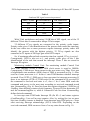
results of implementation are shown in Table 3.
Table 3
FPGA implementation results
Total logic elem.
% FPGA
Clock setup
Interface
165/33216
< 1%
241.25MHz
Data-path
7169/33216
22%
78.47MHz
FSM
172/33216
< 1%
280.50MHz
Σ
7506/33216
23%
From the Table 3 can be seen that Data-path is the most critical part of
FPGA implementation. It requires the most of FPGA resources and also
determines maximal operating frequency.
49