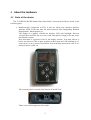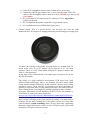
1
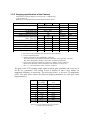
o Canon EOS compatible shutter output (3.5mm stereo jack conn.)
o Camera port (RJ-45 type female conn., can be used any (max. 2m) UTP
cable too but the supplied cable is preferred. Note: NEVER try to use a UTP
cross cable!)
o DC power input (5.5/2.1mm size) (12V nominal, 9-15V), tip positive
(polarity-protected)
o ST-4 compatible autoguider output (RJ-12 type female conn.)
o PC communication port (USB-B mini 5-pin conn.)
•
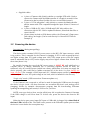
Camera (head). This is a special device, can be used only with the LMG
Handcontroller. It’s function is imaging and doing several image processing steps.
To attach the Camare to the guider telecsope there is a 4-5mm thick T2
inside screw. Any T2→1.25” adapter can be used for 1.25” (31.7mm)
focusers. There is a 1.25” filter thread inside the T2 panel to attach some
filter or “dust preventor”.
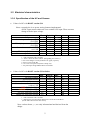
At the back of the Camera there is the same type of connector as on the
HC (RJ-45 female).
The sensor is a high sensitivity monochrome CCD from Sony (with
ExView HAD technology). Due to its exremely low dark current (dark
noise) and the enhanced sensitivity in near infrared it doesn’t need cooling
and saves energy. These with the low readout noise gives the ability of
guiding on very faint stars or using small guidescope. The small pixel size
allows using shorter focal length for guiding compared to other systems.
(For more information see the datasheet of the CCD, its part number is:
ICX279AL-E. Some info can be found here:
http://www.sony.net/Products/SC-HP/datasheet/01/data/E00Z52A3Z.pdf )
Note: ont the CCD there is the protector film by default. You must remove
it before the first use! Cleaning the CCD’s glass is done as for any other
optical surfaces. Avoid scratching! Don’t let any electrically conducting
material or liquid fall into the circuit, on the CCD and its pins. (The foam
around the CCD gives some protection.)
3