1
U235View V1.0 (MGA-B32)
In addition, x-rays are produced by gamma rays interacting (via the photoelectric effect) in the
material itself, the so-called fluorescent x rays. In the case of a pure uranium sample, these will
be uranium x rays. IC processes give rise to characteristic x rays of the daughter product (not the
parent), and are not proportional to the amount of material in the sample (the amount of thorium
in a decaying sample of purified uranium is very small). IC-induced x rays are proportional to
the number of decays; i.e., each decay has a fractional output of x rays of the daughter product
regardless of the parent material present in the sample. This fact makes these x rays usable for
isotopic analysis if the sample has a very low concentration of daughter material (Th). To
accurately use these IC x-ray peaks requires that the thorium present in very old natural uranium
samples be removed. X rays induced by the photoelectric effect (fluorescent x rays) have
energies characteristic of the bulk material and are proportional to the mass of material present
in the source. The observed x rays, from both fluorescent and internally converted sources, must
originate near the surface to be easily observed.
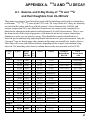
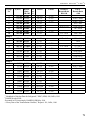
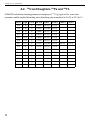
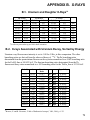
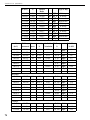
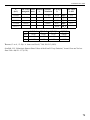
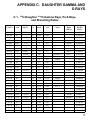
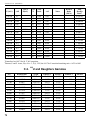
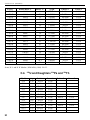
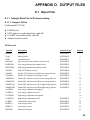
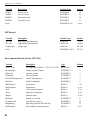
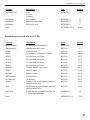
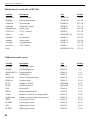
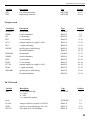
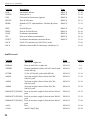
Branching ratio and gamma, x-ray energy data have been published in various places 7,8,9,10 for
235
U and 238U and some of their daughter products; but this data is sometimes incomplete, or of
inadequate accuracy. The current status of this data are summarized in Appendix A.
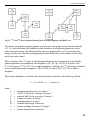
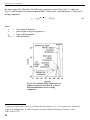
Figure 51 shows the main decay scheme for 235U and 238U.
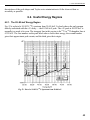
Pure 238U emits only a 49.55 keV gamma that is too weak to be useful for analysis (see Fig. 52).
Fortunately, 238U alpha (and beta) decays so that in within a few months it is in equilibrium with
the 238U decay and there are gammas from 234Th, 234Pa, and 234U available for analysis. (see
Appendix E for a discussion of equilibrium). The small percentage (0.0057%) of natural 234U
typically observed is due to the constant decay of 238U. Similarly, 235U relatively quickly decays
to equilibrium with its daughters, 231Th and 231Pa. Samples of uranium that have been enriched or
separated can be analyzed for their 235U concentrations by using these daughter product decays
in all cases except very fresh (<2-month-old) samples. At present the only way to accurately
measure “fresh” samples before equilibrium is established is to use mass spectrometry.
7
Firestone, B. F. ed., Table of Isotopes, 8th Edition, Lawrence Berkeley Laboratory, John Wiley & Sons, 1996.
8
Decay Data of the Transactinium Nuclides, Technical Report 261, IAEA, 1986.
9
Roy, J. C., et. al. Int. J. Appl. Radiation Isotopes, 35, pg 899, 1984.
10
Lammer, M. and O. Schwerer, Handbook of Nuclear Data for Safeguards, INDC (NDS)-248, IAEA, 1991.
42