1
proved about commercially designed digital artifacts. In this section we give an
informal overview of the ACL2 system.
The sources for ACL2 are freely available on the Web, under the GNU
General Public License. The ACL2 homepage is http://www.cs.utexas.edu/users/moore/acl2 [26]. Extensive documentation, including tutorials, a user’s
manual, workshop proceedings, and related papers are available from the ACL2
homepage. ACL2 is also described in a textbook by Kaufmann, Manolios, and
Moore [23]. There is also a book of case studies [22]. Supplementary material for
both books, including all the solutions to the exercises (over 200 in total) can
be found on the Web [25, 24].
We recently released ACL2s [13], a version of ACL2 that features a modern graphical integrated development environment in Eclipse, levels appropriate for beginners through experts, state-of-the-art enhancements such as our
recent improvements to termination analysis [45], etc. ACL2s is available at
http://www.cc.gatech.edu/home/manolios/acl2s and is being developed with
the goal of making formal reasoning accessible to the masses, with an emphasis
on building a tool that any undergraduate can profitably use in a short amount
of time. The tool includes many features for streamlining the learning process
that are not found in ACL2. In general, the goal is to develop a tool that is
“self-teaching,” i.e., it should be possible for an undergraduate to sit down and
play with it and learn how to program in ACL2 and how to reason about the
programs she writes.
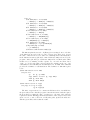
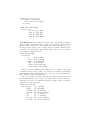
ACL2, the language, is an applicative, or purely functional programming
language. The ACL2 data types and expressions are presented in sections 2.1 and
2.2, respectively. A consequence of the applicative nature of ACL2 is that the rule
of Leibniz, i.e., x = y ⇒ f.x = f.y, written in ACL2 as (implies (equal x
y) (equal (f x) (f y))), is a theorem. This effectively rules out side effects.
Even so, ACL2 code can be made to execute efficiently. One way is to compile
ACL2 code, which can be done with any Common Lisp [59] compiler. Another
way is to use stobjs, single-threaded objects. Logically, stobjs have applicative
semantics, but syntactic restrictions on their use allow ACL2 to produce code
that destructively modifies stobjs. Stobjs have been very useful when efficiency is
paramount, as is the case when modeling complicated computing systems such as
microprocessors. For example, Hardin, Wilding, and Greve compare the speeds
of a C model and an ACL2 model of the JEM1 (a silicon Java Virtual Machine
designed by Rockwell Collins). They found that the ACL2 model runs at about
90% of the speed of the C model [16].
ACL2, the logic, is a first-order logic. The logic can be extended with events;
examples of events are function definitions, constant definitions, macro definitions, and theorems. Logically speaking, function definitions introduce new
axioms. Since new axioms can easily render the theory unsound, ACL2 has a
definitional principle which limits the kinds of functions one can define. For example, the definitional principle guarantees that functions are total , i.e., that
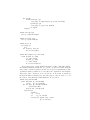
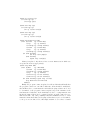
they terminate. ACL2 also has macros, which allow one to customize the syntax.
In section 2.3 we discuss the issues.