1
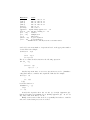
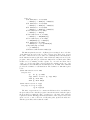
(defun MA-to-ISA (MA)
(let ((MA (committed-MA
(seq-isa nil :pc
(g
:regs (g
:dmem (g
:imem (g
MA)))
:pc MA)
:regs MA)
:dmem MA)
:imem MA))))
The final definition required is that of the well-founded witness. The function
MA-rank serves this purpose by computing how long it will take an MA state to
commit an instruction. An MA state will commit an instruction in the next step
if its second latch is valid. Otherwise, if its first latch is valid it will be ready
to commit an instruction in one step. Otherwise, both latches are invalid and it
will be ready to commit an instruction in two steps.
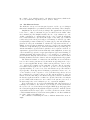
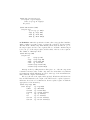
(defun MA-rank (MA)
(let ((latch1 (g :latch1 MA))
(latch2 (g :latch2 MA)))
(cond ((g :validp latch2)
0)
((g :validp latch1)
1)
(t 2))))
4.3
Proof of Correctness
To complete the proof we have to define the machine corresponding to the disjoint union of ISA and MA, define a WEB that relates a (good) MA state s to
(MA-to-ISA s), define the well-founded witness, and prove that indeed the purported WEB really is a WEB. We have implemented macros which automate
this. The macros are useful not only for this example, but have also been used
to verification many other machines, including machines defined at the bit level.
(Non-deterministic versions have also been developed that can be used to reason
about machines with interrupts [31, 30].) The proof of correctness is completed
with the following three macro calls.
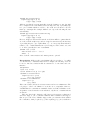
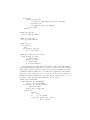
(generate-full-system isa-step isa-p ma-step ma-p
ma-to-isa good-ma ma-rank)
(prove-web isa-step isa-p ma-step ma-p ma-to-isa ma-rank)
(wrap-it-up isa-step isa-p ma-step ma-p good-ma
ma-to-isa ma-rank)
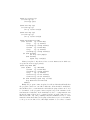
The first macro, generate-full-system, generates the definition of B, the
purported WEB, as well as R, the transition relation of the disjoint union of the
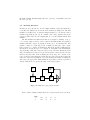
ISA and MA machines. The macro translates to the following. (Some declarations