1
(declare (xargs :guard (if (symbolp x) t (symbolp y))))
(equal x y))
Both endp and eq are logically equivalent to atom and equal, respectively. The
only difference is in their guards, as atom and equal both have the guard t. If
eq is only called when one of its arguments is a symbol, then it can be implemented more efficiently than equal, which can be called on anything, including
conses, numbers, and strings. Guard verification consists of proving that defined
functions respect the guards of the functions they call. If guards are verified,
then ACL2 can use efficient versions of functions.
Another common use of declarations is to declare the measure used to prove
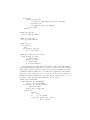
termination of a function. Consider the following function definition.
(defun app (x y)
(declare (xargs :measure (len x)))
(if (consp x)
(cons (car x) (app (cdr x) y))
y))
App is a recursive function that can be used to concatenate lists x and y. Such a
definition introduces the axiom (app x y) = body where body is the body of the
function definition. The unconstrained introduction of such axioms can render
the theory unsound, e.g., consider the “definition” (defun bad (x) (not (bad
x))). The axiom introduced, namely, (bad x) = (not (bad x)) allows us to
prove nil (false). To guarantee that function definitions are meaningful, ACL2
has a definitional principle which requires that the we prove that the function
terminates. This requires exhibiting a measure, an expression that decreases on
each recursive call of the function. For many of the common recursion schemes,
ACL2 can guess the measure. In the above example, we explicitly provide a
measure for function app using a declaration. The measure is the length of x.
Notice that app is called recursively only if x is a cons and it is called on the
cdr of x, hence the length of x decreases. For an expression to be a measure, it
must evaluate to an ACL2 ordinal on any argument. ACL2 ordinals correspond
to the ordinals up to ǫ0 in set theory [43, 41, 42, 44]. They allow one to use many
of the standard well-founded structures commonly used in termination proofs,
e.g., the lexicographic ordering on tuples of natural numbers [42].
Macros Macros are really useful for creating specialized notation and for abbreviating commonly occurring expressions. Macros are functions on ACL2 objects,
but they differ from ACL2 functions in that they map the objects given as arguments to expressions, whereas ACL2 functions map the values of the objects
given as arguments to objects. For example, if m is a macro then (m x1 . . .
xn ) may evaluate to an expression obtained by evaluating the function corresponding to the macro symbol m on arguments x1 , . . . , xn (not their values,
as happens with function evaluation), obtaining an expression exp. Exp is the
immediate expansion of (m x1 . . . xn ) and is then further evaluated until no
macros remain, resulting in the complete expansion of the term. The complete
expansion is then evaluated, as described previously.