Download batteries

Transcript
the voltmeter preferably being shieldedfrom
external magnetic fields.
3-volt
a
scale in .02-volt divisions and be accurate
towithin 1%over full scale for measuring
cell voltageand/orscale
a covering15
volts in .l-volt divisions for testing overall
battery voltage.The
resistance of a good
voltmeter is at least 20,000 ohms per volt.
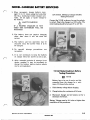
A portable type D.C. voltmeter of at least
20,000 ohmsper voltsensitivity,accurate
to at least 1%and having arange of 150/
15/3volts
would besatisfactoryforaccurate test work.
Example: 1.265 Sp. Gr.
2.10 Volts/Cell
6.3 Volts/6-Volt
Battery
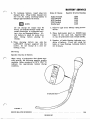
A good Voltmeter should
have
A portable type D.C. Ammeter accurate to
atleast
1 percent, with scalerange
of
50/25/10 amperes and used with an external
500 ampere
500 ampereshunt toobtaina
range, would besatisfactoryforaccurate
test work.
OPEN-CIRCUIT VOLTAGE BATTERY
TESTERS
Theopen-circuitvoltage
of abattery will
vary slightly with the specific gravity of the
electrolyteintheindividualcell.Asensitive voltmeter can therefore be provided
with a scale which indicates equivalent specific gravity o r s t a t e of charge and can be
used as a sort
of "electricalhydrometer"
undercertain conditions.Suchinstruments
musthaveaseparatescalecalibratedfor
eachseparatefully-chargedgravity,ora
correction factor must be used
if the cells
are
adjusted
to any other
fully-charged
O.C.V. meters,
gravity.Forexample,such
in order to be reliable, must either be used
only on batteries and/or cells whose fullychargedgravity
is thatfor which theinstrument is calibrated,orbeused
with a
correctionfactor
of .01 voltequals
.010
specific gravity.
12.6 Volts/12Volt Battery
No temperature correction factor has to be
applied to the gravities indicated by O.C.V.
meters. However,
the
instrumentscannot
be used on batteriesand/orcells
which
have justcome
off charge,as
the gases
held on the plates cause the instrument to
give a falsely high reading.
The
instrumentsareusefulfortestingbatteriesin
stock. Letting batteries stand
on open cirwill
cuitforseveralhoursaftercharging
dissipate the gasesfrom
the plates and
enablecorrectreadings.to
be obtained.
HIGH-RATE DISCHARGE EQUIPMENT
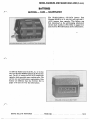
High-ratedischargeequipment
is available
in a variety
of forms. Most of these work
on the principle of discharging the battery
throughafixedresistance,for
about
15
seconds, and measuring the battery and/or
cell voltages while discharginga high rate
to determinethecrankingability
of the
battery.
Thetestermetermust
have 2% accuracy
over the entirescalerange(s).
The tester
should be capable of discharging the battery
a s unit
a
and measuringvoltageasthe
criterion for passing or failing the battery.
BATTERY TESTING CHART
A step-by-step procedure based on hydrom-
eter and voltmeter readings is shown in the
"Battery Testing Chart". This chart will be
helpful in rendering correct battery service.
13-5
SERVICE BULLETIN REFERENCES
REVISED 1977