1
03 | Keysight | Improving Throughput in Network Analyzer Applications - Application Note
Throughput Considerations
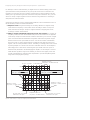
When considering throughput, it is important to examine the overall measurement
process, which is likely to consist of a number of steps. For example, a production
line might have a process where operators use network analyzers to perform manual
tuning on filters. The process might include connecting a filter, recalling a test setup (or
instrument state) on the analyzer, tuning, and watching for a desired result (indicated
perhaps by markers that display values, or limit lines that display whether a device
passes or fails). More tuning might be necessary, then the operator might move on to a
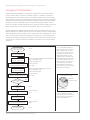
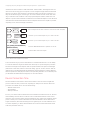
different instrument state to tune another parameter, and so on. (See Figure 1.)
Another example is an automated final test that uses a part handler. Here the process
might include the part handler placing a part in a test fixture, setting up an instrument
state, taking data, transferring data to a PC, having a PC perform calculations or store
data to a file, and then setting up an analyzer for the next test. The instrument-state
setup might be done by recalling an instrument-state file that had previously been set
up and stored, or the PC could issue commands to the analyzer to set up the desired
conditions.
Connect Tx, Ant filter
ports to analyzer
15 sec
Recall instrument
state and calibration
3 sec
Adjust screws to
tune Tx � Ant path
Total for multiple measurements and adjustments:
90 sec measurement time
210 sec adjustment time
Connect Ant, Rx ports to analyzer;
Recall new state and calibration
Total for all measurements and adjustments:
90 sec measurement time
210 sec adjustment time
Adjust screws to
tune Ant � Rx path
Connect Tx, Ant ports to analyzer;
Recall Tx � Ant state and cal
Measurement
OK?
15 sec connection
3 sec recall
15 sec connection
3 sec recall
This is a simplified example of a
manual tuning process for a base
station duplexer filter. The filter
is a 3-port device with two main
signal paths of interest: the one
between the transmit (Tx) and
antenna (Ant) ports, and the one
between the Ant and receive (Rx)
ports. With a standard two-port
network analyzer, two filter ports
are measured at a time, with a
load (termination) connected to
the unused port. Some steps have
been left out for simplicity.
Measurement time 28%
Recall 2%
NO
Connection 8%
YES
Lock adjustment
screws
Verify Tx � Ant measurements
Recall instrument state
and cal for Ant � Rx
Verify Ant � Rx measurements
Disconnect filter
60 sec
Adjustment 62%
Total for all tests:
20 sec
3 sec
Total for all tests:
20 sec
15 sec
Figure 1. Example manual-tuning process for a base-station filter
This pie chart shows that with
one pass of tuning, measurement
time is only about one-quarter of
the total throughput time.