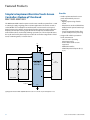
1
Temperature and Humidity Data Logging
Overview
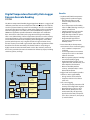
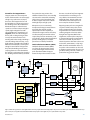
Data logging is a common requirement
in control and automation systems
as a way of providing confirmation of
proper operation over time. The data
logging function may be included
as a part of a control system, or it
may be a stand-alone function that
can provide data independent of
the main system. Temperature and
humidity data loggers are particularly
useful for a variety of purposes:
• Verification of operation of the system
within specified temperature and
humidity ranges. This may be done for
troubleshooting or warranty purposes.
• Verification of proper storage
temperatures of food and
pharmaceutical products to assure
safety and quality. This can be done in
the factory or during transport.
• HVAC temperature/humidity tracking
and troubleshooting
• Confirmation of proper temperature
during chemical/pharmaceutical
manufacturing
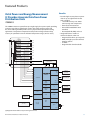
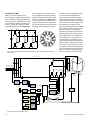
Sensors
Temperature and humidity loggers
employ the following blocks to measure
and log temperature and humidity data:
• Sensors
◦◦ Temperature sensors
◦◦ Humidity sensors
• Timekeeping—generally in the form
of a real-time clock (RTC)
• Nonvolatile memory, which can take
many forms. Mechanical strip-chart
recorders have been used for this
purpose for many decades. Solid-state
nonvolatile memory is common in
recent designs.
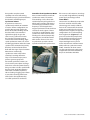
These functions can be implemented at
the board level or they can be integrated
into a single solution. Some are designed
for stationary installation, while others
are small, battery-powered units that
can be used for logging temperature
and humidity during the transport of
sensitive cargo such as food or medicine.
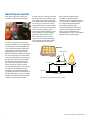
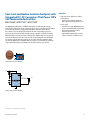
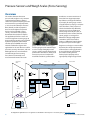
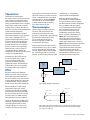
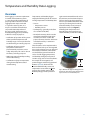
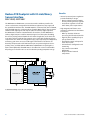
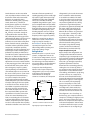
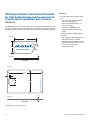
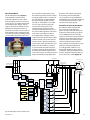
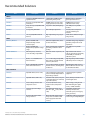
An example of an integrated, selfpowered logger is Maxim’s Hygrochron™
iButton® (DS1923), which includes
an embedded humidity sensor and
temperature sensor within an iButton
package. The durable stainless steel
iButton package provides protection
against environmental hazards such as
dirt, moisture, and mechanical impact.
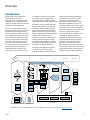
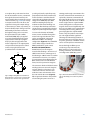
The tiny opening in the Hygrochron’s
lid uses a special filter that allows water
vapor to pass through and reach the
internal humidity sensor, but repels
liquid-phase water (see Figure 1).
Gathering both temperature and
humidity data, the Hygrochron logs
relative humidity as a function of time.
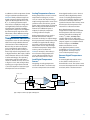
0.642in
0.250in
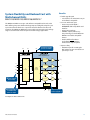
Figure 1. Illustration of the Hygrochron data logger shows the
small size of the canister and how an outer filter allows water
vapor to reach the device’s internal humidity sensor.
71