1
HVAC&R Systems
Introduction
HVAC&R equipment performs space
heating and/or cooling and refrigeration
for residential, commercial, and
industrial buildings. The HVAC&R
system is responsible for providing
fresh outdoor air to ensure that
CO2 levels do not get too high for
the occupants; to heat, cool, and
control humidity levels; and to dilute
or remove airborne contaminants
such as volatile chemicals, cooking
smoke, and other airborne particles.
A properly designed and maintained
system provides a comfortable indoor
environment year-round under a
wide range of usage conditions. The
HVAC&R system is also known as climate
control, which can be quite involved.
Occupancy Response
An occupancy response system
enhances the operation of the HVAC
and lighting systems, providing
greater convenience, comfort, and
energy savings. These systems predict
occupancy based on day of the
week, time of day, and special events
programming. They pre-warm or precool living spaces in anticipation of
the need for room temperatures to be
comfortable prior to the occupant’s
arrival. Due to thermal lag, the heating or
cooling of these spaces must start many
minutes to many hours in advance. In
large buildings with crowds of people
entering the building to start their
work day or to attend a large event,
anticipating this thermal load on the
system is critical. Additionally, depending
on the season and on the weather,
skyscrapers in the morning receive
significantly different solar-heating
effects on the east side of the building
than on the west side, with the opposite
effect in the afternoon. This problem can
be solved by either expending energy
or by properly designing a system to
respond to the presence of an occupant,
which would result in energy savings.
System-inlet air-temperature sensing,
the solar load data, and weather reports,
along with the other factors mentioned,
Environmental Automation
all play a role in system’s ability to
conserve energy while providing the
optimum environment for the occupants.
HVAC Equipment
It is not always possible to separate
components of HVAC&R systems
into heating, ventilation, AC, and
refrigeration systems because many
components are used for multiple
purposes. Instead, we will discuss
commonly used equipment for HVAC&R
systems and describe the equipment’s
basic functions and controls.
Furnace
If “district heating” is not available, then
homes with central heating have a
furnace with air ducts to carry the warm
air to individual rooms. Commercial
buildings may use furnaces if boilers and
steam systems are not used. A furnace
must have a fail-safe control loop
between the burner and fan. Whenever
the temperature is above a set point,
the fan must turn on to prevent the
burner from overheating. The fan
remains on until the temperature has
dropped to the set point. A significant
amount of hysteresis is programmed
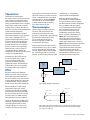
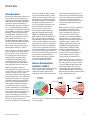
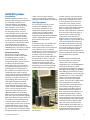
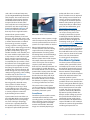
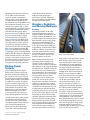
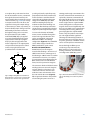
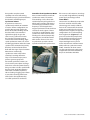
Home air conditioner.
into the system to ensure that all the
heat is pushed through the ductwork
to the rooms. A temperature sensor
is needed in the furnace plenum to
control this action. For this control,
a thermistor or platinum RTD-based
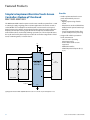
probe is usually used. Maxim’s MAX6603
RTD-to-voltage signal conditioner
provides a dual solution for redundancy
that can enhance fail-safe designs. A
thermocouple is common for high
temperatures inside the furnace;
Maxim’s MAX31855 thermocouple-todigital converter is a good solution. If an
error or overtemperature is detected,
the burner shuts off and an error flag
is set. An error is also indicated if the
burner fails to ignite for some reason.
Gas must be shut off immediately.
These controls are always built into the
furnace. The BAS will simply be told that
these problems have occurred.
Chiller
A chiller drops the temperature of
water through the use of the vapor
compression or the absorption
refrigeration cycle (see the Refrigeration
section in this chapter for a brief
explanation). The cold water is pumped
throughout the building to air handling
units (AHUs) to provide the air cooling
needed. Chilled water systems bring the
water down to 1.5°C to 7°C depending
on the requirements of the system.
(Chillers are not only used in HVAC
systems. They are used in a wide variety
of processing plants to speed the
cooling of many products that are hot
from molding, cutting, casting, etc.).
Vapor compression chillers now use
variable-frequency drives (VFDs) on
their motors to increase efficiency (see
the Motor Control chapter). Sensing
includes temperature at the inlet and
outlet, water pressures (see the Pressure
Sensors and Weigh Scales (Force Sensing)
section in the Sensors chapter), flow
rates, and similar parameters for the
refrigerant fluids. Heat exchangers are
used on the evaporator and condenser
to maximize heat transfer from the
refrigerant to two separate water
87