1
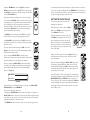
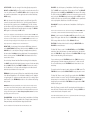
Adjust the LFO settings as shown in Figure 12. Play your
instrument again and you will hear the delayed signal quickly
sliding up and down an octave, somewhat like a siren. With
the AMOUNT and RATE increased, the sine wave has greater
amplitude and is cycling faster thus modulating the delayed
signal more profoundly. If the pitch change is not quite an
octave you might need to fine tune these settings slightly.
Increase the AMOUNT slowly and, at a setting of around 9,
you will find the point where the pitch of the delayed signal
goes up and down by two octaves.
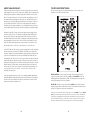
states. Creates octave and other pitch shifting effects when used to modulate another signal.
•Sawtooth– A wave that very quickly reaches a peak and then ramps down
more slowly.
.8
•Sample And Hold – Also known as a random step, a square-ish wave that
randomly changes from up and down state and wave height (amplitude).
8.0
PUTTING IT ALL TOGETHER
Let’s use another WAVEFORM and check out the differences.
FIGURE 12
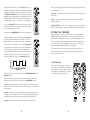
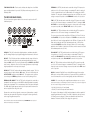
Adjust the settings on your MF-104M as shown in Figure 13.
The delayed signal will bounce up and down one octave
without sliding, or for you more classical types, with no glissando. In theory, a square wave has no slope (See Figure 14).
It goes directly from peak to trough to peak without transition. Thus there is no sliding of the pitch. But in practice
there is a brief transition phase which creates odd harmonics
and adds a definite edge or crispness to the tone. If the
octave is not quite right, fine tune the AMOUNT slightly.
.4
8.0
LFO
TIME • • • • • • • •
••• •• ••
•Ramp– A type of sawtooth wave that ramps up slowly to a peak then
drops down quickly.
FIGURE 13
FIGURE 14
Take a few minutes to experiment with different WAVEFORM, RATE, and
AMOUNT settings.
Having the ability to combine your instrument or source signal with a
delayed signal that is also modulated is one way in which the MF-104M
stands apart. The following four setups contain some familiar uses of the
Delay Line with the LFO providing an interesting twist. And speaking of
twist, these setups are just begging for some serious knob turning,
expression pedal wiggling, and other creative high jinks.
The front panel controls are referred to as performance controls for a
reason: They are meant to be played. Your MF-104M Analog Delay is a
musical instrument in itself.
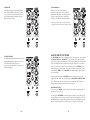
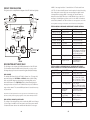
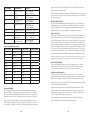
1. STRETCHING TAPE
Classic tape style delay with a stretching
effect courtesy of triangle wave modulation.
Try plugging a Moog EP-2 expression pedal
into the Rate CV jack and use it to speed up
or slow down that stretching effect.
.3
.2
.6
.1
SHORT
Since it’s always good to know the waves before you ride, here are some
brief descriptions, listed from left to right on the WAVEFORM control:
•Sine– A periodic wave that smoothly transitions from peak to trough with
no harmonics. Creates vibrato and tremolo effects when used to modulate
another signal.
•Triangle– A periodic wave creates a triangle shape in moving from peak
to trough. Creates similar effects to a sine wave when modulating another
signal but with a sharper tone due to the generation of odd harmonics.
TIME
•Square– A wave that alternates almost instantaneously between two
12
13
LONG