1
Introduction
1. Introduction
The Network Availability Program (NAP) enables users to predict the
availability of communication networks. The NAP network availability
model utilises an extended Reliability Block Diagram (RBD) methodology
that addresses the specific characteristics of network elements and their
connections. The effectiveness of network restoration after single or
multiple failures may therefore be modelled accurately in NAP. In addition
to predicting network availability, NAP also provides criticality rankings that
identify weak spots in the network. NAP provides many time-saving
features to allow users to quickly construct the network diagram. These
include a parts library facility that allows users to import their parts data in
convenient groupings, a network element library facility that allows users
to construct common network element diagrams and a fully interactive
network diagram construction facility.
One of the important features of NAP is that it allows the modelling of data
flow in different directions along the same network path. This means that
users need not be specific about the direction of data flow in selected
parts of the network. NAP will then automatically determine the allowable
paths between a source and target, and hence determine the minimal cut
sets that determine the availability of the network.
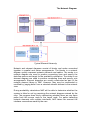
NAP allows you to quickly construct network diagrams using drag and
drop facilities. Users may simply drag a network element or part from the
library tree onto the network diagram. Once a network element is realised
in the network diagram you may modify the default parts (control, power,
interface cards etc.) associated with the element by selecting options from
alternative part lists. Then the network element may be interactively
connected to other elements, through a chosen interface, simply by
clicking the mouse.
Complex or simple networks may be modelled using NAP. Network
elements may be logically modelled right down to part level using the
powerful NAP pagination facility. Individual network element diagrams
have been extended beyond traditional RBDs to allow users to model
multiple interfaces and their interactions with common equipment. In
addition, NAP models the effect of switching delays on network availability
using Markov Analysis. Users may also restrict the analysis to network
paths traversing a limited number of network elements (limiting the ‘hop’
NAP V1.0
1