1
The effective, or observed, spin-spin relaxation time is T2*. It is related to the true spin-lattice time T2
and field inhomogeneity, ΔB0. Inhomogeneity shortens T2*. Great inhomogeneity may make T2* so
short that no signal at all is observed. Shimming fields along the x, y and z directions are added to
reduce ΔB0, and so increase T2*. With our instrument located in room 301 of the Chemistry building,
effective spin-spin relaxation times may be as long as a few seconds.
1
1
=
+ γ Δ B0
(6)
*
T
T2
2
The polarizing pulse aligned the spins. As the spins dephase, their net magnetization is still precessing
around the Earth's field (i.e., around the z axis), so the signal detected in the B1 magnet both oscillates
(with the Larmor frequency) and decays (with time constant T2*). That signal is called the free
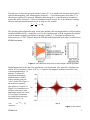
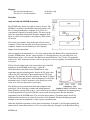
induction decay, or "FID". Figure 2 shows the FID and resulting spectrum from water, recorded on our
EFNMR instrument.
Figure 2. Free-induction decay from a water sample, and the spectrum.
Dephasing need not be the end of the experiment; it can be reversed. The "spin echo" technique (see
section 28.13 of reference 2) uses a 180o (or "π") pulse to flip magnetic moments across the x axis,
converting dephasing to "rephasing." Coherence is
regained as the magnetic
moments refocus, which
leads to another peak (the
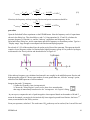
"echo") in the FID. Figure 3
shows echoes caused by
echo pulses at 0.2 and 0.6 s.
(Figure 3 is a simulation, not
real data.) Successive echo
amplitudes (peaks at 0.4, and
0.8 s in Figure 3) decrease
according the the spin-spin
relaxation time T2, as
−t /T 2
echo
. (7)
∝e
amplitude
EFNMR.odt
Figure 3. spin echoes
3