1
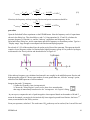
C midway =
C H +C F
2
= CH
γH 2
1+ γ
F
( )
2
= CH
.
1+1.129
= 1.065C H
2
Likewise, the frequency midway between fluorine and proton resonances should be
γF
1+
γH
ω H +ω F
1+0.941
ω midway =
= ωH
= ωH
= 0.970ω H
2
2
2
( )
(15)
(16)
procedure
Open the PulseAndCollect experiment on the EFNMR menu. Note the frequency and coil capacitance
shown in the dialog box. They should be ωH and CH. Using equations 14, 15 and 16, calculate the
resonant frequency of fluorine, ωF, and the "midway" capacitance and frequency. In the
PulseAndCollect dialog box, set the capacitance and the B1 frequency to the midway values. Type in a
"Display range" large enough to encompass both fluorine and hydrogen peaks.
Put a bottle of 2,2,2-trifluoroethanol into the probe cavity. Record the spectrum. The spectrum should
contain a lower-frequency triplet for fluorine and a higher-frequency group of five peaks for hydrogen,
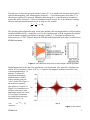
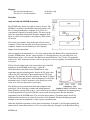
as discussed in the Theory section and sketched below in Figure 10.
Figure 10. Schematic spectrum of trifluoroethanol.
If the midway frequency you calculated and entered is not roughly in the middle between fluorine and
hydrogen peaks, adjust it. Choose some number of scans greater than one, click the "average" option,
and record the NMR spectrum of trifluoroethanol.
Integrate the peaks. To integrate:
◊ Under the 1D menu, chose integrate1d.
◊ Choose the "Select Region" cursor tool to draw a box around peaks,
that range is immediately transferred to the "integrate 1d region" dialog.
In your report, compare the ratio of peak integrals to that expected based on the number of H and F
3
atoms in the sample, correcting for the intrinsically lower signal expected from fluorine: the factor γ
enters, as mentioned in the Theory section.
From your spectrum, calculate J. The weak outer CH2 peaks may not be resolved, but J can still be read
EFNMR.odt
10