1
4 Confined Displacement Algorithm (CDA) Plugin
The Confined Displacement Algorithm (CDA) ImageJ plugin allows the identification of
significant areas of colocalisation within 2D and 3D images.
The quantification of colocalisation is performed in two stages. Stage 1 identifies locations
where the two channels both occur. Stage 2 calculates a measure to quantify the
cooccurrence of the two channels, for example using the percentage of colocated signal or
the correlation between the colocated channels.
However the quantification of colocalisation has no context. This results in subjective
interpretation as to the significance of the value. For example a given colocalisation result
may be very good or very bad depending on the underlying distribution of signal intensity
within the image. In this case the results of many different images can be compared to
provide a context for the result under investigation. However this analysis is also
subjective and it is possible that alternative images are either not available or not
representative.
To solve this issue representative images for comparison can be produced from the
original image. This ensures the total channel intensity is the same. Randomly shuffling the
pixels provides new images but does not maintain a realistic grouping of pixel intensities
characteristic of structural content. Rotating the image in 90 degree intervals or translating
the image with wrapping does maintain the structural content but introduces bias
depending on the nature of the transform, e.g. the centre of the rotation or the angle of the
translation.
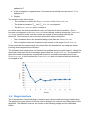
A solution to this situation is to perform translations in all directions and at all possible
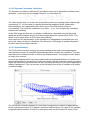
distances. If the colocalisation measure is calculated for each translation then a probability
density function can be computed that shows how the measure varies with distance. If the
two channels are significantly colocated it would be expected that the original
colocalisation measure would be very different from the colocalisation measure of a highly
shifted image. If there is no true colocalisation then shifting the image will produce
colocalisation scores higher (and lower) than the actual measure.
An additional factor to consider is that the information in the two channels may be located
in only parts of the overall image, for example the nucleus of a cell. Consequently the
translation shifts may move the signal of the channel into an area of the image where it
would never naturally occur. This could result in a false conclusion that the two channels
are colocated in the original image. The solution is to define an area within which the
pixels can be translated. Pixels moving beyond the region are wrapped to re-enter from
the other side. This method thus maintains the underlying image structure. This method is
the principle behind the Confined Displacement Algorithm (CDA) [Ramirez et al].