1
Logix5000
Controllers Design
Considerations
1756 ControlLogix
1756 GuardLogix
1768 CompactLogix
1769 CompactLogix
1789 SoftLogix5800
1794 FlexLogix
PowerFlex 700S with DriveLogix
Reference Manual
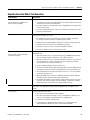
Important User Information
Solid state equipment has operational characteristics differing from those of
electromechanical equipment. Safety Guidelines for the Application, Installation and
Maintenance of Solid State Controls (publication SGI-1.1 available from your local
Rockwell Automation sales office or online at
http://literature.rockwellautomation.com) describes some important differences
between solid state equipment and hard-wired electromechanical devices. Because of
this difference, and also because of the wide variety of uses for solid state equipment,
all persons responsible for applying this equipment must satisfy themselves that each
intended application of this equipment is acceptable.
In no event will Rockwell Automation, Inc. be responsible or liable for indirect or
consequential damages resulting from the use or application of this equipment.
The examples and diagrams in this manual are included solely for illustrative purposes.
Because of the many variables and requirements associated with any particular
installation, Rockwell Automation, Inc. cannot assume responsibility or liability for
actual use based on the examples and diagrams.
No patent liability is assumed by Rockwell Automation, Inc. with respect to use of
information, circuits, equipment, or software described in this manual.
Reproduction of the contents of this manual, in whole or in part, without written
permission of Rockwell Automation, Inc., is prohibited.
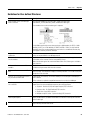
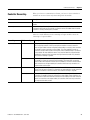
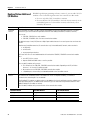
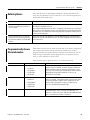
Throughout this manual, when necessary, we use notes to make you aware of safety
considerations.
WARNING
IMPORTANT
ATTENTION
WARNING
BURN HAZARD
Identifies information about practices or circumstances that can cause
an explosion in a hazardous environment, which may lead to personal
injury or death, property damage, or economic loss.
Identifies information that is critical for successful application and
understanding of the product.
Identifies information about practices or circumstances that can lead
to: personal injury or death, property damage, or economic loss.
Attentions help you identify a hazard, avoid a hazard, and recognize
the consequence.
Labels may be on or inside the equipment, for example, a drive or
motor, to alert people that dangerous voltage may be present.
Labels may be on or inside the equipment, for example, a drive or
motor, to alert people that surfaces may reach dangerous
temperatures.
Allen-Bradley, Rockwell Automation, ControlLogix, GuardLogix, CompactLogix, SoftLogix, FlexLogix, PowerFlex 700S, DriveLogix,
FactoryTalk, FactoryTalk Administration Console, FactoryTalk Alarms and Events, FactoryTalk, FactoryTalk Live Data, FactoryTalk View,
FactoryTalk View Studio, Data Highway Plus, SynchLink, PLC-5, SLC, SLC 500, RSLinx, RSBizWare Batch, ControlFlash, Ultra3000, and
PanelView are trademarks of Rockwell Automation, Inc.
Trademarks not belonging to Rockwell Automation are property of their respective companies.
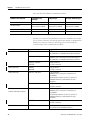
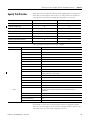
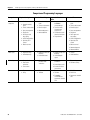
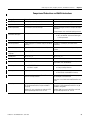
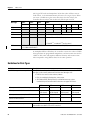
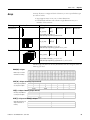
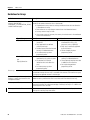
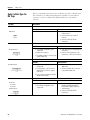
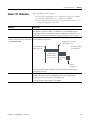
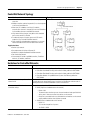
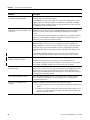
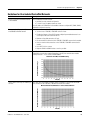
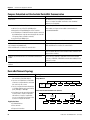
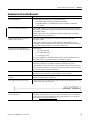
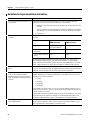
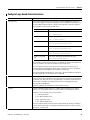
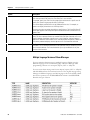
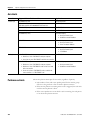
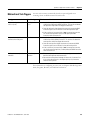
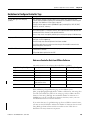
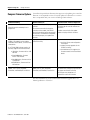
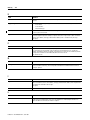
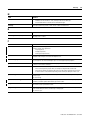
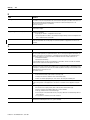
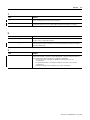
Logix5000 Controller Comparison
Characteristic
1756 ControlLogix
1756 GuardLogix
1768 CompactLogix
1769 CompactLogix
1789 SoftLogix5800
1794 FlexLogix
PowerFlex 700S2
DriveLogix
Controller tasks
• Continuous
• Periodic
• Event
•
•
•
•
•
•
•
•
•
•
•
•
•
User memory
1756-L55M12: 750 KB
1756-L55M13: 1.5 MB
1756-L55M14: 3.5 MB
1756-L55M16: 7.5 MB
1756-L55M22: 750 KB
1756-L55M23: 1.5 MB
1756-L55M24: 3.5 MB
1756-L60M03SE: 750 KB
1756-L61: 2 MB
1756-L62: 4 MB
1756-L63: 8 MB
1756-L64: 16 MB
1756-L61S:
2 MB Standard
1 MB Safety
Nonvolatile user
memory
1756-L55M12: none
1756-L55M13: none
1756-L55M14: none
1756-L55M16: none
1756-L55M22: yes
1756-L55M23: yes
1756-L55M24: yes
1756-L6x: CompactFlash
CompactFlash
CompactFlash
CompactFlash
Built-in
communication
ports
1 port RS-232 serial
1 port RS-232 serial
1 port RS-232 serial
•
100 tasks
Event tasks: all
event triggers
100 tasks
Event tasks: all
event triggers
16 tasks
Event tasks:
consumed tag,
EVENT
instruction, axis,
and motion event
triggers
1768-L43: 2 MB
•
•
•
8 tasks
Event tasks:
consumed tag
and EVENT
instruction
triggers
8 tasks
Event tasks: axis
and motion event
triggers
256 KB
768 KB with memory
expansion
None
Yes
Yes (expansion
memory)
1769-L31: 2
RS-232 ports
1769-L32C,
-L35CR: 1
ControlNet port
and 1 RS-232 port
1769-L32E, -L35E:
1 EtherNet/IP port
and 1 RS-232 port
Depends on personal
computer
•
•
1 RS-232 port
2 slots for 1788
communication
cards
•
•
1 RS-232 port
1 slot for 1788
communication
cards
1789-L10:
2 MB; 3 slots; No
motion
1789-L30:
64 MB; 5 slots
1756-L61S:
4 MB Standard
1 MB Safety
1789-L60:
64 MB; 16 slots
•
•
•
•
EtherNet/IP
ControlNet
DeviceNet
•
•
•
EtherNet/IP
ControlNet
DeviceNet
•
•
•
EtherNet/IP
ControlNet
DeviceNet
•
•
•
EtherNet/IP
ControlNet
DeviceNet
•
•
•
EtherNet/IP
ControlNet
DeviceNet
•
•
•
EtherNet/IP
(standard; safety)
ControlNet
(standard; safety)
DeviceNet
(standard; safety)
Data Highway Plus
Remote I/O
SynchLink
ASCII
DF1 full/half duplex
DF1 radio modem
DH-485
Modbus
•
•
•
•
•
ASCII
DF1 full/half duplex
DF1 radio modem
DH-485
Modbus
•
•
•
•
ASCII
DF1 full/half
duplex
DH-485
Modbus
•
•
•
•
ASCII
DF1 full/half
duplex
DF1 radio
modem
DH-485
Modbus
•
•
•
•
•
ASCII
DF1 full/half
duplex
DF1 radio modem
DH-485
Modbus
•
•
•
•
•
ASCII
DF1 full/half
duplex
DF1 radio modem
DH-485
Modbus
•
•
•
ASCII
DF1 full/half
duplex
DF1 radio modem
DH-485
Modbus
100 ControlNet
128 EtherNet/IP
64 TCP/IP
•
•
•
48 ControlNet
128 EtherNet/IP
64 TCP/IP
•
•
•
48 ControlNet
64 EtherNet/IP
32 TCP/IP
•
•
•
32 ControlNet
32 EtherNet/IP
32 TCP/IP
•
•
48 ControlNet
EtherNet/IP
limited by
type/number
cards
•
•
•
32 ControlNet
32 EtherNet/IP
64 TCP/IP
•
•
•
32 ControlNet
32 EtherNet/IP
64 TCP/IP
•
•
•
•
•
•
EtherNet/IP
ControlNet
DeviceNet
Data Highway Plus
Remote I/O
SynchLink
•
•
•
•
•
•
Connections
•
•
•
Controller
redundancy
Full support
None
N/A
Simple motion
•
•
•
•
•
•
•
•
Serial port
communication
100 Tasks
Event tasks: all
event triggers,
plus outbound
and Windows
events
1794-L34: 512 KB
1769-L31: 512 KB
1769-L32x: 750 KB
1769-L35x: 1.5 MB
•
Communication
options
1769-L35CR,
-L35E: 8 tasks
1769-L32C, -L32E:
6 tasks
1769-L31: 4 tasks
Event tasks:
consumed tag and
EVENT instruction
triggers
Stepper
Servo via DeviceNet
Analog ac drive
•
•
Stepper
Servo via DeviceNet
Analog ac drive
•
N/A
Stepper
Servo via
DeviceNet
Analog ac drive
Integrated
motion
SERCOS interface
Analog options:
• Encoder input
• LDT input
• SSI input
SERCOS interface
Analog options:
• Encoder input
• LDT input
• SSI input
SERCOS interface
Programming
languages
•
•
•
•
•
•
•
•
•
•
•
•
Relay ladder
Structured text
Function block
SFC
Relay ladder
Structured text
Function block
SFC
Relay ladder
Structured text
Function block
SFC
•
•
•
N/A
Stepper
Servo via
DeviceNet
Analog ac drive
N/A
•
•
•
•
•
•
Relay ladder
Structured text
Function block
SFC
•
•
•
Stepper
Servo via
DeviceNet
Analog ac drive
•
Backup via
DeviceNet
N/A
•
•
•
•
•
SERCOS interface
Analog encoder input
N/A
•
•
•
•
•
•
•
•
•
Relay ladder
Structured text
Function block
SFC
External routines
(developed in
C/C++)
Stepper
Servo via
DeviceNet
Analog ac drive
Relay ladder
Structured text
Function block
SFC
•
Stepper
Servo via
DeviceNet
Analog ac drive
•
•
1 full servo
1 feedback axis
•
•
•
•
Relay ladder
Structured text
Function block
SFC
Notes:
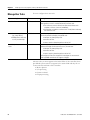
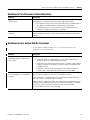
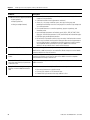
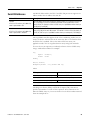
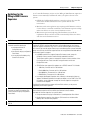
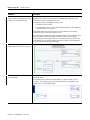
Summary of Changes
This version of the design guidelines corresponds to revision 16 of the
Logix5000 controller firmware.
Summary of Changes
Change
Page
Continuous task execution time at least 1 ms
25
Output processing on event tasks
26
Configurable use for any unused part of the system overhead timeslice
28
Add-On Instructions
31
Addition of a LINT data type
41
Electronic keying
64
Control HART devices
68
Control FOUNDATION Fieldbus devices
69
Runtime addition of generic ControlNet and EtherNet/IP modules
73
Unicast produced and consumed tags over an EtherNet/IP network
77
DeviceNet tag generator tool
83
FactoryTalk Alarms and Events system
91
Controller-initiated firmware updates
117
Autoflash supports SERCOS drives
118
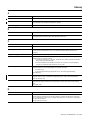
In addition, these modules are now available:
• 1768-L43 CompactLogix controller
• 1768-CNB, 1768-CNBR ControlNet modules
• 1768-EWEB EtherNet/IP web server module
• 1756-L64 ControlLogix controller
• 1756-CN2, 1756-CN2R ControlNet modules
• 1756-EN2T EtherNet/IP module
5Publication 1756-RM094C-EN-P - June 2007
5
Summary of Changes
Notes:
6
Publication 1756-RM094C-EN-P - June 2007
Table of Contents
Preface
Design Logix5000 Systems
Introduction . . . . . . . . . . . . . . . . . . . . . . . . . . . . . . . . . . . . . . . . . . . . . . . . . . . . . . . . . 11
Chapter 1
Logix5000 Controller Resources
Introduction . . . . . . . . . . . . . . . . . . . . . . . . . . . . . . . . . . . . . . . . . . . . . . . . . . . . . . . . . 13
Controller Connections . . . . . . . . . . . . . . . . . . . . . . . . . . . . . . . . . . . . . . . . . . . . . . . . 15
Determine Total Connection Requirements. . . . . . . . . . . . . . . . . . . . . . . . . . . . . . . . 17
Chapter 2
Divide Logic into Tasks, Programs,
Routines, and Add-On Instructions
Introduction . . . . . . . . . . . . . . . . . . . . . . . . . . . . . . . . . . . . . . . . . . . . . . . . . . . . . . . . .
Decide When to Use Tasks, Programs, and Routines . . . . . . . . . . . . . . . . . . . . . . . .
Specify Task Priorities . . . . . . . . . . . . . . . . . . . . . . . . . . . . . . . . . . . . . . . . . . . . . . . . .
Manage User Tasks . . . . . . . . . . . . . . . . . . . . . . . . . . . . . . . . . . . . . . . . . . . . . . . . . . .
Considerations that Affect Task Execution . . . . . . . . . . . . . . . . . . . . . . . . . . . . . . . .
Configure a Continuous Task . . . . . . . . . . . . . . . . . . . . . . . . . . . . . . . . . . . . . . . . . . .
Configure a Periodic Task . . . . . . . . . . . . . . . . . . . . . . . . . . . . . . . . . . . . . . . . . . . . . .
Configure an Event Task . . . . . . . . . . . . . . . . . . . . . . . . . . . . . . . . . . . . . . . . . . . . . . .
Guidelines to Configure an Event Task . . . . . . . . . . . . . . . . . . . . . . . . . . . . . . . . . . .
Select a System Overhead Percentage . . . . . . . . . . . . . . . . . . . . . . . . . . . . . . . . . . . . .
Manage the System Overhead Timeslice Percentage . . . . . . . . . . . . . . . . . . . . . . . . .
Develop Application Code in Routines . . . . . . . . . . . . . . . . . . . . . . . . . . . . . . . . . . .
Guidelines to Pass Parameters to/from Subroutines . . . . . . . . . . . . . . . . . . . . . . . . .
Guidelines for User-defined Add-On Instructions . . . . . . . . . . . . . . . . . . . . . . . . . .
Programming Methods . . . . . . . . . . . . . . . . . . . . . . . . . . . . . . . . . . . . . . . . . . . . . . . .
Controller Prescan of Logic. . . . . . . . . . . . . . . . . . . . . . . . . . . . . . . . . . . . . . . . . . . . .
Controller Postscan of SFC Logic. . . . . . . . . . . . . . . . . . . . . . . . . . . . . . . . . . . . . . . .
Timer Execution. . . . . . . . . . . . . . . . . . . . . . . . . . . . . . . . . . . . . . . . . . . . . . . . . . . . . .
Edit an SFC Online . . . . . . . . . . . . . . . . . . . . . . . . . . . . . . . . . . . . . . . . . . . . . . . . . . .
19
20
21
22
23
25
25
25
26
27
28
29
31
31
34
36
37
37
39
Chapter 3
Address Data
Introduction . . . . . . . . . . . . . . . . . . . . . . . . . . . . . . . . . . . . . . . . . . . . . . . . . . . . . . . . .
Guidelines for Data Types. . . . . . . . . . . . . . . . . . . . . . . . . . . . . . . . . . . . . . . . . . . . . .
Arrays . . . . . . . . . . . . . . . . . . . . . . . . . . . . . . . . . . . . . . . . . . . . . . . . . . . . . . . . . . . . . .
Guidelines for Arrays . . . . . . . . . . . . . . . . . . . . . . . . . . . . . . . . . . . . . . . . . . . . . . . . . .
Indirect Addresses of Arrays . . . . . . . . . . . . . . . . . . . . . . . . . . . . . . . . . . . . . . . . . . . .
Guidelines for Array Indexes. . . . . . . . . . . . . . . . . . . . . . . . . . . . . . . . . . . . . . . . . . . .
Prescan of an Array Index . . . . . . . . . . . . . . . . . . . . . . . . . . . . . . . . . . . . . . . . . . . . . .
Guidelines for User-defined Structures. . . . . . . . . . . . . . . . . . . . . . . . . . . . . . . . . . . .
Select a Data Type for Bit Tags . . . . . . . . . . . . . . . . . . . . . . . . . . . . . . . . . . . . . . . . . .
Serial Bit Addresses . . . . . . . . . . . . . . . . . . . . . . . . . . . . . . . . . . . . . . . . . . . . . . . . . . .
Guidelines for String Data Types . . . . . . . . . . . . . . . . . . . . . . . . . . . . . . . . . . . . . . . .
PLC-5/SLC 500 Access of Strings . . . . . . . . . . . . . . . . . . . . . . . . . . . . . . . . . . . . . . .
Configure Tags . . . . . . . . . . . . . . . . . . . . . . . . . . . . . . . . . . . . . . . . . . . . . . . . . . . . . . .
Guidelines for Base Tags . . . . . . . . . . . . . . . . . . . . . . . . . . . . . . . . . . . . . . . . . . . . . . .
Create Alias Tags . . . . . . . . . . . . . . . . . . . . . . . . . . . . . . . . . . . . . . . . . . . . . . . . . . . . .
Guidelines for Data Scope. . . . . . . . . . . . . . . . . . . . . . . . . . . . . . . . . . . . . . . . . . . . . .
Guidelines for Tag Names. . . . . . . . . . . . . . . . . . . . . . . . . . . . . . . . . . . . . . . . . . . . . .
Tag Descriptions . . . . . . . . . . . . . . . . . . . . . . . . . . . . . . . . . . . . . . . . . . . . . . . . . . . . .
41
42
43
44
45
46
46
47
48
49
50
50
51
52
53
53
54
55
Chapter 4
Share Tag Data with Other Controllers
(produced and consumed tags)
7Publication 1756-RM094C-EN-P - June 2007
Introduction . . . . . . . . . . . . . . . . . . . . . . . . . . . . . . . . . . . . . . . . . . . . . . . . . . . . . . . . .
Guidelines for Produced and Consumed Tags . . . . . . . . . . . . . . . . . . . . . . . . . . . . . .
Guidelines to Specify an RPI Rate for Produced and Consumed Tags . . . . . . . . . .
Guidelines to Manage Connections for Produced and Consumed Tags. . . . . . . . . .
Configure an Event Task Based on a Consumed Tag . . . . . . . . . . . . . . . . . . . . . . . .
Compare Messages and Produced/Consumed Tags . . . . . . . . . . . . . . . . . . . . . . . . .
57
58
59
59
59
60
7
Table of Contents
Chapter 5
Communicate with I/O
Introduction . . . . . . . . . . . . . . . . . . . . . . . . . . . . . . . . . . . . . . . . . . . . . . . . . . . . . . . . .
Buffer I/O Data . . . . . . . . . . . . . . . . . . . . . . . . . . . . . . . . . . . . . . . . . . . . . . . . . . . . . .
Guidelines to Specify an RPI Rate for I/O Modules . . . . . . . . . . . . . . . . . . . . . . . . .
Communication Formats for I/O Modules . . . . . . . . . . . . . . . . . . . . . . . . . . . . . . . .
Guidelines to Manage I/O Connections. . . . . . . . . . . . . . . . . . . . . . . . . . . . . . . . . . .
Control 1771 I/O Modules . . . . . . . . . . . . . . . . . . . . . . . . . . . . . . . . . . . . . . . . . . . . .
Communicate with HART Devices . . . . . . . . . . . . . . . . . . . . . . . . . . . . . . . . . . . . . .
Communicate with FOUNDATION Fieldbus Devices . . . . . . . . . . . . . . . . . . . . . .
Create Tags for I/O Data . . . . . . . . . . . . . . . . . . . . . . . . . . . . . . . . . . . . . . . . . . . . . .
Controller Ownership . . . . . . . . . . . . . . . . . . . . . . . . . . . . . . . . . . . . . . . . . . . . . . . . .
Runtime/Online Addition of I/O Modules . . . . . . . . . . . . . . . . . . . . . . . . . . . . . . . .
61
61
62
63
65
67
68
69
70
71
72
Chapter 6
Determine the Appropriate Network
Introduction . . . . . . . . . . . . . . . . . . . . . . . . . . . . . . . . . . . . . . . . . . . . . . . . . . . . . . . . .
Select a Network. . . . . . . . . . . . . . . . . . . . . . . . . . . . . . . . . . . . . . . . . . . . . . . . . . . . . .
EtherNet/IP Network Topology . . . . . . . . . . . . . . . . . . . . . . . . . . . . . . . . . . . . . . . .
Guidelines for EtherNet/IP Networks. . . . . . . . . . . . . . . . . . . . . . . . . . . . . . . . . . . .
Guidelines for Switches in EtherNet/IP Systems . . . . . . . . . . . . . . . . . . . . . . . . . . .
ControlNet Network Topology. . . . . . . . . . . . . . . . . . . . . . . . . . . . . . . . . . . . . . . . . .
Guidelines for ControlNet Networks . . . . . . . . . . . . . . . . . . . . . . . . . . . . . . . . . . . . .
Guidelines for Unscheduled ControlNet Networks. . . . . . . . . . . . . . . . . . . . . . . . . .
Compare Scheduled and Unscheduled ControlNet Communication . . . . . . . . . . . .
DeviceNet Network Topology . . . . . . . . . . . . . . . . . . . . . . . . . . . . . . . . . . . . . . . . . .
Guidelines for DeviceNet Networks. . . . . . . . . . . . . . . . . . . . . . . . . . . . . . . . . . . . . .
75
75
76
77
78
79
79
81
82
82
83
Chapter 7
Communicate with Other Devices
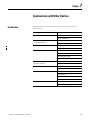
Introduction . . . . . . . . . . . . . . . . . . . . . . . . . . . . . . . . . . . . . . . . . . . . . . . . . . . . . . . . .
Cache Messages . . . . . . . . . . . . . . . . . . . . . . . . . . . . . . . . . . . . . . . . . . . . . . . . . . . . . .
Message Buffers . . . . . . . . . . . . . . . . . . . . . . . . . . . . . . . . . . . . . . . . . . . . . . . . . . . . . .
Guidelines for Messages . . . . . . . . . . . . . . . . . . . . . . . . . . . . . . . . . . . . . . . . . . . . . . .
Guidelines to Manage Message Connections . . . . . . . . . . . . . . . . . . . . . . . . . . . . . . .
Guidelines for Block-transfer Messages . . . . . . . . . . . . . . . . . . . . . . . . . . . . . . . . . . .
Map Tags . . . . . . . . . . . . . . . . . . . . . . . . . . . . . . . . . . . . . . . . . . . . . . . . . . . . . . . . . . .
85
86
86
89
89
90
90
Chapter 8
FactoryTalk Alarms and Events System
Introduction . . . . . . . . . . . . . . . . . . . . . . . . . . . . . . . . . . . . . . . . . . . . . . . . . . . . . . . . .
Guidelines for Logix-based Alarm Instructions . . . . . . . . . . . . . . . . . . . . . . . . . . . . .
Configure Logix-based Alarm Instructions. . . . . . . . . . . . . . . . . . . . . . . . . . . . . . . . .
Alarm Process. . . . . . . . . . . . . . . . . . . . . . . . . . . . . . . . . . . . . . . . . . . . . . . . . . . . . . . .
Buffering Alarms . . . . . . . . . . . . . . . . . . . . . . . . . . . . . . . . . . . . . . . . . . . . . . . . . . . . .
Programmatically Access Alarm Information. . . . . . . . . . . . . . . . . . . . . . . . . . . . . . .
91
92
93
95
97
97
Chapter 9
Optimize an Application for Motion
Control
8
Introduction . . . . . . . . . . . . . . . . . . . . . . . . . . . . . . . . . . . . . . . . . . . . . . . . . . . . . . . . . 99
Coarse Update Rate . . . . . . . . . . . . . . . . . . . . . . . . . . . . . . . . . . . . . . . . . . . . . . . . . . . 99
Axis Limits . . . . . . . . . . . . . . . . . . . . . . . . . . . . . . . . . . . . . . . . . . . . . . . . . . . . . . . . . 100
Performance Limits . . . . . . . . . . . . . . . . . . . . . . . . . . . . . . . . . . . . . . . . . . . . . . . . . . 100
Motion Event Task Triggers . . . . . . . . . . . . . . . . . . . . . . . . . . . . . . . . . . . . . . . . . . . 101
Publication 1756-RM094C-EN-P - June 2007
Table of Contents
Chapter 10
Optimize an Application for Use with
HMI
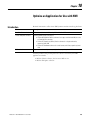
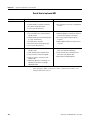
Introduction . . . . . . . . . . . . . . . . . . . . . . . . . . . . . . . . . . . . . . . . . . . . . . . . . . . . . . . .
Compare RSView Enterprise and RSView32 Software . . . . . . . . . . . . . . . . . . . . . .
Guidelines for RSView SE Software . . . . . . . . . . . . . . . . . . . . . . . . . . . . . . . . . . . . .
How RSLinx Software Communicates with Logix5000 Controllers . . . . . . . . . . . .
Compare RSLinx Classic and RSLinx Enterprise Software . . . . . . . . . . . . . . . . . . .
Guidelines for RSLinx Software . . . . . . . . . . . . . . . . . . . . . . . . . . . . . . . . . . . . . . . .
Guidelines to Configure Controller Tags . . . . . . . . . . . . . . . . . . . . . . . . . . . . . . . . .
103
105
105
106
107
108
109
Chapter 11
Develop Equipment Phases for Batch
Control
Introduction . . . . . . . . . . . . . . . . . . . . . . . . . . . . . . . . . . . . . . . . . . . . . . . . . . . . . . . . 111
Guidelines for Equipment Phases . . . . . . . . . . . . . . . . . . . . . . . . . . . . . . . . . . . . . . . 111
Equipment Phase Instructions . . . . . . . . . . . . . . . . . . . . . . . . . . . . . . . . . . . . . . . . . 112
Chapter 12
Optimize an Application for Process
Control
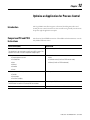
Introduction . . . . . . . . . . . . . . . . . . . . . . . . . . . . . . . . . . . . . . . . . . . . . . . . . . . . . . . .
Comparison PID and PIDE Instructions . . . . . . . . . . . . . . . . . . . . . . . . . . . . . . . . .
Guidelines to Program PID Loops . . . . . . . . . . . . . . . . . . . . . . . . . . . . . . . . . . . . . .
Advanced Process Instructions . . . . . . . . . . . . . . . . . . . . . . . . . . . . . . . . . . . . . . . . .
Faceplates . . . . . . . . . . . . . . . . . . . . . . . . . . . . . . . . . . . . . . . . . . . . . . . . . . . . . . . . . .
Compare Active-X Faceplates and Graphic Library Elements . . . . . . . . . . . . . . . .
113
113
114
115
116
116
Chapter 13
Manage Firmware
Publication 1756-RM094C-EN-P - June 2007
Introduction . . . . . . . . . . . . . . . . . . . . . . . . . . . . . . . . . . . . . . . . . . . . . . . . . . . . . . . .
Guidelines to Manage Controller Firmware . . . . . . . . . . . . . . . . . . . . . . . . . . . . . . .
Compare Firmware Options . . . . . . . . . . . . . . . . . . . . . . . . . . . . . . . . . . . . . . . . . . .
Guidelines for the RSLogix 5000 Firmware Supervisor. . . . . . . . . . . . . . . . . . . . . .
Access Firmware . . . . . . . . . . . . . . . . . . . . . . . . . . . . . . . . . . . . . . . . . . . . . . . . . . . .
117
117
118
119
121
9
Table of Contents
Notes:
10
Publication 1756-RM094C-EN-P - June 2007
Preface
Design Logix5000 Systems
Introduction
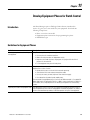
This reference manual provides guidelines you can follow to optimize your
system. This manual also provides system information you need to make
system design choices.
In addition to the controller-specific topics covered in each chapter, the back
of this manual includes a:
• glossary of commonly used terms.
• list of related publications.
This manual is meant for experienced Logix-system programmers. The
information in this manual is presented with the assumption that you
understand how to implement the guidelines. The list of related publications
web sites at the back of the manual identifies resources you can use for more
details on how to implement the guidelines.
11Publication 1756-RM094C-EN-P - June 2007
11
Preface
Design Logix5000 Systems
Notes:
12
Publication 1756-RM094C-EN-P - June 2007
Chapter
1
Logix5000 Controller Resources
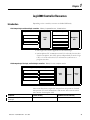
Depending on the controller, resources are divided differently.
Introduction
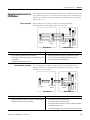
1768 CompactLogix and ControlLogix controllers - Memory is separated into two, isolated sections.
Logic and Data Memory
I/O Memory
I/O data
Program source code
Logix
CPU
Tag data
I/O force tables
Backplane
CPU
Message buffers
RSLinx tag group lists
Produced/consumed tags
• The Logix CPU executes application code and messages.
• The backplane CPU communicates with I/O and sends/receives data
from the backplane. This CPU operates independently from the Logix
CPU, so it sends and receives I/O information asynchronous to
program execution.
1769 CompactLogix, FlexLogix, and DriveLogix controllers - Memory is in one, contiguous section.
Logic, Data, and I/O Memory
Program source code
I/O data
Tag data
I/O force tables
RSLinx tag group lists
Message buffers
Logix
CPU
I/O task
Comms
task
Produced/consumed tags
These controllers have a single CPU that performs all operations. Isolated
tasks perform I/O and communication and interact with networks. These
tasks simulate the backplane CPU.
Controller
I/O Task Priority
Communication Task Priority
1769 CompactLogix, FlexLogix, and
DriveLogix
6
12
13Publication 1756-RM094C-EN-P - June 2007
13
Chapter 1
Logix5000 Controller Resources
SoftLogix controllers - Memory is in one, contiguous section.
Logic, Data, and I/O Memory
Program source code
I/O data
Tag data
I/O force tables
RSLinx tag group lists
Message buffers
Logix
CPU
Windows
operating
system
Produced/consumed tags
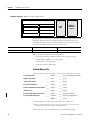
The SoftLogix controller has a single CPU that works in conjunction with the
Windows operating system to perform all operations. Rather than using
controller priority levels for I/O and communication tasks, the SoftLogix
controller uses Windows priority levels for these tasks.
Controller
I/O Task Priority
Communication Task Priority
SoftLogix
Windows priority 16 (Idle)
Windows priority 16 (Idle)
For all controllers, memory is used at run time for:
• message processing to buffer incoming and outgoing messages.
• RSLinx data handling to store tag groups.
• online edits to store edit rungs.
• graphical trends to buffer data.
Estimate Memory Use
These equations provide an estimate of the memory needed for a controller.
Controller tasks
_____ * 4000 =
_____ bytes (minimum 1 needed)
Digital I/O points
_____ * 400
=
_____ bytes
Analog I/O points
_____ * 2600 =
_____ bytes
DeviceNet modules1
_____ * 7400 =
_____ bytes
Other communication modules2_____ * 2000 =
_____ bytes
Motion axis
_____ bytes
_____ * 8000 =
FactoryTalk alarm instruction _____ * 1000 =
_____ bytes (per alarm)
FactoryTalk subscriber
_____ bytes (per subscriber)
_____ * 10000 =
Total =
_____ bytes
1The first DeviceNet module is 7400 bytes. Additional DeviceNet modules are 5800 bytes each.
2
Count all the communication modules in the system, not just those in the local chassis. This includes device
connection modules, adapter modules, and ports on PanelView terminals.
Reserve 20...30% of the controller memory to accommodate growth.
14
Publication 1756-RM094C-EN-P - June 2007
Logix5000 Controller Resources
Chapter 1
RSLinx Software Use of Logix5000 Controller Memory
The amount of memory RSLinx software needs depends on the type of data
RSLinx software reads. These equations provide a memory estimate.
RSLinx overhead
(per connection)
_____ * 1345 = _____ bytes (4 connections by default)
Individual tags
_____ * 45
= _____ bytes
Arrays / structures
_____ * 7
= _____ bytes
Total = _____ bytes
Consolidating tags into an array or a structure reduces the communication
overhead and the number of connections needed to obtain the data.
Compare PLC/SLC MEMORY
The Logix5000 controllers use compiled instructions to provide faster
execution times than PLC or SLC processors. The compiled instructions use
more memory when compared to the instructions in PLC and SLC processors.
If you have a PLC/SLC program, you can estimate the number of bytes it will
take in a Logix5000 controller by:
number PLC/SLC words ∗ 18 = number of Logix5000 bytes
Controller Connections
Publication 1756-RM094C-EN-P - June 2007
A Logix5000 controller uses a connection to establish a communication link
between two devices. Connections can be:
• controller to local I/O modules or local communication modules.
• controller to remote I/O or remote communication modules.
• controller to remote I/O (rack optimized) modules.
For more information on connections for I/O, see Chapter 5,
Communicate with I/O.
• produced and consumed tags.
For more information, see Chapter 4, Share Tag Data with Other
Controllers (produced and consumed tags).
• messages.
For more information, see Chapter 7, Communicate with Other
Devices.
• access to RSLogix 5000 programming software.
• RSLinx software access for HMI or other software applications.
15
Chapter 1
Logix5000 Controller Resources
The controllers have different communication limits.
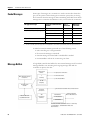
Communication Attribute
ControlLogix and
SoftLogix
CompactLogix
FlexLogix and DriveLogix
Connections
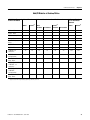
250
100
100
Cached messages(1)
32 for messages and
block-transfers combined
32 for messages and
block-transfers combined
32 for messages and
block-transfers combined
Unconnected receive buffers
3
3
3
Unconnected transmit buffers
10 (can be increased to 40)
10 (can be increased to 40)
10 (can be increased to 40)
(1)
See Chapter 7 Communicate with Other Devices for more information about messages and buffers.
The limit of connections may ultimately reside in the communication module
you use for the connection. If a message path routes through a communication
module, the connection related to the message also counts towards the
connection limit of that communication module.
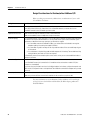
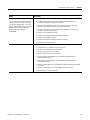
Controller
Communication Device
Supported Connections
ControlLogix
1756-CN2, 1756-CN2R
100 CIP connections
(any combination of scheduled and message connections)
1756-CNB,1756 -CNBR
64 CIP connections
depending on RPI, recommend using only 48 connections
(any combination of scheduled and message connections)
1756-EN2T, 1756-ENBT
128 CIP connections
1756-EWEB
64 TCP/IP connections
1768-ENBT
64 CIP connections
1768-EWEB
32 TCP/IP connections
1769-L32C, 1769-L35CR
32 CIP connections
depending on RPI, as many as 22 connections can
be scheduled
1768 CompactLogix
1769 CompactLogix
The remaining connections (or all 32, if you have no
scheduled connections) can be used for message
connections
1769-L32E, 1769-L35E
32 CIP connections
64 TCP/IP connections
FlexLogix
1788-CNx, 1788-CNxR
PowerFlex 700S with DriveLogix
32 CIP connections
depending on RPI, as many as 22 connections can
be scheduled
The remaining connections (or all 32, if you have no
scheduled connections) can be used for message
connections
1788-ENBT
32 CIP connections
64 TCP/IP connections
SoftLogix5800
16
1784-PCICS
128 CIP connections
127 of which can be scheduled connections
Publication 1756-RM094C-EN-P - June 2007
Logix5000 Controller Resources
Determine Total Connection
Requirements
Chapter 1
The total connections for a Logix5000 controller include both local and
remote connections. Tallying local connections is not an issue for FlexLogix or
CompactLogix controllers because both support the maximum number of
modules allowed in their systems. The ControlLogix and SoftLogix controllers
support more communication modules than the other controllers, so you must
tally local connections to make sure you stay within the 250 connection limit.
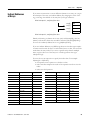
Use this table to tally local connections.
Connection Type
Device
Quantity
x
Connections
per Module
=
Local I/O module (always a direct connection)
x
1
=
Motion servo module
x
3
=
ControlNet communication module
x
0
=
EtherNet/IP communication module
x
0
=
DeviceNet communication module
x
2
=
DH+/Remote I/O communication module
x
1
=
RSLogix 5000 programming software access to controller
x
1
=
Total
Connections
Total
The communication modules you select determine how many remote
connections are available. Use this table to tally remote connections.
Connection Type
Device
Quantity
x
Connections
per Module
=
Remote ControlNet communication module
Configured as a direct (none) connection
Configured as a rack-optimized connection
x
Distributed I/O module over a ControlNet network (direct
connection)
x
Remote EtherNet/IP communication module
Configured as a direct (none) connection
Configured as a rack-optimized connection
x
Distributed I/O module over an EtherNet/IP network (direct
connection)
x
1
=
Remote device over a DeviceNet network
(accounted for in rack-optimized connection for local
DeviceNet module)
x
0
=
Other remote communication adapter
x
1
=
Produced tag and first consumer
x
1
=
Total
Connections
=
0 or
1
1
=
=
0 or
1
Each additional consumer
1
Consumed tag
x
1
=
Connected message (CIP Data Table Read/Write and DH+)
x
1
=
Block-transfer message
x
1
=
RSLinx software access for HMI or other software applications
x
4
=
RSLinx Enterprise software for HMI or other software applications
x
5
=
Total
Publication 1756-RM094C-EN-P - June 2007
17
Chapter 1
Logix5000 Controller Resources
Notes:
18
Publication 1756-RM094C-EN-P - June 2007
Chapter
2
Divide Logic into Tasks, Programs, Routines,
and Add-On Instructions
The controller operating system is a preemptive multitasking system that is
IEC 61131-3 compliant.
Introduction
Tasks to configure
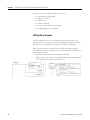
controller execution
A task provides scheduling and priority information for a set of one or more
programs. You can configure tasks as either continuous, periodic, or event.
Programs to group data
and logic
A task contains programs, each with its own routines and program-scoped
tags. Once a task is triggered (activated), all the programs assigned to the task
execute in the order in which they are listed in the Controller Organizer.
Programs are useful for projects developed by multiple programmers. During
development, the code in one program that makes use of program-scoped
tags, can be duplicated in a second program and minimize the possibility of tag
names colliding.
With firmware revision 15, tasks can contain programs and equipment phases.
Routines to encapsulate
executable code written in a
single programming language
Routines contain the executable code. Each program has a main routine that is
the first routine to execute within a program. Use logic, such as the Jump to
Subroutine (JSR) instruction, to call other routines. You can also specify an
optional program fault routine.
See Develop Application Code in Routines on page 29 for information on
selecting programming languages and how the controller prescans and
postscans logic.
Add-On Instructions to
encapsulate executable code
into user-defined instructions
19Publication 1756-RM094C-EN-P - June 2007
An Add-On Instruction is a user-created instruction that encapsulates logic.
Add-On Instructions help divide a controller project into smaller, more
manageable pieces.
19
Chapter 2
Divide Logic into Tasks, Programs, Routines, and Add-On Instructions
Decide When to Use Tasks,
Programs, and Routines
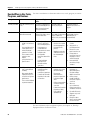
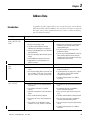
Comparison
Use these considerations to determine when to use a task, program, or routine.
Task
Program and Equipment
Phase
Quantity available Varies by controller (4, 6, 8,
or 32)
Routine
Add-On Instruction
32 program and equipment Unlimited number of
phases (combined) per task routines per program
(100 for ControlLogix and
SoftLogix controllers)
Function
Determines how and when
code will be executed
Organizes groups of
routines that need to share
a common data area
Use
•
Most code should
reside in a continuous
task
•
•
Use a periodic task for
slower processes or
when time-based
operation is critical
•
Use an event task for
operations that
require
synchronization to a
specific event
•
Configurable
execution order within
a task
•
Isolate individual
batch phases or
discrete machine
operations
•
A high number of
tasks can be difficult
to debug
•
•
May need to disable
output processing on •
some tasks to improve
performance
Data spanning
•
multiple programs
must go into
controller-scoped area •
Listed in the Controller
Organizer in the order
of execution
•
Considerations
•
Tasks can be inhibited
to prevent execution
Contains executable code
(relay ladder, function block
diagram, sequential
function chart, or structured
text)
•
Put major equipment
pieces or plant cells
into isolated programs •
Use programs to
isolate different
programmers or create •
reusable code
•
•
Unlimited number of
Add-On Instructions in a
project
Contains executable code
(relay ladder, function
block diagram, or
structured text)
Isolate machine or cell •
functions in a routine
Use the appropriate
language for the
process
Modularize code into
subroutines that can
be called multiple
times
Subroutines with
multiple calls can be
difficult to debug
Data can be
referenced from
program-scoped and
controller-scoped
areas
Standardize modules
of code
•
Very specific or
focused operations
•
Extensions to the
base instruction set
•
Encapsulate an
instruction from one
language for use in
another language
•
Instance based
monitoring of logic
and data
•
If you have a lot of
parameters or
specialized options,
consider multiple
Add-On Instructions
•
Calling a large
number of Add-On
Instructions impacts
scan time
Calling a large number
•
of routines impacts
scan time
Listed in the Controller
Organizer as Main,
•
Fault, and then
alphabetically
•
•
Must use
cross-reference or
find to locate calls to
an Add-On Instruction
Can edit offline only
Supports only some
data types.
Changes to data
values must be made
for each instance
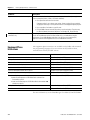
For more information about equipment phases, see Chapter 11, Develop
Equipment Phases for Batch Control.
20
Publication 1756-RM094C-EN-P - June 2007
Divide Logic into Tasks, Programs, Routines, and Add-On Instructions
Specify Task Priorities
This Logix5000 controller
Chapter 2
Each task in the controller has a priority level. A higher priority task (such as 1)
interrupts any lower priority task (such as 15). The continuous task has the
lowest priority and is always interrupted by a periodic or event task.
Supports this many user tasks
And has this many priority levels
ControlLogix
32
15
1768-L43 CompactLogix
16
15
1769-L35CR, 1769-L35E CompactLogix
8
15
1769-L32C,1769-L32E CompactLogix
6
15
1769-L31 CompactLogix
4
15
FlexLogix
8
15
PowerFlex 700S with DriveLogix
8
15
SoftLogix5800
32
3
The Logix5000 controller has these types of tasks.
Priority
Highest
User Task
Description
N/A
CPU overhead - serial port and general CPU operations
N/A
Motion planner - executed at coarse update rate
N/A
Redundancy task - communication to 1757-SRM in redundant systems
N/A
Trend data collection - high-speed collection of trend data values
Priority 1 Event/Periodic
N/A
Priority 2 Event/Periodic
N/A
Priority 3 Event/Periodic
N/A
Priority 4 Event/Periodic
N/A
Priority 5 Event/Periodic
N/A
Priority 6 Event/Periodic
1769 CompactLogix, FlexLogix, and DriveLogix controllers process I/O as a periodic
task based on the chassis RPI setting
Priority 7 Event/Periodic
N/A
Priority 8 Event/Periodic
N/A
Priority 9 Event/Periodic
N/A
Priority 10 Event/Periodic
N/A
Priority 11 Event/Periodic
N/A
Priority 12 Event/Periodic
DriveLogix communication to drives
CompactLogix and FlexLogix communication and scheduled connection
maintenance
Priority 13 Event/Periodic
N/A
Priority 14 Event/Periodic
N/A
Priority 15 Event/Periodic
N/A
Continuous
Message handler - based on system overhead timeslice
Lowest
If a periodic or event task is executing when another is triggered and both
tasks are at the same priority level, the tasks timeslice execution time in 1 ms
increments until one of the tasks completes execution.
Publication 1756-RM094C-EN-P - June 2007
21
Chapter 2
Divide Logic into Tasks, Programs, Routines, and Add-On Instructions
Manage User Tasks
You can configure these user tasks.
If you want logic to execute
Then use a
Description
All of the time
Continuous task
The continuous task runs in the background. Any CPU time not allocated to
other operations or tasks is used to execute the continuous task.
• The continuous task runs all the time. When the continuous task
completes a full scan, it restarts immediately.
• A project does not require a continuous task. If used, there can be only
one continuous task.
• At a constant period
(e.g., every 100 ms)
Periodic task
• Multiple times within the
scan of your other logic
A periodic task performs a function at a specific time interval. Whenever the
time for the periodic task expires, the periodic task:
• interrupts any lower priority tasks.
• executes one time.
• returns control to where the previous task left off.
Immediately when an event
occurs
Event task
An event task performs a function only when a specific event (trigger) occurs.
Whenever the trigger for the event task occurs, the event task:
• interrupts any lower priority tasks.
• executes one time.
• returns control to where the previous task left off.
See Configure an Event Task on page 25 for the triggers for an event task.
Some Logix5000 controllers do not support all triggers.
The user tasks you create appear in the Tasks folder of the controller. These
pre-defined system tasks do not appear in the Tasks folder and they do not
count toward the task limit of the controller:
• Motion planner
• I/O processing
• System overhead
• Output processing
22
Publication 1756-RM094C-EN-P - June 2007
Divide Logic into Tasks, Programs, Routines, and Add-On Instructions
Chapter 2
Considerations that Affect Task Execution
Consideration
Description
Motion planner
The motion planner interrupts all other tasks, regardless of their priority.
See also Optimize an Application for
Motion Control on page 99.
• The number of axes and coarse update period for the motion group affect how long
and how often the motion planner executes.
• If the motion planner is executing when a task is triggered, the task waits until the
motion planner is done.
• If the coarse update period occurs while a task is executing, the task pauses to let
the motion planner execute.
I/O processing
CompactLogix, FlexLogix, DriveLogix, and SoftLogix controllers use a dedicated periodic
task to process I/O data. This I/O task:
• for CompactLogix, FlexLogix, and DriveLogix controllers, operates at priority 6.
For SoftLogix controllers, operates at Windows priority 16 (Idle).
• higher-priority tasks take precedence over the I/O task and can impact processing.
• executes at the fastest RPI you have scheduled for the system.
• executes for as long as it takes to scan the configured I/O modules.
• for local I/O, updates also occur at the end of each task.
System overhead
See also Select a System Overhead
Percentage on page 27.
System overhead is the time that the controller spends on message communication and
background tasks.
• Message communication is any communication that you do not configure through
the I/O configuration folder of the project, such as MSG instructions.
• Message communication occurs only when a periodic or event task is not running. If
you use multiple tasks, make sure that their scan times and execution intervals
leave enough time for message communication.
• System overhead interrupts only the continuous task.
• The system overhead timeslice specifies the percentage of time (excluding the time
for periodic or event tasks) that the controller devotes to message communication.
• The controller performs message communication for up to 1 ms at a time and then
resumes the continuous task.
• Adjust the update rates of the tasks as needed to get the best trade-off between
executing your logic and servicing message communication.
• Unused time allocated to system overhead is used to increase the scan rate of the
continuous task, which can lead to scan time variability. To reduce this variability,
reserve the time for communication via controller property settings.
Output processing
At the end of a task, the controller performs output processing for the output modules in
your system. This output processing may effect the update of the I/O modules in your
system.
Too many tasks
If you have too many tasks, then:
• the continuous task may take too long to complete.
• other tasks may experience overlaps. If a task is interrupted too frequently or too
long, it may not complete its execution before it is triggered again.
• controller communication might be slower.
• if your application is designed for data collection, try to avoid multiple tasks.
Switching between multiple tasks limits communication bandwidth.
Publication 1756-RM094C-EN-P - June 2007
23
Chapter 2
Divide Logic into Tasks, Programs, Routines, and Add-On Instructions
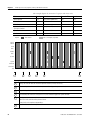
This example depicts the execution of a project with these tasks.
Task
Priority
Period
Execution Time
Duration
Motion planner
N/A
8 ms (course update rate)
1 ms
1 ms
Event task 1
1
N/A
1 ms
1...2 ms
Periodic task 1
2
12 ms
2 ms
2...4 ms
I/O task—N/A to ControlLogix and
SoftLogix controllers
7
5 ms (fastest RPI)
1 ms
1...5 ms
System overhead
N/A
Timeslice = 20%
1 ms
1...6 ms
Continuous task
N/A
N/A
20 ms
48 ms
Legend:
Task executes.
Task is interrupted (suspended).
Motion
Planner
Event
Task 1
Periodic
Task 1
I/O Task
System
Overhead
Continuous
Task
5
1
10
2
15
3
20
4
25
30
35
40
45
5
50
6
Description
1
Initially, the controller executes the motion planner and the I/O task (if one exists).
2
After executing the continuous task for 4 ms, the controller triggers the system overhead.
3
The period for periodic task 1 expires (12 ms), so the task interrupts the continuous task.
4
After executing the continuous task again for 4 ms, the controller triggers the system overhead.
5
The triggers occur for event task 1.
Event task 1 waits until the motion planner is done.
Lower priority tasks experience longer delays.
6
24
The continuous task automatically restarts.
Publication 1756-RM094C-EN-P - June 2007
Divide Logic into Tasks, Programs, Routines, and Add-On Instructions
Configure a
Continuous Task
Chapter 2
The continuous task is created automatically when you open an RSLogix 5000
project. A continuous task is similar to how logic executes on PLC-5 and SLC
500 processors. A Logix5000 controller supports one continuous task, but a
continuous task is not required. You can configure whether the task updates
output modules at the end of the continuous task. You can change the
continuous task to either a periodic or event task.
The CPU timeslices between the continuous task and system overhead. Each
task switch between user task and system overhead takes additional CPU time
to load and restore task information.
RSLogix 5000 software, version 16, forces at least 1 ms of execution time for
the continuous task, regardless of the system overhead timeslice. This more
efficiently uses system resources because allowing shorter execution times of
the continuous task means switching tasks more frequently.
Configure a Periodic Task
A periodic task executes automatically based on a preconfigured interval. This
task is similar to selectable timed interrupts in PLC-5 and SLC 500 processors.
You can configure whether the task updates output modules at the end of the
periodic task. After the task executes, it does not execute again until the
configured time interval has elapsed.
If your application has a lot of communication (such as message instructions
or RSLinx communication), use a periodic task rather than a continuous task.
This avoids the overhead associated with task switching, which can improve
performance.
Configure an Event Task
An event task executes automatically based on a trigger event occurring or if a
trigger event does not occur in a specific time interval. You configure whether
the task updates output modules at the end of the task. After the task executes,
it does not execute again until the event occurs again. Each event task requires
a specific trigger.
Trigger
Description
Module Input Data State Change
The input module (digital or analog) triggers the event task based on the change of state
(COS) configuration for the module. Enable COS for only one point on the module. If you
enable COS for multiple points, a task overlap of the event task may occur.
The ControlLogix sequence of events modules (1756-IB16ISOE, 1756-IH16ISOE) use the
Enable CST Capture feature instead of COS.
Consumed Tag
Only one consumed tag can trigger a specific event task. Use an IOT instruction in the
producing controller to signal the production of new data.
Axis Registration 1 or 2
A registration input triggers the event task.
Axis Watch
A watch position triggers the event task.
Motion Group Execution
The coarse update period for the motion group triggers the execution of both the motion
planner and the event task. Because the motion planner interrupts all other tasks, it
executes first.
EVENT Instruction
Multiple EVENT instructions can trigger the same task.
Publication 1756-RM094C-EN-P - June 2007
25
Chapter 2
Divide Logic into Tasks, Programs, Routines, and Add-On Instructions
For more information on event tasks, see:
• Logix5000 Controllers Common Procedures Programming Manual,
publication 1756-PM001.
• Using Event Tasks with Logix5000 Controllers, LOGIX-WP003.
Guidelines to Configure an Event Task
Guideline
Description
Place the I/O module being used to trigger
an event in the same chassis as the
controller.
Placing the I/O module in a remote chassis adds additional network communication and
processing to the response time.
Limit events on digital inputs to a single
input bit on a module.
All inputs on a module trigger a single event, so using multiple bits increases the chance of
a task overlap. Configure the module to detect change-of-state on the trigger input and turn
off the other bits.
Set the priority of the event task as the
highest priority on the controller.
If the priority of the event task is lower than a periodic task, the event task will have to wait
for the periodic task to complete execution
Limit the number of event tasks.
Increasing the number of event tasks reduces the available CPU bandwidth and increases
the chances of task overlap.
Additional Considerations for Event Tasks
Consideration
Description
Amount of code in the event task
Each logic element (for example, rung, instruction, or structured text construct) adds to
scan time.
Task priority
If the event task is not the highest priority task, a higher priority task may delay or
interrupt the execution of the event task.
CPS and UID instructions
If one of these instructions are active, the event task cannot interrupt the currently
executing task. (The task with the CPS or UID.)
Communication interrupts
Serial port communication interrupts a task, regardless of the priority of the task.
Motion planner
The motion planner takes precedence over an event task.
Trends
Trend data collection takes precedence over an event task.
Output processing
You can disable output processing at the end of a task to reduce the amount of task
processing time. With RSLogix 5000 software, version 16, the Controller Organizer
displays whether outputs processing is disabled.
26
Publication 1756-RM094C-EN-P - June 2007
Divide Logic into Tasks, Programs, Routines, and Add-On Instructions
Select a System Overhead
Percentage
Chapter 2
The system overhead timeslice specifies the percentage of continuous task
execution time that is devoted to communication and background redundancy
functions. System overhead functions include the following:
• Communicating with programming and HMI devices (such as
RSLogix 5000 software)
• Responding to messages
• Sending messages
• Serial port message and instruction processing
The controller performs system overhead functions for up to 1 ms at a time. If
the controller completes the overhead functions in less than 1 ms, it resumes
the continuous task. The following chart compares a continuous and periodic
task.
Continuous Task Restarts
Continuous Task
10% CPU Overhead
Continuous Task
25% CPU Overhead
Periodic Task
CPU Overhead
Periodic Task Restarts
Example
Description
Continuous task
10% CPU overhead
In the top example, the system overhead timeslice is set to 10%. Given 40 ms of code to
execute, the continuous task completes the execution in 44 ms. During a 60 ms timespan,
the controller is able to spend 5 ms on communication processing.
Continuous task
25% CPU overhead
By increasing the system overhead timeslice to 25%, the controller completes the
continuous task scan in 57 ms and spends 15 ms of a 60 ms timespan on communication
processing.
Periodic task
Placing the same code in a periodic task yields even more time for communication
processing. The bottom example assumes the code is in a 60 ms periodic task. The code
executes to completion and then goes dormant until the 60 ms, time-based trigger occurs.
While the task is dormant, all CPU bandwidth can focus on communication. Since the code
takes only 40 ms to execute, the controller can spend 20 ms on communication processing.
Depending on the amount of communication to process during this 20 ms window, it can be
delayed as it waits for other modules in the system to process all the data that was
communicated.
The Logix5000 CPU timeslices between the continuous task and system
overhead. Each task switch between user task and system overhead takes
additional CPU time to load and restore task information. You can calculate
the continuous task interval as:
ContinuousTime=(100/SystemOverheadTimeSlice%) - 1
Publication 1756-RM094C-EN-P - June 2007
27
Chapter 2
Divide Logic into Tasks, Programs, Routines, and Add-On Instructions
Manage the System
Overhead Timeslice
Percentage
As the system overhead timeslice percentage increases, time allocated to
executing the continuous task decreases. If there are no communication for the
controller to manage, the controller uses the communication time to execute
the continuous task.
Consideration
Description
Impact on communication and scan time
Increasing the system overhead timeslice percentage decreases execution time for the
continuous task while it increases communication performance.
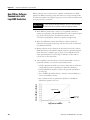
Tags Per
Second
Program Scan
Time
Tags per Second
Program Scan Time in Milliseconds
Increasing the system overhead timeslice percentage also increases the amount of time it
takes to execute a continuous task - increasing overall scan time.
System Timeslice %
Unused portion of system overhead
timeslice
With RSLogix 5000 software, version 16, you can configure any unused portion of the
system overhead timeslice to:
• run the continuous task, which results in faster execution of application code and
increases the variability of the program scan.
• process communication, which results in more predictable and deterministic scan
time for the continuous task.
Individual applications may differ, but the overall impact on communication
and scan time remains the same. The above data is based on a
ControlLogix5555 controller running a continuous task with 5000 tags (no
arrays or user-defined structures).
28
Publication 1756-RM094C-EN-P - June 2007
Divide Logic into Tasks, Programs, Routines, and Add-On Instructions
Develop Application Code
in Routines
Chapter 2
Each routine contains logic in one programming language. Choose a
programming language based on the application.
In general, if a section of your code represents
Then use this language
Continuous or parallel execution of multiple operations (not sequenced)
Relay ladder logic (LD)
Boolean or bit-based operations
Complex logical operations
Message and communication processing
Machine interlocking
Operations that service or maintenance personnel may have to interpret in order
to troubleshoot the machine or process.
Servo motion control
Continuous process and drive control
Function block diagram (FBD)
Loop control
Calculations in circuit flow
High-level management of multiple operations
Sequential function chart (SFC)
Repetitive sequences of operations
Batch process
Motion control sequencing (via sequential function chart with embedded
structure text)
State machine operations
Complex mathematical operations
Structured text (ST)
Specialized array or table loop processing
ASCII string handling or protocol processing
Publication 1756-RM094C-EN-P - June 2007
29
Chapter 2
Divide Logic into Tasks, Programs, Routines, and Add-On Instructions
Comparison of Programming Languages
Comparison
Instruction
categories
Relay Ladder Logic
Function Block Diagram
• Boolean
• General and trig
math
• General and trig
math
• Timers and counters
• Timers and counters
• Bitwise logical
• Array management
• Advanced process
• Diagnostic
• Advanced drive
• Serial port and
messaging
Sequential Function
Chart
• Step/action with
embedded
structured text
• General and trig
math
• Transition with
structure text
comparisons
• Bitwise logical
• Simultaneous and
selection branches
• Stop element
• ASCII manipulation
Structured Text
• Timers and counters
• Array management
• Diagnostic
• Serial port and
messaging
• ASCII manipulation
• Specialty CPU
control
• Specialty CPU
control
• Motion control
• Motion control
• Advanced process
• Advanced drive
Editor style
• Graphical rungs
• Unlimited rungs
Monitoring
• Rung animation
• Data value
animation
• Graphical, free-form
drawing
• Graphical, free-form
drawing
• Unlimited sheets
• Unlimited grid
space
• Output and input
pin data value
animation
• Active steps
animation
• Force status
Comments
30
• Auto display scroll
• Textual
• Unlimited lines
• Tag watch pane
• Context coloring
• Branch/transition
force status
• Tag
• Tag
• Tag
• Multi-line
• Rung
• Text box
• Text box
• End if line
• Embedded
structured text
comments stored in
CPU
• Comments stored in
CPU
Publication 1756-RM094C-EN-P - June 2007
Divide Logic into Tasks, Programs, Routines, and Add-On Instructions
Chapter 2
Guidelines to Pass Parameters to/from Subroutines
Guideline
Description
Input and Return parameters depend on the
subroutine logic.
If the subroutine needs to know the previous state of any Return parameters (the values are
used elsewhere in the project), these values should also be Input parameters:
• If the subroutine contains latch/unlatch logic (holding circuits), intended outputs of
the subroutine should be passed into and returned from the subroutine.
• If the subroutine does not contain latch/unlatch logic, intended outputs of the
subroutine only need to be returned from the subroutine.
Pass complete timers in and out of
subroutines.
If a subroutine needs a timer, pass the complete timer tag to the subroutine as an input and
return the complete timer tag as an output. Store the timer in a buffer tag outside of the
subroutine.
Guidelines for User-defined Add-On Instructions
A user-defined Add-On Instruction is a user-created instruction that
encapsulates code and local data.
Guideline
Description
Use Add-On Instructions to create
standardized modules of code for reuse
across a project.
Use Add-On Instructions to:
• encapsulate specific or focused operations, such as a Motor or Valve action. A
Conveyor or Tank action is better managed as a routine.
• create extensions to the base controller instructions. For example, create an Add-On
Instruction to execute an SLC 500 or PLC controller instruction not available in the
Logix5000 controllers.
• encapsulate an instruction from one language for use in another language. For
example, create a function block PIDE instruction for use in relay ladder.
Create Add-On Instructions in relay ladder,
function block diagram, or structured text
languages.
Supports all Add-On Instructions and most built-in instructions. Excludes JSR/SBR/RET,
JXR, FOR/BRK (relay ladder), SFR, SFP, SAR, IOT and EVENT) instructions.
GSV/SSV instructions in an Add-On Instruction cannot reference the Module, Message,
Axis, Motion Group, or Coordinate System class names.
Add-On Instructions support function block, relay ladder, and structured text programming
languages. Each of the Add-On Instruction logic areas can be any language. For example,
the main logic can be function block and the prescan logic can be relay ladder.
You can nest Add-On Instructions seven levels deep.
Publication 1756-RM094C-EN-P - June 2007
31
Chapter 2
Divide Logic into Tasks, Programs, Routines, and Add-On Instructions
Guideline
An Add-On Instruction supports parameters:
• Input (copied in)
• Output (copied out)
• InOut (passed by reference)
Description
• Limited to 512 total: Input parameter + Output parameter + local tags (no limit on the
number of InOut parameters)
• 2 MB maximum data instance (parameters and locals)
• Alarm, axis, axis group, coordinate system, message, motion group, and
produced/consumed tags must exist at the program or controller scope and passed
as an InOut parameter
• Can include references to controller-scoped tags, program-scoped tags, and
immediate values.
• Input and Output parameters are limited to atomic (BOOL, SINT, INT, DINT, REAL)
data types. Use the InOut parameter for LINT, user-defined, and structure data types.
• DINT data types provide optimal execution.
• Default values of parameters and local tags are used to initialize the data structure
when a tag is created of the instruction’s data type. When an existing parameter or
local tag's default value is modified, the existing tag instances for that instruction
are not updated. When a parameter or local tag is added to the instruction
definition, the tag's default value is used in the existing tags.
Create and modify offline only.
Online operation supports monitoring.
Modifications to Add-On Instructions are made offline. Make changes once to the Add-On
Instruction definition to affect all instances.
An Add-On Instruction executes like a
routine.
A task with a higher execution priority can interrupt an Add-On Instruction. Use a UID/UIE
instruction pair to block a task switch to check that an Add-On Instruction completes
execution before switching to another task.
The code within an Add-On Instruction can
access data specified only via parameters
or defined as local.
Copy the local data to a parameter if you want to programmatically access it outside of an
Add-On Instruction.
Use optional Scan mode logic to setup,
initialize, or reset the Add-On Instruction
code.
An Add-On Instruction can have logic in addition to the main logic for the instruction.
• Prescan logic executes on controller startup.
• Postscan logic executes on SFC Automatic reset.
• EnableInFalse logic executes when rung condition is false.
32
Publication 1756-RM094C-EN-P - June 2007
Divide Logic into Tasks, Programs, Routines, and Add-On Instructions
Chapter 2
Comparison of Subroutines and Add-On Instructions
Comparison
Subroutine
Add-On Instructions
Accessibility
Within program (multiple copies)
Anywhere in controller (single copy)
Parameters
Pass by value
Pass by value or reference via InOut
Numeric parameters
No conversion, user must manage
Automatic data type conversion for Input and Output
parameters
InOut parameters must match declared type exactly
Parameters data types
Atomic, arrays, structures
• Atomic data types as In or Out parameters
• LINT, user-defined, and structure data types
as InOut parameters
Parameter checking
None, user must manage
Data encapsulation
All data at program or controller scope (accessible to Local data is isolated (only accessible within
anything)
instruction)
Monitor/debug
Logic animated with mixed data from multiple calls
Logic animated with data from a single calling
instance
Supported programming
languages
FBD, LD, SFC, ST
FBD, LD, ST
Callable from
FBD, LD, SFC, ST
FBD, LD, SFC, ST
Protection
Locked and View Only
Locked and View Only
Documentation
Routine, rung, textbox, line
Instruction description, revision information, vendor,
rung, textbox, line, extended help
Execution performance
Memory use
Verification checks
• JSR/SBR/RTN add overhead
• Call is more efficient
• All data is copied
• InOut passed by reference
Very compact
• Call requires more memory
• All references need additional memory
Edit
Both code and data can be modified offline and
online in a running controller
Code modifications limited to offline in the project
file and require a new download
Data values associated can be modified online and
offline
Import/export
All routines are imported/exported in the full project
.L5K file (protected routines may be excluded or
encrypted)
All Add-On Instructions are imported/exported in the
full project .L5K file (protected instructions may be
excluded or encrypted)
Individual LD rungs and references and tags/UDTs
can be imported/exported via the .L5X file
Individual Add-On Instruction definitions and code
are imported/exported via the .L5X file
Publication 1756-RM094C-EN-P - June 2007
33
Chapter 2
Divide Logic into Tasks, Programs, Routines, and Add-On Instructions
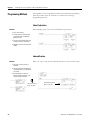
The capabilities of the Logix5000 controllers make different programming
methods possible. There are tradeoffs to consider when selecting a
programming method.
Programming Methods
Inline Duplication
Write multiple copies of the code with different tag references.
Benefits
• Uses more memory
• Fastest execution time because
all tag references are defined
before run time
• Easiest to maintain because rung
animation matches tag values
• Requires more time to create and
modify
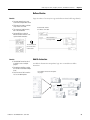
Indexed Routine
Write one copy of code and use indexed references to data stored in arrays.
Benefits
• One copy of code is faster to
develop
• Slowest execution time because
all tag references are calculated
at run time
• Can be difficult to maintain
because the data monitor is not
synchronized to execution
The JSR instruction
passes the index.
34
Each indexed reference
adds to scan time.
Publication 1756-RM094C-EN-P - June 2007
Divide Logic into Tasks, Programs, Routines, and Add-On Instructions
Chapter 2
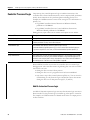
Buffered Routine
Copy the values of an array into tags and reference these buffer tags directly.
Benefits
• One copy operation can occur
faster than multiple index offsets
• Eliminates the need to calculate
array offsets at run time
A user-defined structure
consolidates control data.
• The amount of code increases,
but so do the benefits
• Can be difficult to maintain
because the data monitor is not
synchronized to execution
Direct reference to a
local copy of data.
The JSR instruction
passes all control
instance data.
Benefits
• User-defined instruction that is
re-usable in one or multiple
projects
• Encapsulate code like a routine
that can be instantiated multiple
times
• Each instance of the instruction
has its own backing data
Publication 1756-RM094C-EN-P - June 2007
Add-On Instruction
An Add-On Instruction encapsulates logic into a reusable user-define
instruction.
Reuse Add-On Instructions throughout
the project.
35
Chapter 2
Divide Logic into Tasks, Programs, Routines, and Add-On Instructions
Controller Prescan of Logic
On power-up, the controller prescans logic to initialize instructions. The
controller resets all state-based instructions, such as outputs (OTE) and timers
(TON). Some instructions also perform operations during prescan. For
example, the ONSR instructions turns off the storage bit. For information on
prescan, see:
• Logix5000 Controllers General Instructions Reference Manual,
publication 1756-RM003.
• Logix5000 Controllers Process Control and Drives Instructions
Reference Manual, publication 1756-RM006.
During prescan, input values are not current and outputs are not written.
Prescan Affects
Description
Relay ladder logic
The controller resets non-retentive I/O and internal values.
Function block diagram logic
In addition to resetting non-retentive I/O and internal values, the controller clears the
EnableIn parameter for every function block diagram.
Structured text logic
The controller resets bit tags and forces numeric tags to zero (0).
Use the bracketed assignment operator ([:=]) to force a value to be reset during prescan.
If you want a tag left in its last state, use the non-bracketed assignment operator (:=).
Sequential function chart logic
Embedded structured text follows the same rules as listed above.
Array indexed values
Array index values can fault the controller during prescan. If an array index value is larger
than the dimension of the array, the controller will detect a major fault during prescan. To
avoid this, make sure the index is always set properly or use a fault routine to handle this
error during prescan. See Prescan of an Array Index on page 46.
Prescan differs from first scan in that the controller does not execute logic
during prescan. The controller executes logic during first scan. The controller
sets S:FS for one scan:
• during the first scan that follows prescan.
• during the first scan of a program when it has been uninhibited.
• each time a step is first scanned (when step.FS is set). You can view the
S:FS bit being set only from the logic contained in actions that execute
during the first scan of their parent step (N, L, P, and P1).
Add-On Instruction Prescan Logic
An Add-On Instruction prescan logic executes after the main logic executes in
Prescan mode. Use the prescan logic to initialize tag values prior to execution.
For example, set a PID instruction to Manual mode with a 0% output prior to
its first execution.
36
Publication 1756-RM094C-EN-P - June 2007
Divide Logic into Tasks, Programs, Routines, and Add-On Instructions
Chapter 2
When an Add-On Instruction executes in Prescan mode, any required
parameters have their data passed.
• Values are passed to Input parameters from their arguments in the
instruction call.
• Values are passed out of Output parameters to their arguments defined
in the instruction call.
Controller Postscan of
SFC Logic
SFCs support an automatic reset option that performs a postscan of the
actions associated with a step once a transition indicates that the step is
completed. Also, every Jump to Subroutine (JSR) instruction causes the
controller to postscan the called routine. During this postscan:
• output energize (OTE) instructions are turned off and non-retentive
timers are reset.
• in structured text code, use the bracketed assignment operator ([:=]) to
have tags reset.
• in structured text code, use the non-bracketed assignment operator (:=)
to have tags left in their last state.
Add-On Instruction Postscan Logic
When an Add-On Instruction is called by logic in an SFC Action and the
Automatic Reset option is set, the Add-On Instruction executes in Postscan
mode. An Add-On Instruction postscan routine executes after the main logic
executes in Postscan mode. Use the postscan logic to reset internal states and
status values or to disable instruction outputs when the SFC action completes.
Timer Execution
Timers in the PLC, SLC, and Logix5000 controllers all store off a portion of
the real-time clock each time they are scanned. The next time through, they
compare this stored value against the current clock and then adjust the ACC
value by the difference.
PLC/SLC Controller
Logix5000 Controller
In a PLC/SLC controller, the timers stores 8 bits at 10 ms/bit. This
allows 2.56 seconds (2**8 / 100) of padding before a timer
overlaps.
A Logix5000 controller uses native 32-bit data, so there is more
space to store the time. The timer stores 22 bits at 1 ms/bit, which
equates to 69.905 minutes (2**22 / 1000 ms per second / 60
seconds per minute).
If program execution skips timers, it appears as if the timers pause.
Actually, the timers are overrunning themselves. Depending on
when the timer logic next executes, the lost time varies between 0
and 2.56 seconds.
Publication 1756-RM094C-EN-P - June 2007
If program execution skips timers, it takes longer than in PLC/SLC
controllers to overrun the timers. This results in a larger jump in
lapsed time when the timer code next executes.
37
Chapter 2
Divide Logic into Tasks, Programs, Routines, and Add-On Instructions
Program execution can skip executing timers due to:
• a subroutine not being called.
• jumping over code.
• an SFC action.
• an inactive SFC step.
• an event or periodic task not executing.
• an equipment phase state routines.
SFC Step Timer Execution
An SFC step timer stores the clock time each time the step executes. On
subsequent scans of the step, the controller compares the current clock time
with the last scan and updates the step timer’s ACC by the difference.
When you pause an SFC and then release the SFC, the step timer jumps
forward by the duration of the pause. If you want a step timer to remain at its
position during a pause:
• latch a recovery bit when the chart pause is released.
• add an action to the step to store the step timer’s .ACC value and restore
that value when the pause recovery bit is set.
38
Publication 1756-RM094C-EN-P - June 2007
Divide Logic into Tasks, Programs, Routines, and Add-On Instructions
Edit an SFC Online
Chapter 2
Firmware revision 13 adds support for editing SFCs online. When you edit an
SFC online, the software initially makes the changes in the offline project.
When you accept the changes, they are downloaded to the controller. If you
transition the controller to test or un-test edits, the controller resets the SFC
and starts execution at the initial step. If you edit an SFC online:
• plan when you test or untest edits to coincide with the SFC executing
the initial step.
• place structured text logic in subroutines to minimize the impact of
online edits.
• use an SFR instruction to programmatically shift SFC execution to the
desired step.
In some cases, this can result in the SFC being out of sync with the equipment.
Program logic in the initial step to check the last state and use an SFR
instruction to change to the appropriate step, if needed. One method is to set
an index number in an action of each step. Then when the restart occurs, use
the SFR instruction to jump to appropriate step based on the index value.
Publication 1756-RM094C-EN-P - June 2007
39
Chapter 2
Divide Logic into Tasks, Programs, Routines, and Add-On Instructions
Notes:
40
Publication 1756-RM094C-EN-P - June 2007
Chapter
3
Address Data
Logix5000 controllers support IEC 61131-3 atomic data types, such as BOOL,
SINT, INT, DINT, LINT, and REAL. The controllers also support compound
data types, such as arrays, predefined structures (such as counters and timers)
and user-defined structures.
Introduction
Data Type
Description
Atomic data type
Benefit
(BOOL, SINT, INT, DINT,
REAL)
• Individual names
• Each tag uses 32 bits of memory
• No limit to the number of tags
• Require more communication overhead and,
potentially, more controller memory than
compound data types
• Tag Editor and Data Monitor can filter
individual tags and display any references
• Always listed alphabetically in the Tag Editor
and Data Monitor
• Full alias tag support (both the base tag and
its bits)
• Can be added when programming online
• Supported as In or Out parameter in an
Add-On Instruction
Special-use atomic data
type
(LINT)
Consideration
Benefit
• Can only change a tag’s data type when
programming offline
• The root tag is listed alphabetically in the Tag
Editor and Data Monitor, but the structure
members are listed in the order in which they
were defined in the structure
Consideration
• 64-bit integer value to store date and time
values
• Limited instruction support: GSV, SSV, ALMD,
ALMA, COP, and CPS
• Data monitor display radix for Date and Time
lets you display a LINT value as year, month,
day, hours, minutes, seconds, microseconds
• For math operations or comparisons, copy the
LINT value into a pair of DINTs and then
manipulate through code
• Limited to InOut parameter in an Add-On
Instruction
Compound data type
(array, structure)
Benefit
Consideration
• Allow for specific names and user-defined
organization
• 2 MB data limit per user-defined structure or
array
• Consolidates information in controller
memory
• User-defined structures are padded to
enforce 32-bit data alignment
• Optimizes communication time and memory
impact
• Alias tags cannot point to the root tag of an
array
• Arrays can be dynamically indexed
• Tag Editor and Data Monitor filtering limited
• Can create new arrays when programming
online
• Can only create or change a user-defined
structure when programming offline
• Alias support for user-defined structures,
members of an array, and bits of a member
• Can only change an array when programming
offline
• Limited to InOut parameter in an Add-On
Instruction
41Publication 1756-RM094C-EN-P - June 2007
41
Chapter 3
Address Data
The Logix CPU reads and manipulates 32-bit data values. All data starts at
32-bit offsets, so the minimum memory allocation for a tag is 4 bytes. When
you create a standalone tag that stores data that is less than 4 bytes, the
controller allocates 4 bytes, but the data only fills the part it needs.
Data Type
Byte 3
Byte 2
Byte 1
Byte 0
31...0
31...0
31...0
31
BOOL
Not used
Not used
Not used
Not used
SINT
Not used
Not used
Not used
Not used
INT
Not used
Not used
Not used
Not used
DINT
Not used
Not used
Not used
-2,147,483,648...2,147,483,647
REAL
Not used
Not used
Not used
-3.40282347E38...-1.17549435E-38 (negative values)
16 15
8 7
1
0
0 or 1
-128...127
-32,768...32,767
0
1.17549435E-38...3.40282347E38 (positive values)
LINT
Valid Date/Time range is from 1/1/1970 12:00:00 AM coordinated universal time (UTC)
to 1/1/3000 12:00:00 AM UTC
To manipulate SINT or INT data, the controller converts the values to DINT
values, performs the programmed manipulation, and then returns the result to
a SINT or INT value. This requires additional memory and execution time
when compared to using DINT values for the same operation.
Guidelines for Data Types
Guideline
Description
Use DINT data types whenever possible
The Logix5000 controllers perform DINT (32 bit) and REAL (32 bit) math operations. DINT
data types use less memory and execute faster than other data types. Use:
• DINT for most numeric values and array indexes.
• REAL for manipulating floating-point, analog values.
• SINT (8 bit) and INT (16 bit) primarily in user-defined structures or when
communicating with an external device that does not support DINT values.
SINT
INT
DINT
REAL
Memory reserved for a standalone tag
4 bytes
4 bytes
4 bytes
4 bytes
Memory reserved for data in a user-defined structure
1 byte
(8-bit aligned)
2 bytes
(16-bit aligned)
4 bytes
(32-bit aligned)
4 bytes
(32-bit aligned)
Memory used to access a tag in an ADD instruction
236 bytes
260 bytes
28 bytes
44 bytes
Execution time on a 1756-L63 controller required to
perform an ADD instruction
3.31 μs
3.49 μs
0.26 μs
1.45 μs
Group BOOL values into arrays
42
When using BOOL values, group them into DINT arrays to best use controller memory and to
make the bits accessible via FBC or DDT instructions.
Publication 1756-RM094C-EN-P - June 2007
Address Data
Chapter 3
An array allocates a contiguous block of memory to store a specific data type
as a table of values.
• Tags support arrays in one, two, or three dimensions.
• User-defined structures can contain a single-dimension array as a
member of the structure.
Arrays
This array
Stores data like
For Example
One dimension
Tag name
Type
Dimension 0
Dimension 1
Dimension 2
one_d_array
DINT[7]
7
--
--
Total number of elements = 7
Valid subscript range DINT[x] where x=0...6
Two dimension
Tag name
Type
Dimension 0
Dimension 1
Dimension 2
two_d_array
DINT[4,5]
4
5
--
Total number of elements = 4 ∗ 5 = 20
Valid subscript range DINT[x,y] where x=0...3; y=0...4
Three dimension
Tag name
Type
Dimension 0
three_d_array
DINT[2,3,4] 2
Dimension 1
Dimension 2
3
4
Total number of elements = 2 ∗ 3 ∗ 4 = 24
Valid subscript range DINT[x,y,z] where x=0...1; y=0...2, z=0...3
The data type you select for an array determines how the contiguous block of
memory gets used.
BOOL[96] = 12 bytes
BOOL arrays use 32-bit
increments of memory
SINT[10] = 12 bytes of memory (2 bytes unused)
SINT arrays are padded to
use any left over bytes
INT[5] = 12 bytes of memory (2 bytes unused)
INT arrays are padded to
use any left over bytes
DINT[3] = 12 bytes and REAL[3] = 12 bytes
DINT and REAL arrays use
4-byte increments of
memory
Publication 1756-RM094C-EN-P - June 2007
43
Chapter 3
Address Data
Guidelines for Arrays
Guideline
Description
You can create arrays of most data types,
except for ALARM, AXIS,
COORDINATE_SYSTEM, MOTION_GROUP,
and MESSAGE data types.
A subscript identifies an individual element within the array. A subscript starts at 0 and
extends to the number of elements minus 1 (zero based).
• Single-dimension arrays take less memory and execute faster than two-dimension
or three-dimension arrays.
• Direct references to array elements execute faster than indexed references.
• An array can be as large as 2 MB.
• If you create an array of structures, the memory for each element is allocated based
on the structure definition.
Type of Array
Single (1) dimension
Benefit
• Better support by native file
instructions
• Fully supported in user-defined
structures and arrays
• Smallest impact (execution time and
memory) for indexed references
• Can create new arrays when
programming online
Double (2) dimension
and
Triple (3) dimension
Considerations
• Multiple arrays cannot be indirectly
referenced like in PLC or SLC
processors (such as, N[N7:0]:5)
• BOOL arrays not directly supported
by file instructions
• Can be changed only when
programming offline
• Can provide a more accurate data
representation for a physical system
• Larger impact (execution time and
memory) for indexed references
• Can emulate PLC file/word
indirection with a two-dimension
array
• File manipulation requires extra code
in addition to file instructions
• Can create new arrays when
programming online
• Can only be changed when
programming offline
Nest arrays.
The file instructions offer limited support for arrays. To work with array data, create a
user-defined structure with one array as a member of the structure. Then create an array tag
by using the user-defined structure as its data type.
Select the data type of the array based on
the data, as well as the instructions that
manipulate that data.
While SINT and INT arrays can compact more values into a given memory area, they require
additional memory and execution time for each instruction that references the array.
Limit arrays to 2 MB of data.
The maximum array size is 2 MB. The software displays a warning if you try to create an
array that is too large. The software also displays a warning if an array is 1.5...2 MB in size,
even though these sizes are valid.
Edit arrays online and offline.
You can create new arrays when online or offline. However, you can modify only the size or
data type of an existing array when offline.
44
Publication 1756-RM094C-EN-P - June 2007
Address Data
Indirect Addresses
of Arrays
Chapter 3
If you want an instruction to access different elements in an array, use a tag in
the subscript of the array (an indirect address). By changing the value of the
tag, you change the element of the array that your logic references.
When index equals 1, array[index] points here.
array[0]
4500
array[1]
6000
array[2]
3000
array[3]
2500
When index equals 2, array[index] points here.
Directly referencing an element in an array (such as MyArray[20]), uses less
memory and executes faster than an indirect reference (MyArray[MyIndex]).
You can also indirectly address bits in a tag (MyDint.[Index]).
If you use indirect addresses, use DINT tags because other data types require
conversion and execute slower. For each indexed access to data, the controller
recalculates the array index. If you access a specific array element multiple
times, copy the data out of the array into a fixed tag and use that tag in
subsequent logic.
You can also use an expression to specify the index value. For example:
MyArray[10 + MyIndex].
• An expression uses operators to calculate a value.
• The controller computes the result of the expression and uses it as the
index.
• These are valid operators.
Operator
Description
Optimal
Operator
Description
Optimal
+
Add
DINT, REAL
LN
Natural log
REAL
-
Subtract/negate
DINT, REAL
LOG
Log base 10
REAL
*
Multiply
DINT, REAL
MOD
Modulo divide
DINT, REAL
/
Divide
DINT, REAL
NOT
Bitwise complement
DINT
**
Exponent (x to y)
DINT, REAL
OR
Bitwise OR
DINT
ABS
Absolute value
DINT, REAL
RAD
Degrees to radians
DINT, REAL
ACS
Arc cosine
REAL
SIN
Sine
REAL
AND
Bitwise AND
DINT
SQR
Square root
DINT, REAL
ASN
Arc sine
REAL
TAN
Tangent
REAL
ATN
Arc tangent
REAL
TOD
Integer to BCD
DINT
COS
Cosine
REAL
TRN
Truncate
DINT, REAL
DEG
Radians to degrees
DINT, REAL
XOR
Bitwise exclusive OR
DINT
FRD
BCD to integer
DINT
Publication 1756-RM094C-EN-P - June 2007
45
Chapter 3
Address Data
Guidelines for Array Indexes
Guideline
Description
Use the SIZE instruction to determine the
number of elements in an array.
By determining the number of elements in an array at run time, you can write reusable code
that adjusts itself to meet each instance where it is used.
The SIZE instruction returns the number of elements. Arrays are zero-based, so subtract 1
from the result to determine the last element position.
Use immediate values to reference array
elements.
Immediate value references to array elements are quicker to process and execute faster
than indexed references.
Use DINT tags for array indexes.
DINT tags execute the fastest. SINT, INT, and REAL tags require conversion code that can
add additional scan time to an operation.
Avoid using array elements as indexes.
The Logix5000 controller does not directly support the use of an array element as the index
to look up a value in another array. To work around this, you can create an alias to the
element and then use this as the index. Or copy the element to a base tag and use that base
tag as the index.
Prescan of an Array Index
During prescan, the controller resets state based on instructions such as
outputs and timers. If you use calculated array indexes based on program
execution, an Indexed address out of range error occurs because the program
has not executed and the index was not initialized. Use a fault handler routine.
• Place an unconditional rung with an OTE instruction referencing an
internal bit in the first program of the first task. During prescan, the
prescan bit will be turned off. During normal scan, the prescan bit will
be on at all times.
• Indexed address out of range error occurs and the prescan bit is off,
reset the error and continue.
See the Logix5000 Controllers Common Procedures Programming Manual,
publication 1756-PM001, for information and sample code to handle faults.
IMPORTANT
46
This prescan condition no longer exists in controllers with firmware
revision 13 and later. You do not need to program a fault handler
routine to handle indexed address out-of-range errors.
Publication 1756-RM094C-EN-P - June 2007
Address Data
Chapter 3
Guidelines for User-defined Structures
Guideline
Description
Group members of the same data type
within a structure.
You can create members of most data types, except for ALARM, AXIS,
COORDINATE_SYSTEM, MOTION_GROUP, and MESSAGE data types.
Place members that use the same data type in sequence.
A Logix5000 controller aligns every data type along an 8-bit boundary for SINTs, a 16-bit
boundary for INTS, or a 32-bit boundary for DINTs and REALs. BOOLs also align on 8-bit
boundaries, but if they are placed adjacent to each other in a user-defined structure, they
are mapped so that they share the same byte.
Arrays within structures can only be
1-dimension.
If you include an array as a member, limit the array to a single dimension. Multidimension
arrays are not permitted in a user-defined structure.
I/O data used in structure must be copied
into the members.
If you include members that represent I/O devices, you must use logic to copy the data into
the members of the structure from the corresponding I/O tags.
Make sure the data type of the structure member matches the I/O data type to avoid data
type conversion.
Limit user-defined structures to 500
members.
Logix5000 controllers limit user-defined structures to 500 members. If you need more,
consider nesting structures within the main structure.
Limit user-defined structures to 2 MB of
data.
The maximum UDT size is 2 MB. The software displays a warning if you try to create an UDT
that is too large. The software also displays a warning if the UDT is 1.5...2 MB in size, even
though these sizes are valid.
Limit the size of user-defined structures if
they are to be communicated.
Produced and consumed tags are limited to 500 bytes over the backplane and 480 bytes if
over a network.
RSLinx software can optimize user-defined structures that are less than 480 bytes.
Use the appropriate instruction to load data
into a structure.
Load input values into the user-defined structure at the beginning of the program and copy
output values from the user-defined structure at the end of the program.
• Single bit - Examine On (XIC) and Output Energize (OTE) instructions
• Contiguous bits - Bit Field Distribute (BTD) instruction
• Single value - Copy (COP) instruction
• Multiple contiguous values - Synchronize Copy (CPS) instruction
Use structure descriptions to automatically
create tag descriptions.
Enable the Use Pass-through Description workstation option (Tools > Options > Display) to
display the descriptions you add to the members of structures for each tag that uses that
structure data type.
Online and offline editing.
You can create new user-defined structures when online or offline. However, you can modify
only an existing structure when offline.
Publication 1756-RM094C-EN-P - June 2007
47
Chapter 3
Address Data
Select a Data Type for
Bit Tags
Bits in a Logix5000 controller can exist as: BOOL tags, bits in a BOOL array,
bits in elements of a SINT, INT, DINT array, members of a user-defined
structure, or as bits in a SINT, INT, DINT member of a user-defined
structure.
Tag Type
Description
BOOL tag
Each tag accesses a specific bit. Each tag uses 4 bytes.
Benefits
MyBit:BOOL
Considerations
• Each bit has a specific tag
• Requires extra bandwidth to
communication
• Uses more memory; 32-bits for
each tag
• Cannot use FBC/DDT bit file
instructions
BOOL array
A BOOL array combines multiple bits into adjacent words (32-bit words).
Benefits
BitTable:BOOL[32]
Considerations
• Consolidates multiple bits into a
single word
• BOOL data type only supported by bit
instructions
• Better use of memory
• Cannot use file instructions, copy
instructions, or DDT/FBC instructions
• Can address all bits in an array using
indirect addressing
DINT array
A DINT combines multiple bits into adjacent words.
Benefits
FaultTable:DINT[3]
Considerations
• Consolidates multiple bits into a
single word
• Requires extra planning to indirectly
address bits
• File instructions, copy instructions,
and DDT/FBC instructions support
DINT arrays
• Difficult to address bits in the array
using indirect addressing
• Lets you access the bits by element
(word) and bit number
User-defined structure
A user-defined structure combines multiple bits into adjacent, individually-named words.
Benefits
BitStructure
Bit1:BOOL
Bit2:BOOL
Fault:BitStructure
• Object based
• Consolidates multiple bits into a
single word
Considerations
• Structures are not directly supported
by 3rd party MMI/EOI products
(RSView does support 32-bit tags
and structures)
• Cannot use FBC/DDT bit file
instructions
48
Publication 1756-RM094C-EN-P - June 2007
Address Data
Serial Bit Addresses
Chapter 3
The BOOL B data table in the PLC-5 and SLC 500 processors supports two
address modes that can address the same bit.
Address Mode
Description
Serial bit
Serial bit addressing provides the ability to reference all bits as a contiguous list (array) of
bits. For example, if you want to reference the third bit in the second word of a B file,
specify B3/18. This method is similar to a BOOL array in a Logix5000 controller where you
would specify FaultBit[18].
In PLC-5 or SLC software, this addressing
mode is represented as /Bit
Word bit
In PLC-5 or SLC software, this addressing
mode is represented as Word/Bit
Word bit addressing identifies a bit within a specific word. For example, B3:1/2 is the
same as B3/18 from the serial bit example. This method is similar to accessing the bits of
a SINT, INT, DINT array in a Logix5000 controller where you would specify FaultTable[1].2.
The Logix5000 controller supports both of these addressing modes, but you
cannot use both to reference bits in the same array due to conformance with
the IEC 61131-3 standard. Choose the method that best meets your
application needs. You can copy data between arrays using both methods.
You can also use an expression to indirectly reference a bit in a DINT array
using a serialized bit number. For example:
Tag
MyBits : DINT[10]
BitRef : DINT
EndTag
MOV(34, BitRef)
XIC(MyBits[BitRef / 32].[BitRef AND 31])
where:
This expression
Calculates the
[BitRef / 32]
Element in the DINT array
If the tag MyBits is an INT or SINT, the divisor would be 16 or 8, respectively.
[BitRef AND 31]
Bit within the element
If the tag MyBits is an INT or SINT, the mask value would be 15 or 7, respectively.
The Diagnostic Detect (DDT) and File Bit Compare (FBC) instructions
provide a bit number as a result of their operation. These instructions are
limited to DINT arrays so you can use them to locate the bit number returned
from the example above.
Publication 1756-RM094C-EN-P - June 2007
49
Chapter 3
Address Data
Guidelines for String
Data Types
String data types are structures that hold ASCII characters. The first member
of the structure defines the length of the string; the second member is an array
that holds the actual ASCII characters.
Guideline
Description
You can create a string data type that is
longer or shorter than the default string
data type.
The default string data type can contain as many as 82 characters, but you can create
custom-length string data types to hold as many characters as needed.
Only some instructions support string data
types.
These comparison instructions support string tags: EQU, NEQ, GRT, GEG, LES, LEQ, CMP.
These serial port instructions support string tags: ARD, ARL, AWA, AWT.
These string-handling instructions support string tags: STOD, DTOS, STOR, RTOS, CONCAT,
MID, FIND, DELETE, INSERT, UPPER, LOWER, SIZE.
These file instructions support string arrays: FAL, FFL, FFU, LFL, LFU, COP, CPS, FSC.
Use the SIZE instruction to determine the
number of characters in a string,
By determining the number of characters in a string at run time, you can write reusable code
that adjusts itself to meet each instance where it is used.
Using the DTOS, RTOS, and CONCAT
instructions, you can embed tag values
within a string.
The SLC 500 processor supports the ability to embed a data-table reference address within
a string (inline indirection). The SLC 500 AWA and AWT instructions can then look up the
data value and place an ASCII representation into the outgoing string. The Logix5000
controller does not directly support this ability. Use the DTOS or RTOS instructions to
convert a value to a string and the CONCAT instruction to merge characters with another
string.
Set the LEN field to indicate the number
characters that are present.
The LEN field in the string structure indicates how many characters are in the string.
RSLogix 5000 software and the controller instructions that manipulate strings use the LEN
value to determine how many positions in the string DATA array contain valid characters.
Both RSLogix 5000 software and the instructions stop processing the DATA array once they
reach the LEN value.
PLC-5/SLC 500 Access of
Strings
50
The ASCII A data table in the PLC-5 and SLC 500 processors uses a string
format that is similar to the Logix string data type. The main difference is that
the LEN field (length) in a PLC-5/SLC 500 processor is a 16-bit, INT value
whereas the LEN field in a Logix5000 controller is a 32-bit, DINT field. This
difference can impact converted logic and data communication. The
Logix5000 controller will convert the LEN field to the appropriate value and
size when a PLC-5/SLC 500 message format is used to read or write a string.
Publication 1756-RM094C-EN-P - June 2007
Address Data
Configure Tags
Chapter 3
A tag is a text-based name for an area of the controller’s memory where data is
stored. Tags are the basic mechanism for allocating memory, referencing data
from logic, and monitoring data.
If you want the tag to
Then choose this type
Store a value for use by logic within the project
Base
Use a different name for an existing tag’s data
Alias
(can help simplify long, pre-determined tag names,
such as for I/O data or user-defined structures)
Send (broadcast) data to another controller
Produced
Receive data from another controller
Consumed
For more information on I/O tags, see Chapter 5 Communicate with I/O.
Publication 1756-RM094C-EN-P - June 2007
51
Chapter 3
Address Data
Guidelines for Base Tags
Guideline
Description
Create standalone atomic tags.
The controller supports pre-defined, standalone tags.
• Atomic tags are listed directly in the Tag Editor and Data Monitor and can be easily
located by browsing the alphabetical list.
• Atomic tags can be created online, but the data type can be only modified offline.
Using only atomic tags can impact HMI communication performance as more information
must be passed and acted on.
Create user-defined structures
User-defined structures (data types) let you organize your data to match your machine or
process.
• One tag contains all the data related to a specific aspect of your system. This keeps
related data together and easy to locate, regardless of its data type.
• Each piece of data (member) gets a descriptive name.
• You can use the structure to create multiple tags with the same data layout.
• User-defined structure can only be modified offline.
RSLinx software optimizes user-defined structures more than standalone tags.
Use arrays like files to quickly create a
group of similar tags.
An array creates multiple instances of a data type under a common tag name.
• Arrays let you organize a block of tags that use the same data type and perform a
similar function.
• You organize the data in one, two, or three dimensions to match what the data
represents.
• Arrays can be only modified offline.
• RSLinx software optimizes array data types more than standalone tags.
Minimize the use of BOOL arrays. Many array instructions do not operate on BOOL arrays.
This makes it more difficult to initialize and clear an array of BOOL data.
Take advantage of program-scoped tags.
If you want multiple tags with the same name, define each tag at the program scope
(program tags) for a different program. This lets you reuse both logic and tag names in
multiple programs.
Avoid using the same name for both a controller tag and a program tag. Within a program,
you cannot reference a controller tag if a tag of the same name exists as a program tag for
that program.
Use mixed case and the underscore
characters.
Although tags are not case sensitive (upper case A is the same as lower case a), mixed
case is easier to read. For example, Tank_1 can be easier to read than tank1.
Consider alphabetical order.
RSLogix 5000 software displays tags of the same scope in alphabetical order. To make it
easier to monitor related tags, use similar starting characters for tags that you want to keep
together. For example, consider using Tank_North and Tank_South rather than North_Tank
and South_Tank.
Use leading zeroes (0) when numbers are
part of tag names
RSLogix 5000 software uses a simple sort to alphabetize tag names in the Tag Editor and
Data Monitor. This means if you have Tag1, Tag2, Tag11, and Tag12, the software displays
them in order as Tag1, Tag11, Tag12, and then Tag2. If you want to keep them in numerical
order, name them Tag01, Tag02, Tag11, and Tag12.
52
Publication 1756-RM094C-EN-P - June 2007
Address Data
Chapter 3
An alias tag lets you create one tag that represents another tag.
• Both tags share the same value as defined by the base tag.
• When the value of a base tag changes, all references (aliases) to the base
tag reflect the change.
Create Alias Tags
Guideline
Description
An alias tag references a base tag.
When assigning aliases, avoid:
• nesting aliases (you cannot have an alias of an alias).
• using multiple aliases to the same tag.
On upload, the software decompiles the program and uses the physical memory addresses
to determine which tags are referenced in the code. All references to a base tag reverts to
an alias if one exists. If multiple aliases point to the same tag, RSLogix 5000 software uses
the first alias tag (alphabetically) that it finds.
Alias tags do not affect controller
execution.
During download, the program is compiled into machine executable code and physical
memory addresses. While the existence of an alias requires controller memory to store the
name, the program performs the same operation for a reference with an alias or its
associated base tag.
Access alias tags from RSLinx software.
Because an alias tag appears as a standalone tag to RSLinx software, an alias tag that
references a compound array or structure might require additional communication time.
When referencing tags from RSLinx software or other HMI, it might be fastest to reference
base tags directly.
Guidelines for Data Scope
Data scope defines where you can access tags. Controller-scoped tags are
accessible by all programs. Program-scoped tags are accessible only by the
code within a specific program; phase-scoped tags are accessible only by the
code within a specific equipment phase.
Controller
scope
If you want to
Then assign this scope
Program
scope
Use a tag in more than one program in the
same project
Controller scope (controller tags)
Phase
scope
Use a tag in a message (MSG) instruction
Produce or consume data
Use motion tags
Communicate with a PanelView terminal
Reuse the same tag name multiple times for
different parts or processes within a controller
Program scope (program tags)
Phase scope (phase tags)
Have multiple programmers working on logic
and you want to merge logic into one project
Isolate portions of a machine or different stations into separate programs or
equipment phases and use program-scoped or phase-scoped tags. This:
• provides isolation between programs and equipment phases.
• prevents tag name collisions.
• improves the ability to reuse code.
Publication 1756-RM094C-EN-P - June 2007
53
Chapter 3
Address Data
Guidelines for Tag Names
Guideline
Description
Create descriptive names but keep them
short.
Tag names can be from 1...40 characters long.
• Each character of the tag name uses 1 byte of controller memory, rounded to a
4-byte boundary.
For example, a tag name with 1...4 characters uses 4 bytes. A tag name with 5
characters uses 8 bytes.
• Tag names are stored in the controller.
• Use structures to reduce the number and size of tags needed.
Program upload preserves tag names.
Create a naming convention.
Develop a tag-naming convention on electrical drawings or machine design. For example,
Conv1_Full_PE101 combines the sensor function with the photoeye number.
Use correct characters in tag names.
Logix5000 tag names follow the IEC 61131-3 standard. You can use:
• letters A through Z.
• numbers 0...9.
• underscore character (_).
Tags must start with a letter (this avoids confusion with logical expressions). The remaining
characters can be any of the supported characters.
Pad names to improve sort order.
RSLogix 5000 software displays tags in alphabetical order. If you use numbers in your tag
names, pad the number with leading zeros so the names sort in the proper order.
For example, tag names: TS1, TS2, TS3, TS10, TS15, TS20, TS30
display as: TS1, TS10, TS15, TS2, TS20,TS3, and TS30.
Pad the numbers with zero so they display as: TS01, TS02, TS03, TS10, TS15, TS20, TS30.
54
Publication 1756-RM094C-EN-P - June 2007
Address Data
Tag Descriptions
Guideline
Tag descriptions display in RSLogix 5000
software according to the tag’s origin.
Chapter 3
RSLogix 5000 software searches a tag’s origin to locate the first available
description. This reduces the number of descriptions you need to enter. This
also verifies that tag references display associated descriptions.
Description
Type of Tag
Description Display in RSLogix 5000 Software
Atomic
For a BOOL, SINT, INT, DINT, or REAL tag, the description associated
with the tag is the only description available for display.
Alias
First the alias tag description, then the base tag description.
User-defined
structure and
Add-On
Instruction
All the members use the description for tag, unless you define a
specific description for a member.
Atomic array
For example, MyTimer.DN uses the description for MyTimer if there
is no description for MyTimer.DN.
• All references into an array use the description for the array,
unless you define a description for an element of the array.
For example, MyTable[10] uses the description for MyTable
if there is no description for MyTable[10].
• All indexed references into an array use the description for
the array.
For example, MyTable[Index] uses the description for
MyTable.
Structure array
All references to a member of a structure in an array default to the
array definition, unless you define a description for the structure
member of the array.
For example, Table[0].Field1 uses the description for Table if there is
no description for the specific field.
For more information, see Create Tag Descriptions Automatically with
User-Defined Data Types White Paper, LOGIX-WP004.
Publication 1756-RM094C-EN-P - June 2007
55
Chapter 3
Address Data
Notes:
56
Publication 1756-RM094C-EN-P - June 2007
Chapter
4
Share Tag Data with Other Controllers
(produced and consumed tags)
Logix5000 controllers support the ability to produce (broadcast) and consume
(receive) system-shared tags.
Introduction
For two controllers to share produced or consumed tags, both controllers
must be attached to the same control network (such as a ControlNet or
Ethernet/IP network). You cannot bridge produced and consumed tags over
two networks.
Logix5000 controllers can produce and consume tags over these networks (as
long as they support communication over these networks):
• The ControlLogix backplane
• A ControlNet network
• An EtherNet/IP network
If there are no other connections, the controller supports these tags.
As a
The controller support
Producer
(number of produced tags) ≤ 127
Consumer
(number of consumed tags) ≤ 250 (or controller maximum)
The total combined number of consumed and produced tags that a controller
supports is:
(produced tags) + (consumed tags) + (other connections) ≤ 250 (or controller maximum)
IMPORTANT
57Publication 1756-RM094C-EN-P - June 2007
The actual number of produced and consumed tags that you can
configure in a project depends on the connection limits of the
communication module through which you produce or consume the
tags.
57
Chapter 4
Share Tag Data with Other Controllers (produced and consumed tags)
Guidelines for Produced and Consumed Tags
Guideline
Description
You cannot bridge produced and consumed
tags over different networks.
For two controllers to share produced or consumed tags, both controllers must be attached
to the same network. You can produce and consume tags over ControlNet or EtherNet/IP
networks.
Create the tag at controller scope.
You can only produce and consume (share) controller-scoped tags.
Limit the size of the tag
to ≤ 500 bytes.
If you transfer a tag with more than 500 bytes, create logic to transfer the data in packets.
Combine data that goes to the same
controller.
If you are producing several tags for the same controller:
If you consume a tag over a ControlNet hop, the tag must be ≤ 480 bytes. This is a limitation
of the ControlNet network, not the controller.
• group the data into one or more user-defined structures. This uses less connections
than producing each tag separately.
• group the data according to similar update intervals. To conserve network
bandwidth, use a greater RPI for less critical data.
Use one of these data types:
• DINT
• REAL
To share data types other than DINT or REAL, create a user-defined structure to contain the
required data.
Use the same data type for the produced tag and the corresponding consumed tag or tags.
• Array of DINTs or REALs
• User-defined structure
Use a user-defined structure to produce or
consume INT or SINT data.
To produce or consume INT or SINT data, create a user-defined structure with INT or SINT
members. The members can be individual INTs or SINTs or the members can be INT or SINT
arrays. The resulting user-defined structure can then be produced or consumed.
The data type in the producer and the
consumer must match.
The data type for a produced or consumed tag must be the same in both the producer and
the consumer.
Produce tags based on user-defined
structures to non-Logix devices.
The controller produces tags in 32-bit words. For devices that communicate in other word
boundaries, such as 16-bit words, the resulting data in the target device can be misaligned.
To help avoid misalignment, structure the produced data in a user-defined structure.
Use a programmatic handshake to ensure
data is exchanged.
Produced tags continually transmit based on the RPI, so it can be difficult to know when
new data arrives. You can set a bit or increment a counter embedded in the produced tag to
identify to the consumer that new data is present. You can also provide a return handshake
via a reverse produced/consumed tag so that the original producer knows that the tag was
received and processed by the consumer.
Use a CPS instruction to buffer produced
and consumed data.
Use the CPS instruction to copy the data to the outgoing tag on the producer side. Then use
another CPS instruction to copy the data into a buffer tag on the consumer side.
The CPS instructions provides data integrity for data structures greater than 32 bits.
Important: The controller inhibits all interrupts while it executes a CPS instruction.
Use unicast EtherNet/IP communication to
reduce broadcast network traffic.
To reduce bandwidth use and preserve network integrity, some facilities block multicast
Ethernet packets. With RSLogix 5000 software, version 16, you can configure a
produced/consumed tag to use multicast or unicast connections. Unicast connections:
• reduce network bandwidth.
• simplify Ethernet switch configuration.
58
Publication 1756-RM094C-EN-P - June 2007
Share Tag Data with Other Controllers (produced and consumed tags)
Guidelines to Specify an
RPI Rate for Produced and
Consumed Tags
Chapter 4
When configuring produced and consumed tags, you specify an Requested
Packet Interval (RPI) rate. The RPI value is the rate at which the controller
attempts to communicate with the module.
Guideline
Description
Make sure the RPI is equal to or greater
than the NUT.
You use RSNetWorx for ControlNet software to select the network update time (NUT) and
the software schedules the network connections.
RSNetWorx software cannot schedule a ControlNet network if a module and/or
produced/consumed tag on the network has an RPI that is faster than the network update
time.
The smallest (fastest) consumer RPI
determines the RPI for the produced tag.
If multiple consumers request the same tag, the smallest (fastest) request determines the
rate at which the tag is produced for all the consumers.
Guidelines to Manage
Connections for Produced
and Consumed Tags
Guideline
Description
Minimize the use of produced and
consumed tags.
To reduce network traffic, minimize the size of produced and consumed tags. Also, minimize
the use of produced and consumed tags to high-speed, deterministic data, such
as interlocks.
Use arrays or user-defined structures.
When sending multiple tags to the same controller, use an array or user-defined structure to
consolidate the data. The byte limit of ≤ 500 bytes per produced and consumed tag
still applies.
Configure the number of consumers
accurately.
Make sure the number of consumers configured for a produced tag is the actual number of
controllers that will consume the tag. If you set the number higher than the actual number
of controllers, you unnecessarily use up connections.
The default is two consumers per produced tag.
Multiple produced/consumed connections
are linked.
If there are multiple produced and consumed connections between two controllers and one
connection fails, all the produced and consumed connections fail.
Consider combining all produced and consumed data into one structure or array so that you
only need one connection between the controllers.
Configure an Event Task
Based on a Consumed Tag
An event task executes automatically based on a preconfigured event
occurring. One such event can be the arrival of a consumed tag.
• Only one consumed tag can trigger a specific event task.
• Typically, use an IOT instruction in the producing controller to signal
the production of new data.
• When a consumed tag triggers an event task, the event task waits for all
the data to arrive before the event task executes.
For information on configuring an event task, see Chapter 2, Divide Logic into
Tasks, Programs, Routines, and Add-On Instructions.
Publication 1756-RM094C-EN-P - June 2007
59
Chapter 4
Share Tag Data with Other Controllers (produced and consumed tags)
Compare Messages and Produced/Consumed Tags
Method
Read/Write Message
Benefits
• Programmatically initiated
• Communication and network resources only
used when needed
• Support automatic fragmentation and
reassembly of large data packets, up to as
many as 32,767 elements
• Some connections can be cached to improve
re-transmission time
Considerations
• Delay may occur if resources are not
available when needed
• MSG instruction and processing impacts
controller scan (system overhead timeslice)
• Data arrives asynchronous to program scan
(use a programmatic handshake or an
UID/UIE instruction pair to reduce impact, no
event task support)
• Generic CIP message useful for third-party
devices
Produced/Consumed Tag
• Configured once and sent automatically
based on requested packet interval (RPI)
• Multiple consumers can simultaneously
receive the same data from a single
produced tag
• Can trigger an event task when consumed
data arrives
• ControlNet resources are reserved up front
• Does not impact the scan of the controller
• Support limited to Logix5000 and PLC-5
controllers, and the 1784-KTCS I/O Linx and
select third party devices
• Limited to 500 bytes over the backplane and
480 bytes over a network
• Must be scheduled when using ControlNet
• Data arrives asynchronous to program scan
(use a programmatic handshake or CPS
instruction and event tasks to synchronize)
• Connection status must be obtained
separately
• On an EtherNet/IP network, you can
configure produced/consumed tags to use
multicats or unicast connections.
60
Publication 1756-RM094C-EN-P - June 2007
Chapter
5
Communicate with I/O
In Logix5000 controllers, I/O values update at a period, requested packet
interval (RPI), that you configure via Module Property dialog in the I/O
configuration folder of the project. The values update asynchronously to the
execution of logic.
Introduction
The module sends input values to the controller at the specified RPI. Because
this transfer is asynchronous to the execution of logic, an I/O value in the
controller can change in the middle of a scan.
If you reference an I/O tag multiple times and the application could be
impacted if the value changes during a program scan, you must copy the I/O
value into a buffer tag prior to the first reference of that tag in your code. In
your code, reference the buffer tag rather than the I/O tag.
Buffer I/O Data
IMPORTANT
Use the synchronous copy (CPS) instruction to buffer I/O data. While the CPS instruction
copies data, no I/O updates or other tasks can change the data. Tasks that attempt to
interrupt a CPS instruction are delayed until the instruction is done. Overuse of the CPS
instruction can impact controller performance by keeping the communication task from
executing.
Buffer I/O data to:
• prevent an input or output value from changing during the execution of
a program. (I/O updates asynchronous to the execution of logic.)
• copy an input or output tag to a member of a structure or element of an
array.
• prevent produced or consumed data from changing during the
execution of a program.
• ensure all produced and consumed data arrives or is sent as a group (not
mixed from multiple transfers)
• only use the CPS instruction if the I/O data that you want to buffer is
greater than 32 bits (or 4 bytes) in size
Overuse of the CPS instruction can greatly impact CPU use.
If you have a user-defined structure with members that represent I/O devices,
you must use logic to copy the data into the members of the structure from the
corresponding I/O tags.
61Publication 1756-RM094C-EN-P - June 2007
61
Chapter 5
Communicate with I/O
Guidelines to Specify an
RPI Rate for I/O Modules
Configure an RPI rate per module (ControlLogix and SoftLogix) or an RPI
rate per controller (CompactLogix and FlexLogix). The RPI value is the rate at
which the controller attempts to communicate with the module.
Guideline
Description
Specify an RPI at 50% of the rate you
actually need.
Setting the RPI faster (specifying a smaller number) than what your application needs
wastes network resources, such as ControlNet schedule bandwidth, network processing
time, and CPU processing time.
For example, if you need information every 80 ms, set the RPI at 40 ms. The data is
asynchronous to the controller scan, so you sample data twice as often (but no faster) than
you need it to make sure you have the most current data.
Group devices with similar performance
needs onto the same module.
By grouping devices with similar performance needs on the same module, you consolidate
data transmission to one module rather than multiple modules. This conserves network
bandwidth.
Set the ControlNet network update time
(NUT) equal to or less than the fastest RPI.
When configuring a ControlNet network, set the network update time (NUT) equal to or less
than the fastest RPI of the I/O modules and produced/consumed tags in the system. For
example, if your fastest RPI is 10 ms, set the NUT to 5 ms for more flexibility in scheduling
the network.
In an ControlNet system, the RPI should be
an even multiple of the NUT.
Set the RPI to a binary multiple of the NUT. For example, if the NUT is 10 ms, select an RPI
such as 10, 20, 40, 80, 160 ms, and so on.
In a ControlNet system, isolate I/O
communication.
If you use unscheduled ControlNet communication or want to be able to add ControlNet I/O
at runtime (see page 72), dedicate one ControlNet network to I/O communication only. On
the dedicated I/O network, make sure there is:
• no HMI traffic.
• no MSG traffic.
• no programming workstations.
• no peer-to-peer interlocking in a multi-processor system architectures.
In an EtherNet/IP system, module
change-of-state is limited to 1/4 of the RPI.
If you configure change of state communication for a module in a remote chassis connected
via an EtherNet/IP network, the module can send data only as fast as the module RPI.
Initially, the module sends its data immediately. However, when an input changes, the
module data is held at the adapter until 1/4 of the RPI is reached to avoid overloading the
EtherNet/IP network with the module communication.
Data transmission depends on the
controller.
The type of controller determines the data transmission rate.
• ControlLogix and SoftLogix controllers transmit data at the RPI you configure for the
module.
• CompactLogix and FlexLogix controllers transmit data at powers of 2 ms (such as 2,
4, 8, 16, 64, or 128). For example, if you specify an RPI of 100 ms, the data actually
transfers at 64 ms.
62
Publication 1756-RM094C-EN-P - June 2007
Communicate with I/O
Communication Formats for
I/O Modules
Direct connection
Chapter 5
The communication format determines whether the controller connects to the
I/O module via a direct or a rack-optimized connection. The communication
format also determines the type and quantity of information that the module
will provide or use.
Each module passes its data to/from the controller individually.
Communication modules bridge data across networks.
Digital Inputs
Communication
Module
Local Chassis
Benefits
Digital Outputs
Communication
Module
Controller
Remote Chassis
Considerations
• Each module can determine its own rate (RPI)
• Requires additional connections and network resources
• More data can be sent per module, such as diagnostic and
analog data
• This is the only method supported in the local chassis
• Supports event task communication
Rack-optimized connection
• I/O data presented as individual tags
The communication module in a remote chassis consolidates data from
multiple modules into a single packet and transmits that packet as a single
connection to the controller.
Digital Inputs
Communication
Module
Communication
Module
Local Chassis
Digital Outputs
Controller
Remote Chassis
.
Benefits
Considerations
• One connection can service a full chassis of digital modules
• All modules are sent at the same rate
• Reduces network resources and loading
• Unused slots are still communicated
• Still need a direct connection for analog and diagnostic data
• Limited to remote chassis
• I/O data presented as arrays with alias tags for each module
Publication 1756-RM094C-EN-P - June 2007
63
Chapter 5
Communicate with I/O
The rack-optimized format limits data to a single 32-bit input word per
module in a chassis. If you place a diagnostic module in a chassis, the
rack-optimized format eliminates the value that the diagnostic module offers.
In this case, it’s better to use a direct connection so that all of the module's
diagnostic information is passed to the controller.
Electronic Keying
When you configure a module, you select an electronic keying configuration to
determine how you can place a different module in the same chassis slot or
position.
Option
Description
Exact Match
Any future module you place in this chassis slot or position must be the exact same
physical module as the original module and have the same vendor code, catalog number,
major revision, and where appropriate, minor revision.
Compatible Match
Any future module you place in this chassis slot or position must be the same physical
module as the original module and have the same vendor code, catalog number, and major
revision. In addition, the minor revision must be equal to or greater than the original.
Compatible match also lets modules replace other modules that they can emulate. For
example, you can replace a 1756-ENET module (configured with compatible match) with a
1756-ENET, 1756-ENBT, or 1756-EN2T module.
Disable Keying
No electronic keying configuration is required. You can place any module in the same
chassis slot or position.
WARNING
!
64
Changing the RPI and electronic keying selections may cause the connection to the
module to be broken and may result in a loss of data.
Be extremely cautious when using the Disable Keying option. If used incorrectly, this
option can lead to personal injury or death, property damag, or economic loss.
Publication 1756-RM094C-EN-P - June 2007
Communicate with I/O
Chapter 5
Guidelines to Manage I/O Connections
Guideline
Description
The type of I/O module can determine the
type of connection.
Analog modules always use direct connections, except for 1771 analog modules that use
connected messaging.
Digital modules can use direct or rack-optimized connections. Communication formats that
include optimization in the title are rack-optimized connections; all other connection options
are direct connections.
Select the communication format for a
remote adapter based on the remote I/O
modules.
Select one of these formats for a remote adapter.
Select
If
None
The remote chassis contains only analog modules, diagnostic digital modules, fused output
modules, or communication modules.
On a ControlNet network, use None to add a new chassis to the network while the
controller is running.
Rack-Optimized
The remote chassis only contains standard, digital input, and output modules (no diagnostic
modules or fused output modules).
A ControlNet network supports rack-optimized for scheduled communication only. At
runtime (controller is online), you can add new digital modules to an existing rack-optimized
connection, but new rack-optimized connections can only be added when offline. An
EtherNet/IP network supports new rack optimized connections both offline and at runtime
(online). For more information, see page 72.
Listen Only Rack-Optimized
You want to receive I/O module and chassis slot information from a rack-optimized remote
chassis owned by another controller.
The runtime capability for listen only rack-optimized connections is the same as for
rack-optimized connections.
Publication 1756-RM094C-EN-P - June 2007
65
Chapter 5
Communicate with I/O
Guideline
Description
Use rack-optimized connections to conserve If you are trying to limit the number of controller and network connections, rack-optimized
connection use.
connections can help.
In some cases, all direct connections work
best.
For a remote adapter module configured for rack-optimized connections, there is always
data sent for each slot in the chassis, even if a slot is empty or contains a direct connection
module. There are 12 bytes of data transferred for rack-optimized overhead between the
controller and the remote adapter module. In addition, the remote adapter module sends
8 bytes per slot to the controller; the controller sends 4 bytes per slot to the remote adapter.
For a small number of digital modules in a large chassis, it might be better to use direct
connections because transferring the full chassis information might require more system
bandwidth than direct connections to a few modules.
Example
Description
Remote 17-slot chassis
Option 1: Select Rack Optimization for remote adapter’s communication format. This
example uses 16 controller connections (15 for analog modules and 1 for the
rack-optimized connection). This example also transfers:
Slot 0: 1756-CNBR/D
Slots 1...15: analog modules
• 12 bytes for rack-optimized overhead.
Slot 16: standard digital module
• 12 bytes for the digital module.
• 12 bytes for each of the 15 analog modules, for a total of 180 bytes.
Option 2: Select None for the remote adapter’s communication format. This example
also uses 16 controller connections (1 direct connection to each I/O module). There is
no rack-optimized overhead data to transfer.
Recommendation: Option 2 is recommended because it avoids unnecessary network
traffic, and thus improves network performance.
Remote 17-slot chassis
Slot 0: 1756-CNBR/D
Option 1: Select Rack Optimization for the remote adapter’s communication format.
This example uses nine controller connections (eight for analog modules and one for
the rack-optimized connection). This example also transfers:
Slots 1...8: analog modules
• 12 bytes for rack-optimized overhead.
Slots 9...16: digital modules
• 12 bytes for each of the 8 digital modules, for a total of bytes 96 bytes.
• 12 bytes for each of the 8 analog modules, for a total of 96 bytes.
Option 2: Select None for remote adapter’s communication format. This example uses
16 controller connections (1 direct connection to each I/O module). There is no
rack-optimized overhead data to transfer.
Recommendation: The best option for this example depends on the type of digital
I/O modules in the system and other controller connections. If the total system has
many analog modules, diagnostic modules, fused output modules, or
produced/consumed tags, select Option 1 to conserve controller connections. If there
are plenty of controller connections available, select Option 2 to reduce unnecessary
network traffic.
66
Publication 1756-RM094C-EN-P - June 2007
Communicate with I/O
Control 1771 I/O Modules
Chapter 5
The Logix5000 controllers support:
• remote I/O communication to 1771 digital and analog I/O modules.
• ControlNet communication to 1771 digital I/O modules.
• block-transfer message instructions via a ControlNet network to 1771
analog and intelligent I/O modules.
Guideline
Description
Distribute 1771 analog I/O modules.
Spread 1771 I/O analog I/O modules across multiple chassis to reduce the number of
block-transfers a single 1771-ACN15, 1771-ACNR15, or 1771-ASB adapter manages.
Isolate different 1771 chassis on different networks to diversify the communication so no
single network communication module has to manage all the block-transfer messages.
For block-transfers over a ControlNet
The amount of time available for unscheduled communication is determined by the traffic
network, increase the amount of ControlNet load of scheduled communication.
unscheduled bandwidth.
Boundary moves according to
scheduled traffic load.
Network Update Time
(NUT) Period Start
Next Network Update
Time (NUT) Period
• Scheduled traffic
• Each device/node
transmits only once
• Unscheduled
traffic
• Network
maintenance
Increase the controller system overhead to allocate more CPU time to message and
block-transfer processing.
Program block-transfers.
Unscheduled data is limited to 510 bytes/node per ControlNet NUT. The 1756-CNB is
limited to 128 words per transfer. If needed, data will be sent in multiple packets.
The data transfer occurs asynchronous to the program scan.
For more information on block-transfers, see page 90.
Publication 1756-RM094C-EN-P - June 2007
67
Chapter 5
Communicate with I/O
Communicate with HART
Devices
HART (Highway Addressable Remote Transmitter) is an open protocol
designed to connect analog devices in industrial process-measurement
applications. The protocol uses the standard 4...20 mA current loop widely
used for such measurements.
The 1756-IF8H and 1756-OF8H modules offer analog and HART
connectivity in one module. You can place modules local to the controller or
remote over ControlNet or EtherNet/IP networks. You do not need external
hardware to access the HART signal.
ControlLogic Controller with
1756-IF8H and 1756-OF8H Modules
HART Field Devices
Guideline
Description
Enable HART support on only those
channels that need the support.
All the channels share the HART modem, so HART response time is better if you enable only
the needed HART channels.
The update rate for the HART part of a tag
is slower than for the analog part.
The update rate varies, depending on HART network traffic. If all eight channels have HART
enabled, update rates are in the range of 10 s. Be sure to consider this response time in your
control strategy. Also, check the data quality indications provided with the HART data.
The Device Variable Status (PVStatus,
SVStatus, TVStatus, FVStatus) is a
relatively new feature in HART systems.
If your HART device does not support Device Variable Status, the 1756-IF8H and 1756-OF8H
module synthesizes a status value based on the communication status with the HART field
device.
The Dynamic Variables do not update as fast as the Analog Signal. The actual rate depends
on the number of channels configured for HART, the number of Pass Through commands, the
presence of handheld communicators or other secondary masters, and the response speed
of the field device.
The 1756 HART modules support asset
management software.
HART must be enabled before any asset management access is possible, including
scanning for multiplexors. RSLinx Professional software, RSlinx Gateway software, and
RSLinx OEM software let asset management software communicate through NetLinx
networks and 1756 backplane.
Endress+Hauser FieldCare asset management software is a Field Device Tool (FDT) frame
application. The frame application runs the Device Type Manager (DTM) files. The DTM files
are executable files provided by control and device vendors. There are communication
DTMs and device DTMs. Rockwell Automation provides one communication DTM for RSLinx
software and the 1756 backplane and two other communication DTMs for the 1756 HART
modules. Companies like Endress+Hauser provide device DTMs for their instruments and
valves. The device DTMs provide visualization of the parameters needed to configure,
monitor, and maintain the devices.
68
Publication 1756-RM094C-EN-P - June 2007
Communicate with I/O
Communicate with
FOUNDATION Fieldbus
Devices
Chapter 5
The 1757-FFLD linking device bridges an EtherNet/IP network to
FOUNDATION Fieldbus links.
EtherNet/IP Network
ControlLogix Controller
1756-FFLD Device
FOUNDATION Fieldbus Network
509 -BOD
24vdc
T
Guideline
Description
Each 1757-FFLD device supports 16 Logix
exchange function blocks.
Each Logix exchange function block supports eight analog inputs and eight analog outputs.
Each function block uses one CIP connection.
One 1756-ENBT communication module supports 125 CIP connections, which in turn
supports seven 1757-FFLD devices that each have 16 function blocks. Add another
1756-ENBT module to support additional 1757-FFLD devices.
The type of device affects the maximum
number of FOUNDATION Fieldbus devices
per H1 segment.
Each 1757-FFLD device supports two or four H1 segments.
Do not exceed the maximum number of
virtual communication relationships (VCRs)
on each H1 segment.
A VCR is a channel that provides for the transfer of data between FOUNDATION Fieldbus
devices. The number of VCRs required to send data or receive data depends on the device
and type of data.
• 8...10 instruments (16 maximum) per each H1 segment.
• For valves, 4...6 per segment because valves have more data.
The 1757-FFLD supports a maximum of 16 publisher and 16 subscriber VCRs for each H1
segment. Each parameter you pass to or from the Logix5000 controller uses a VCR. Some
devices, such as valves, use more VCRs than transmitters.
Make sure you have the correct device
description (DD) for each FOUNDATION
Fieldbus device.
DDs are like EDS files for DeviceNet devices. You can find DDs on vendor/organization
websites or on media that ships with the device. A host with DD services can interoperate
with all parameters defined in the DD for a field device.
Use the right wiring and connection
products.
Always use a tree or modified tree topology. Never daisy chain devices.
Noise is the most frequent problem, due to:
• wrong wiring.
• improper grounding.
• bad connectors.
To get the best implementation, understand
the details of a FOUNDATION Fieldbus
system.
Publication 1756-RM094C-EN-P - June 2007
See these references:
• FOUNDATION Fieldbus Technical Overview at http://www.fieldbus.org
• RelcomWiring Guide at http://www.relcominc.com
69
Chapter 5
Communicate with I/O
Create Tags for I/O Data
Each I/O tag is automatically created when you configure the I/O module
through the programming software. Each tag name follows this format.
Location:SlotNumber:Type.MemberName.SubMemberName.Bit
This address variable
Is
Location
Identifies network location
LOCAL = local chassis or DIN rail
ADAPTER_NAME = identifies remote adapter or bridge
SlotNumber
Slot number of I/O module in its chassis
Type
Type of data:
I = input
C = configuration
O = output
S = status
MemberName
Specific data from the I/O module, such as Data and Fault; depends on the module
SubMemberName
Specific data related to a MemberName
Bit (optional)
Specific point on the I/O module; depends on the size of the I/O module (0...31 for a 32-point module)
If you configure a rack-optimized connection, the software creates a
rack-object tag for the remote communication module. You can reference the
rack-optimized I/O module individually, or by its element within the
rack-object tag.
For example, a remote ControlNet communication
module (remote_cnb) has an I/O module in slot 1.
This is the individual tag created for
the I/O module in remote slot 1.
This is the entry in the rack-object tag
for the remote communication module
that identifies the I/O module in
remote slot 1.
70
Publication 1756-RM094C-EN-P - June 2007
Communicate with I/O
Controller Ownership
Chapter 5
When you choose a communication format, you have to choose whether to
establish an owner or listen-only relationship with the module.
Mode
Description
Owner
The owner controller writes configuration data and can establish a connection to the
module.
Listen-only
A controller using a listen-only connection only monitors the module. It does not write
configuration data and can only maintain a connection to the I/O module when the owner
controller is actively controlling the I/O module.
There is a noted difference in the ownership of input modules versus the
ownership of output modules.
Controlling
This Ownership
Description
Input modules
Owner
An input module is configured by a controller that establishes a connection as an owner.
This configuring controller is the first controller to establish an owner connection.
Once an input module has been configured (and owned by a controller), other controllers
can establish owner connections to that module. This allows additional owners to
continue to receive multicast data if the original owner controller breaks its connection
to the module. All other additional owners must have the identical configuration data
and identical communication format that the original owner controller has, otherwise
the connection attempt is rejected.
Output modules
Listen-only
Once an input module has been configured (and owned by a controller), other controllers
can establish a listen-only connection to that module. These controllers can receive
multicast data while another controller owns the module. If all owner controllers break
their connections to the input module, all controllers with listen-only connections no
longer receive multicast data.
Owner
An output module is configured by a controller that establishes a connection as an
owner. Only one owner connection is allowed for an output module. If another controller
attempts to establish an owner connection, the connection attempt is rejected.
Listen-only
Once an output module has been configured (and owned by one controller), other
controllers can establish listen-only connections to that module. These controllers can
receive multicast data while another controller owns the module. If the owner controller
breaks its connection to the output module, all controllers with listen-only connections
no longer receive multicast data.
Publication 1756-RM094C-EN-P - June 2007
71
Chapter 5
Communicate with I/O
Runtime/Online Addition of
I/O Modules
With RSLogix 5000 programming software, version 15, you can add 1756 I/O
modules to the Controller Organizer when the controller is in Run mode.
• You can only add 1756 I/O modules at runtime.
• You can add the 1756 I/O modules to the local chassis, remotely via the
unscheduled portion of a ControlNet network, and remotely via an
EtherNet/IP network.
Network
Considerations
ControlNet
network
The ControlNet I/O modules you add at runtime can be added to existing rack-optimized connections or as direct
connections (you cannot create rack-optimized connections when adding ControlNet I/O modules at runtime).
You can use:
• 1756-CN2, 1756-CN2R any series modules.
• 1756-CNB, 1756-CNBR series D or later communication modules.
Disable the change of state (COS) feature on digital input modules because it can cause inputs to be sent faster than
the RPI.
Dedicate one ControlNet network to I/O communication only. On the dedicated I/O network, make sure there is:
• no HMI traffic.
• no MSG traffic.
• no programming workstations.
RPIs faster than 25 ms for unscheduled modules will overload the 1756-CNB, 1756-CNBR communication module.
Also:
• use a NUT of 10 ms or more.
• keep the SMAX and UMAX values as small as possible.
You can add I/O modules until you reach:
• 75% utilization of the 1756-CNB, 1756-CNBR communication module. Depending on the RPI, utilization
increases 1...4% for each I/O module you add.
• 48 connections on the 1756-CNB, 1756-CNBR communication module.
• < 350,000 bytes as the remaining unscheduled bandwidth on the ControlNet network.
EtherNet/IP
network
Adding EtherNet/IP I/O at runtime follows the same guidelines as adding EtherNet/IP I/O when offline. EtherNet/IP
I/O communicates immediately based on the module RPI. There is no required scheduling, so EtherNet/IP
communication can be thought of as unscheduled.
The EtherNet/IP I/O modules you add at runtime can be added to existing rack-optimized connections, added to new
rack-optimized connections, or added as direct connections (you can create new rack-optimized connections when
adding EtherNet/IP I/O modules at runtime).
You can add I/O modules until you reach the limits of the communication module.
72
1756-EN2T Module
1756-ENBT Module
1756-ENET/B Module
10,000 pps
5000 pps
900 pps
128 TCP connections
64 TCP connections
64 TCP connections
256 CIP connected messages
128 CIP connected messages
160 CIP connected messages
Publication 1756-RM094C-EN-P - June 2007
Communicate with I/O
Chapter 5
Add I/O Modules at Runtime/Online
1756 Module Type and
Connection Method
In Local Chassis
In Remote Chassis via a ControlNet Network
In Remote Chassis
via an EtherNet/IP
Network
Offline
Offline
Offline
Runtime(1)
Runtime(1)
Scheduled
Unscheduled
Scheduled
Unscheduled
Runtime(1)
Motion - direct
Yes
No
N/A
N/A
N/A
N/A
N/A
N/A
Digital - direct
Yes
Yes
Yes
Yes
No
Yes
Yes
Yes
Digital - rack-optimized
N/A
N/A
Yes
No
Yes
No
Yes
Yes
Analog - direct
Yes
Yes
Yes
Yes
No
Yes
Yes
Yes
Generic third party direct
Yes
Yes
Yes
Yes
No
Yes
Yes
Yes
1756-DNB
Yes
No
Yes
No
No
No
Yes
Yes
1756-DHRIO
Yes
No
Yes
No
No
No
Yes
Yes
1756-CNx - no
connection
Yes
Yes
Yes
Yes
No
Yes
N/A
N/A
1756-CNx rack-optimized
N/A
N/A
Yes
N/A
N/A
N/A
N/A
N/A
Generic ControlNet 3rd
party - direct
N/A
N/A
Yes
Yes
No
Yes
N/A
N/A
1756-EN2T, 1756-ENBT,
1756-ENET - no
connection
Yes
Yes
N/A
N/A
N/A
N/A
Yes
Yes
1756-EN2T, 1756-ENBT,
1756-ENET rack-optimized
N/A
N/A
N/A
N/A
N/A
N/A
Yes
Yes
Generic EtherNet/IP third
party - direct
N/A
N/A
N/A
N/A
N/A
N/A
Yes
Yes
(1)
Support added with RSLogix 5000 programming software, version 15.
Publication 1756-RM094C-EN-P - June 2007
73
Chapter 5
Communicate with I/O
Design Considerations for Runtime/online Addition of I/O
When you design your network, address these considerations if you to add
I/O modules at runtime.
Design Issue
Considerations
I/O modules
Currently, you can only add 1756 I/O modules at runtime.
Leave space in the local chassis, remote chassis on a ControlNet network, or remote chassis on an
EtherNet/IP network for the I/O modules you want to add.
Input transmission rate
Make sure the RPIs work for the data you want to send and receive.
Make sure the added I/O does not depend on change-of-state data.
Network topology
On a ControlNet network, install spare taps so you can add 1756 I/O modules at runtime without disrupting
the network. Each tap must be terminated so as to not ground out the system. Check ControlNet system
requirements to determine how many spare taps your network can support.
• In a ControlNet network with redundant cabling, you can break the trunk and add a new tap, but
redundant cabling is lost during the module installation.
• In a ControlNet ring, add a new drop off the ring or add new nodes off the coax and disrupt only part
of the network.
• You could remove a single existing node and add a repeater off of that drop. Then re-add the existing
node and add any new nodes off of the new segment.
On EtherNet/IP, reserve some connection points on the switch so that you can connect additional nodes or
switches in the future.
Network configuration
On a ControlNet network, plan which communication can be scheduled or can be unscheduled.
On an EtherNet/IP network, all communication is immediate and occurs based on a module’s RPI (also
referred to as unscheduled).
If you know that you will need a new chassis with digital modules in the future, configure the network and
add it to the I/O configuration tree as rack optimized. Then inhibit the communication adapter until you need
the chassis.
Network performance
You can I/O modules at runtime until you impact the capacity of the communication module.
Make sure you have sufficient communication modules for the connections you plan to add.
For more information, see the Runtime/Online Addition of ControlLogix
(1756) I/O Over ControlNet and EtherNet/IP White Paper, publication
LOGIX-WP006.
74
Publication 1756-RM094C-EN-P - June 2007
Chapter
6
Determine the Appropriate Network
Introduction
NetLinx Open Network Architecture is the Rockwell Automation strategy of
using open networking technology for seamless, top-floor to shop-floor
integration. The networks in the NetLinx architecture — DeviceNet,
ControlNet, and EtherNet/IP — share a universal set of communication
services. These are the recommended networks for Logix control systems.
Select a Network
Comparison
Control I/O
EtherNet/IP Network
ControlNet Network
DeviceNet Network
Better
Best
Low density
Configuration devices
Best
Best
Best
Collect data
Best
Better
Good
Peer interlocking
Better
Best
Good
Devices
Better
Better
Best
Star
Trunkline/dropline
Trunkline/dropline
Requires switches
Star with repeaters
Many nodes
99 nodes
63 nodes
Best
Best
Good
Supported(1)
Supported(1)
Coming soon(2)
Topologies
Number of nodes
Performance
Runtime/online addition of I/O modules
(1)
For information, see Runtime/Online Addition of I/O Modules on page 72.
(2)
With 1756-DNB firmware, revision 7 and later, and its associated RSNetWorx for DeviceNet software, you can add nodes to a running network. Until this firmware is
available, you can only add nodes to a DeviceNet network when the scanner is in Idle mode.
75Publication 1756-RM094C-EN-P - June 2007
75
Chapter 6
Determine the Appropriate Network
Follow these guidelines when planning a network.
Design Issue
Considerations
Network topology
Plan for future connections.
Plan for additional controllers and/or communication modules to handle future I/O modules.
Network configuration
On a ControlNet network, plan which communication can be scheduled or can be unscheduled.
On an EtherNet/IP, network all I/O communication is based on a module’s RPI (also referred to as
unscheduled).
If you know that you will need a new chassis with digital modules in the future, configure the network and
add it to the I/O configuration tree as rack optimized. Then inhibit the communication adapter until you need
the chassis.
Network performance
Make sure you have sufficient communication modules for the connections you plan to use.
Chassis
Consolidate communication connections for multiple modules to a single network node. Group digital I/O
modules into a rack-optimized connection to reduce the amount of communication and network bandwidth.
Input transmission rate
Make sure the RPIs work for the data you want to send and receive.
Make sure that I/O added at runtime does not depend on change-of-state data.
For more information about planning for adding I/O modules at
runtime/online, see page 72.
EtherNet/IP Network Topology
EtherNet/IP Network
• An EtherNet/IP network supports messaging,
produced/consumed tags, and distributed I/O
• An EtherNet/IP network supports half/full duplex 10 Mbps or
100 Mbps operation
Topology
Example 1
Device
• An EtherNet/IP network requires no network scheduling and no
routing tables
• There are several methods available to configure EtherNet/IP
network parameters for devices. Not all methods are available
at all times. These methods are device and configuration
dependent:
Switch
Device
Device
Example 2
− DHCP
Router
− Rockwell Automation BOOTP/DHCP utility
− RSLinx software
Switch
Switch
− RSLogix 5000 software
− RSNetWorx for EtherNet/IP software
Device
Device
Device
Device
Application Ideas
• Connect many computers
• Default gateway to business systems
• Star topology best for few nodes and short distances
76
Publication 1756-RM094C-EN-P - June 2007
Determine the Appropriate Network
Chapter 6
Guidelines for EtherNet/IP Networks
Guideline
Description
Use these publications.
Use these publications when installing an EtherNet/IP network:
• EtherNet/IP Modules in Logix5000 Control Systems User Manual, publication
ENET-UM001
• EtherNet/IP Web Server Module User Manual, publication ENET-UM527
• EtherNet/IP Media Planning and Installation Guide, ENET-IN001
Make sure the switch has the required
features.
For EtherNet/IP control, use an industrial-grade switch.
Required or
Recommended
Switch Feature
Required
Full-duplex capability on all ports
Recommended
• VLAN
• Autonegotiation and manually configurable
speed/duplex
• Wire-speed switching fabric
• SNMP
Recommended in systems
that require managed
switches
• IGMP snooping
− Constrains multicast traffic to ports associated
with a specific IP multicast group
− Most switches require a router for IGMP
snooping
− In a standalone network, make sure the switch
supports IGMP snooping without a router
present
• Port diagnostics
(see Guidelines for
Switches in EtherNet/IP
Systems on page 78)
• Port mirroring (required for troubleshooting)
Consider using switches from Encompass
partners.
These Encompass partners have switches that meet the required features: Cisco,
Hirschmann, and N-Tron.
Data transmission depends on the
controller.
The type of Logix5000 controller determines the data transmission rate.
• ControlLogix and SoftLogix controllers transmit data at the RPI you configure for the
module.
• CompactLogix, FlexLogix, and DriveLogix controllers transmit data at powers of 2 ms
(such as 2, 4, 8, 16, 64, or 128). For example, if you specify an RPI of 100 ms, the
data actually transfers at 64 ms.
You can add I/O modules at runtime.
With Logix controller firmware, revision 15, you can add 1756 I/O modules to remote
chassis connected via an EtherNet/IP network to a running controller. You can configure
direct or rack-optimized connections. For more information see page 72.
Data transmission rate depends on the RPI.
An EtherNet/IP network broadcasts I/O information to the controller based on the RPI
setting. With change of state (COS) enabled and:
• no data changes, the EtherNet/IP module produces data every RPI.
• data changes, the EtherNet/IP module produces data at a maximum rate of RPI/4.
Use unicast EtherNet/IP communication to
reduce broadcast network traffic.
To reduce bandwidth use and preserve network integrity, some facilities block multicast
Ethernet packets. With RSLogix 5000 software, version 16, you can configure a
produced/consumed tag to use multicast or unicast connections. Unicast connections:
• reduce network bandwidth.
• simplify Ethernet switch configuration.
Publication 1756-RM094C-EN-P - June 2007
77
Chapter 6
Determine the Appropriate Network
Guidelines for Switches in EtherNet/IP Systems
Use a Managed Switch
Use an Unmanaged Switch
• The EtherNet/IP control system is directly connected to the In I/O Systems
business system via a switch or router. Proper segregation
• In an isolated EtherNet/IP architecture. The control system
of the control and business network is always a good design
is not directly connected to the business system. Or the
practice.
control system is connected to the business system via a
• The system has non-Rockwell Automation EtherNet/IP
ControlLogix gateway (for example, a ControlLogix chassis
devices connected on the network (except for personal
contains two 1756-ENBT modules; one is connected to the
computers). These devices might not be able to properly
control system and the other is connected to the business
handle the multicast traffic generated by the I/O devices.
system).
• If the system needs to perform troubleshooting. For
• The EtherNet/IP control system contains only Rockwell
troubleshooting, you need port mirroring, which is only
Automation devices (with the exception of personal
supported with a managed switch.
computers).
• Traffic loading through each device (in packets/sec) is less
than the capacity of each device.
In Non-I/O Systems
• The EtherNet/IP traffic on the network consists of
messaging only (MSG instructions, HMI, program
upload/download). In this case, an unmanaged switch is
acceptable regardless of network architecture.
If you use an unmanaged switch, you give up these features:
• Switch port diagnostics
• Port mirroring
• Forced duplex speed
• SNMP
• IGMP snooping
• Web browser for viewing configuration and diagnostics
Determine Whether Your System Operates Properly
Rockwell Automation EtherNet/IP devices (such as the 1756-ENBT scanner)
have embedded diagnostic web pages.
On this web page
Look for
Ethernet Statistics page
These numbers should be near zero (0) and not incrementing.
• All media counters
• In Error and Out Error counters
• Rejected Packets counter
Diagnostic Overview page
• There should be no connection timeouts.
• The packets/sec counts should be within each device’s capacity.
• The MISSED counter under I/O Packet Counter Statistics should be zero (0).
If connections frequently break or if HMIs appear to update slowly, reduce
traffic loading. If the situation is multicast-related, it might also help to use
managed switches with IGMP snooping.
78
Publication 1756-RM094C-EN-P - June 2007
Determine the Appropriate Network
Chapter 6
ControlNet Network Topology
ControlNet Network
Topology
• A ControlNet network allows both I/O and messaging on the
same wire.
Shared
I/O
• Multiple controllers and their respective I/O can also be placed
on the same ControlNet wire.
ControlNet Network
• When new I/O is added or an existing I/O module’s
communication structure is changed, you must use RSNetWorx
for ControlNet software to reschedule the network.
• Place shared I/O and produced/consumed tags on a common
network available to each CPU that needs the information.
Application Ideas
• Default Logix network.
ControlNet Network
• To reduce the impact of changes, place each CPU and its
respective I/O on isolated ControlNet networks.
CPU
I/O
I/O
ControlNet Network
CPU
• If the network timing changes, every device with scheduled
traffic on the network is affected.
I/O
I/O
• Best replacement for Universal Remote I/O.
• Backbone to multiple distributed DeviceNet networks.
• Peer interlocking network.
• Common devices include: Logix5000 controllers, PanelView
terminals, I/O modules, and drives.
Guidelines for ControlNet Networks
Guideline
Description
Use these publications.
Use these publications when installing a ControlNet network:
• ControlNet Coax Media Planning and Installation Guide, publication CNET-IN002
• ControlNet Fiber Media Planning and Installation Guide, publication CNET-IN001
• ControlNet Modules in Logix5000 Control Systems User Manual, publication
CNET-UM001
Limit the number of nodes per ControlNet
network to 40.
The ControlNet network was designed with a limit of 99 nodes per network, but this number
of nodes decreases network performance. A maximum of 40 nodes per network results in
better performance and leaves bandwidth for other communication.
Adjust the default RSNetWorx for
ControlNet settings.
Change these settings in the RSNetWorx for ControlNet software:
• UMAX (highest unscheduled node on the network)
− Default is 99
− The network takes the time to process the total number of nodes specified in this
setting, even if there are not that many devices on the network
− Change to a reasonable level to accommodate the active devices on the network
and any additional devices that might be connected
• SMAX (highest scheduled node on the network)
− Default is 1
− This must be changed for all systems
− Set SMAX < UMAX
Publication 1756-RM094C-EN-P - June 2007
79
Chapter 6
Determine the Appropriate Network
Guideline
Description
Design for at least 400 KB of available,
unscheduled network bandwidth.
Leaving too little memory for unscheduled network bandwidth results in poor message
throughput and slower workstation response.
Unscheduled data transfers on ControlNet occur asynchronous to the program scan and
support a maximum of 510 bytes/node per ControlNet NUT. The 1756-CNB, 1756-CNBR
communication modules support a maximum of 128 words per data transfer. If necessary,
unscheduled data is sent in multiple packets.
Place DeviceNet (1756-DNB) and serial
(1756-MVI) communication modules in the
local chassis.
DeviceNet (1756-DNB) and serial (1756-MVI) communication modules have multiple,
500-byte data packets that will impact scheduled bandwidth. Placing these modules in the
same chassis as the controller avoids this data being scheduled over the ControlNet
network.
If you must place these communication devices in remote chassis, configure the input and
output sizes to match the data configured in RSNetWorx for DeviceNet software. This
reduces the amount of data that must be transmitted.
Limit 1756-CNB, 1756-CNBR connections.
For best performance, limit the 1756-CNB, 1756-CNBR to 40...48 connections. Add
additional modules in the same chassis if you need more connections. Adding more
modules and splitting connections among the modules can improve system performance.
If the chassis that contains the CNB module also contains multiple digital I/O modules,
configure the CNB module’s communication format for Rack Optimization. Otherwise, use
None.
Use 1756-CNB, 1756-CNBR modules in chassis that contain only I/O modules. Use the
1756-CN2, 1756-CN2R communication modules in the same chassis as the controller.
For additional connections, consider the
1756-CN2, 1756-CN2R modules.
The 1756-CN2, 1756-CN2R communication modules each support 100 connections.
In addition to the 100 connections, the modules also have higher performance.
Use 1756-CN2, 1756-CN2R communication modules in the same chassis as the controller.
Use 1756-CNB, 1756-CNBR modules in chassis that contain only I/O modules.
If you change network settings, resave each Any time you use RSNetWorx for ControlNet software and you save or merge your edits,
controller’s project.
attach to each controller in the system with their respective RSLogix 5000 project file and
perform a save. This copies the ControlNet settings into the offline, database file and
makes sure that future downloads of the controller permit it to go online without having to
run RSNetWorx for ControlNet software.
You can add I/O modules at runtime.
With Logix controller firmware, revision 15, you can add 1756 I/O modules to remote
chassis connected via EtherNet/IP to a running controller. You can configure direct or
rack-optimized connections.
Data transmission depends on the
controller.
The type of Logix5000 controller determines the data transmission rate.
• ControlLogix and SoftLogix controllers transmit data at the RPI you configure for the
module.
• CompactLogix, FlexLogix, and DriveLogix controllers transmit data at powers of 2 ms
(such as 2, 4, 8, 16, 64, and 128). For example, if you specify an RPI of 100 ms, the
data actually transfers at 64 ms.
80
Publication 1756-RM094C-EN-P - June 2007
Determine the Appropriate Network
Chapter 6
Guidelines for Unscheduled ControlNet Networks
Guideline
Description
You can run an entire ControlNet network
as unscheduled.
An unscheduled ControlNet network:
• provides for easier network configuration.
• is useful if your I/O updates needs are slower.
You still need to run RSNetWorx for ControlNet software to configure NUT, SMAX, UMAX,
and media configuration settings.
Plan appropriately if you place I/O on an
unscheduled ControlNet network.
Follows these recommendations for I/O on an unscheduled ControlNet network:
• You must use a 1756-CNB, 1756-CNBR series D or later.
• Disable the Change of State (COS) feature on digital input modules because it can
cause inputs to be sent faster than the RPI.
• Dedicate a ControlNet network to I/O only.
• Do not exceed 75% utilization of the 1756-CNB, 1756-CNBR communication module.
• Have no more than 48 connections on the 1756-CNB, 1756-CNBR communication
module.
• Use a NUT of 10 ms or more.
• Keep the SMAX and UMAX values as small as possible.
Set the RPI at 25 ms or slower.
Use RPIs of 25 ms or slower for unscheduled modules to avoid overload on the 1756-CNB,
1756-CNBR communication module. Depending on the RPI, the communication module
loading increases 1...4% for each I/O module added.
Additional CNB Loading %
Additional 1756-CNB, 1756-CNBR Loading
RPI (ms)
The RPI affects how many I/O modules you
can have.
This chart shows the number of modules and associated RPIs so that you do not exceed
75% utilization of the 1756-CNB, 1756-CNBR communication module.
Number of Unscheduled Modules
Maximum Number of I/O Modules in an Unscheduled Network
RPI (ms)
Publication 1756-RM094C-EN-P - June 2007
81
Chapter 6
Determine the Appropriate Network
Compare Scheduled and Unscheduled ControlNet Communication
Scheduled ControlNet Communication
Unscheduled ControlNet Communication
Deterministic
Less deterministic than scheduled communication
Allows for simpler ControlNet installations when scheduled
networks are not required
Can be changed online without impacting schedule
To add scheduled I/O on ControlNet you must:
• add the I/O to an offline RSLogix5000 project.
New modules can impact other modules communicating via
unscheduled bandwidth
• download the RSLogix5000 project to the controller.
• run RSNetWorx to schedule the network requires network to
be scheduled (must stop the network and put the controller
in Program mode to schedule a network).
• save the RSLogix 5000 project.
RPI and NUT determine module communication rates
RPI determines module communication rates
MSG and HMI traffic can occur on the same network because they
are isolated in unscheduled traffic
Should dedicate a ControlNet network for I/O only
MSG and HMI traffic can affect I/O communication
MSG and HMI traffic can affect I/O communication
Direct and rack-optimized connections to I/O
Only direct connections to I/O (results in being able to use fewer
total I/O modules because of the connection limits controllers and
communication modules)
Supports any firmware revision of a ControlNet communication
module
You can use any 1756-CN2, 1756-CN2R communication module
Supports any I/O platform that can communicate via a ControlNet
network
With RSLogix software, version 15, supports only 1756 I/O modules
If you use a 1756-CNB, 1756-CNBR communication module, it must
be series D or later
DeviceNet Network Topology
DeviceNet Network
• You need a DeviceNet scanner to connect
the controller to DeviceNet devices.
• You must use RSNetWorx for DeviceNet
software to configure devices and create
the scanlist for the scanner.
• You can configure the network baud rate
as 125 Kbps (default and a good starting
point), 250 Kbps, or 500 Kbps.
• If each device on the network (except the
scanner) sends ≤ 4 bytes of input data
and receives ≤ 4 bytes of output data,
you can use the AutoScan feature on the
scanner to configure the network.
Application Ideas
Topology
Single Network
CPU
Scanner
Device
Device
Device
Device
Device
Several Smaller Distributed Networks (Subnets)
Linking
Device
CPU
Device
Device
Linking
Device
Device
Device
Device
Device
• Distributed devices
• Drives network
• Diagnostic information
82
Publication 1756-RM094C-EN-P - June 2007
Determine the Appropriate Network
Chapter 6
Guidelines for DeviceNet Networks
Guideline
Description
Use these publications.
Use these publications when installing a DeviceNet network:
• DeviceNet Cable System Manual, publication DN-UM072
• DeviceNet Modules in Logix5000 Control Systems User Manual, publication
DNET-UM001
Use the DeviceNet Tag Generator tool.
RSLogix 5000 software, version 16, includes a DeviceNet tag generator tool that creates
device-specific structured tags and logic based on the network configuration in RSNetWorx
for DeviceNet software.
The logic copies data to/from the DNB data array tags to the device tags so that data is
presented synchronously to program scan.
Place DeviceNet (DNB) communication
modules in the local chassis.
Placing DNB modules in the local chassis maximizes performance, especially in
ControlLogix systems.
Size the input and output image for the DNB modules to the actual devices that are
connected plus 20% for future growth. If you have to place DNB modules in remote chassis,
sizing the input and output images is critical for best performance.
Verify the total network data does not
exceed the maximum DNB data table size.
A DNB supports:
• 124, 32-bit input words.
• 123, 32-bit output words.
• 32, 32-bit status words.
You can use RSNetWorx for DeviceNet software offline to estimate network data. Use a
second DNB if there is more network data than one module can support.
Set up slaves first.
Configure a device’s parameters before adding that device to the scanlist. You cannot
change the configuration of many devices once they are already in the scanlist.
If you configure the scanner first, there is a chance that the scanner configuration will not
match the current configuration for a device. If the configuration does not match, the device
will not show up when you browse the network.
Leave node address 63 open to add nodes.
Devices default to node 63 out-of-the-box. Leave node address 63 unused so you can add a
new devices to the network. Then change the address of the new device.
Leave node address 62 open to connect a
computer.
Always leave at least one open node number to let a computer be attached to the network if
needed for troubleshooting or configuration.
Don’t forget to set the scanner run bit.
For the scanner to be in Run mode, the controller must be in Run mode and the logic in the
controller must set the scanner’s run bit.
Make sure you have the most current EDS
files for your devices.
RSNetWorx for DeviceNet software uses EDS file to recognize devices. If the software is
not properly recognizing a device, you are missing the correct EDS files) For some devices,
you can create an EDS file by uploading information from the device. Or you can get EDS
files from: http://www.ab.com/networks/eds.
Publication 1756-RM094C-EN-P - June 2007
83
Chapter 6
Determine the Appropriate Network
Notes:
84
Publication 1756-RM094C-EN-P - June 2007
Chapter
7
Communicate with Other Devices
Introduction
The MSG instruction asynchronously reads or writes a block of data to
another device.
If the target device is a
Select one of these message types
Logix5000 controller
CIP Data Table Read
CIP Data Table Write
I/O module that you configure using
RSLogix 5000 software
Module Reconfigure
SERCOS drive
SERCOS IDN Read
CIP Generic
SERCOS IDN Write
PLC-5 controller
PLC5 Typed Read
PLC5 Typed Write
PLC5 Word Range Read
PLC5 Word Range Write
SLC controller
SLC Typed Read
MicroLogix controller
SLC Typed Write
Block-transfer module
Block-Transfer Read
Block-Transfer Write
PLC-3 processor
PLC3 typed read
PLC3 typed write
PLC3 word range read
PLC3 word range write
PLC-2 processor
PLC2 unprotected read
PLC2 unprotected write
85Publication 1756-RM094C-EN-P - June 2007
85
Chapter 7
Communicate with Other Devices
Some types of messages use a connection to send or receive data. Some also
give you the option of either leaving the connection open (cache) or closing
the connection when the message is done transmitting. This table shows which
messages use a connection and whether or not you can cache the connection.
Cache Messages
This type of message
Using this communication
method
Uses a
connection
Which you
can cache
CIP data table read or write
CIP
X
X
PLC2, PLC3, PLC5, or SLC (all types)
CIP
CIP with Source ID
DH+
X
X
CIP generic
N/A
Your option
Block-transfer read or write
N/A
X
(1)
(1)
Your option(1)
X
You can connect CIP generic messages, but for most applications we recommend you leave CIP generic messages unconnected.
A cached connection remains open until one of the following occurs:
• The controller goes to Program mode.
• You rerun the message as uncached.
• Another message is initiated and a cached buffer is needed.
• An intermediate node in the connection goes down.
Message Buffers
A Logix5000 controller has buffers for unconnected messages and for cached
messages. Buffers store incoming and outgoing message data until the
controller can process the data.
Unconnected
Buffers
MSG and Block-transfer
Instructions
3
Incoming
Open/Close Connections
CIP Generic MSG
Unconnected MSG
10...40
Outgoing
Communication
Handler
Controller
Connections
Data To and From
Logix5000 Controller
250
Connections
(Buffers)
Uncached Connected CIP MSG or Block-transfer
Cache Buffers
Cached Connected
MSG or Block-transfer
32 MSG Buffers
32 BT Buffers
Controller firmware earlier than revision 12 allow only
16 cache buffers, shared between MSGs and
block-transfers.
86
Publication 1756-RM094C-EN-P - June 2007
Communicate with Other Devices
Buffer
Description
10 outgoing unconnected buffers
The outgoing unconnected buffers are for:
You can increase this to 40 by using a CIP
Generic message instruction. Each buffer
you add uses approximately 1.2 KB of I/O
memory. See the MSG section in the Logix
5000 Controllers General Instructions
Reference Manual, publication
1756-RM003
Chapter 7
• establishing I/O connections to local I/O modules and remote devices on
ControlNet, EtherNet/IP, and remote I/O networks.
• executing unconnected PLC2, PLC3, PLC5, or SLC (all types) messages over
Ethernet or ControlNet (CIP and CIP with Source ID) networks.
• initiation of messaging over a DH+ network (uses 2 buffers, one to open the
connection and one to transfer data).
• initiation of uncached block transfers.
• initiation of uncached CIP read/write message instructions.
• initiation of cached block transfers.
• initiation of cached CIP read/write messages instructions.
• CIP Generic message instructions.
3 incoming unconnected buffers
The incoming unconnected buffers are for:
• initial receiving of a cached CIP message instruction.
• receiving an uncached CIP message instruction.
• receiving a message over a DH+ network.
• receiving a CIP Generic message instruction.
• receiving a read or write request from a ControlNet PanelView terminal
(unconnected messaging).
• initial receiving of a read request from an EtherNet/IP PanelView terminal
(connected messaging).
• receiving a write request from an EtherNet/IP PanelView terminal (unconnected
messaging).
• receiving a initial request from RSLogix 5000 software to go online.
• initial receiving of RSLinx connections.
Publication 1756-RM094C-EN-P - June 2007
87
Chapter 7
Communicate with Other Devices
Buffer
Description
Cached buffers
32 cached buffers for any combination of
messages and block-transfers
The cached buffers are outgoing buffers for messages and block-transfers. A cached
connection helps message performance because the connection is left open and does not
need to be reestablished next time it is executed. A cached connection counts towards the
total limit of connections for a controller. A cached connection is refreshed at the
connection RPI. All cached entries are closed when the controller transitions to Program
mode.
Revision 11 and earlier firmware
With revision 12 and later firmware, you can cache 32 messages and block-transfers (any
combination). Previous revisions of controller firmware let you cache 16 messages only
and 16 block-transfers only.
16 cached buffers for messages only and
16 cached buffers for block-transfers only
The first time a cached message is executed, it uses one of the 10 out going unconnected
buffers. When the connection is established it will then move into the cached buffer area.
Revision 12 and later firmware:
For optimum performance, do not cache more messages or block-transfers than there are
cached buffers. If you cache more than the available cached buffers, the controller looks
for a connection that has been inactive for the longest time, closes that connection, and
allows a new connection take its place. The controller will close a cached message or
block-transfer, depending on which has been inactive the longest. If all 32 cached
connections are in use, the message uses one of the unconnected out going buffers. If all
the unconnected buffers are in use, the message instruction generate error code 301 (No
Buffer Memory) or 302 (Bandwidth Not Available).
You can multiplex cached connections. If a connection is inactive and a message
instruction executes that has the same target and path, it uses that inactive connection
For example, if you have a block-transfer read and write to the same module, interlock the
read and write so that only one is active at a time. Then when they are cached, they will
use the same cached connection.
Outgoing Unconnected Buffers
Buffers
Use
1...10
The first 10 buffers (default) are shared for unconnected messaging, initiating connected
messaging, establishing I/O connections, and establishing produced/consumed connections.
11
The 11th buffer is dedicated to establishing I/O and produced/consumed connections.
12...40
The 12th to the 40th buffers are used only for initiating connected messages and executing
unconnected messages. To increase the outgoing buffers to a value higher than 11, execute a
CIP generic message to configure that change each time you transition from Program mode to
Run mode.
88
Publication 1756-RM094C-EN-P - June 2007
Communicate with Other Devices
Chapter 7
Guidelines for Messages
Guideline
Description
Message tags must exist as
controller-scoped, base tags.
The information in a message tag is accessed by the operating system asynchronously to
the program scan. In addition to the visible fields within the message tag, there are hidden
attributes only referenced by the background operating system.
You can have more than 32 messages in a
program.
The controller supports 32 active, cached messages at a time. If you determine that there
are more than 32 messages, you cannot cache all of the messages. You need extra
programming to ensure that no more than 32 messages are active at the same time.
Prior to controller revision 12, the controller supported 16 active, cached messages at a
time.
You can use a message to send a large
amount of data.
Even though there are network packet limitations (such as 500 bytes on ControlNet and
244 bytes on DH+), the controller can send a large amount of data from a single MSG
instruction. When configuring the message, select an array as the source/destination tags
and select the number of elements (as many as 32,767 elements) you want send. The
controller automatically breaks the array into small fragments and sends all the fragments
to the destination. On the receiving side, the data appears in fragments, so some
application code may be required to detect the arrival of the last piece.
Guidelines to Manage Message Connections
Guideline
Description
Create user-defined structures or arrays.
User-defined structures let you organize your data to match your machine or process.
• One tag contains all the data related to a specific aspect of your system. This keeps
related data together and easy to locate, regardless of its data type.
• Each individual piece of data (member) gets a descriptive name. This automatically
creates an initial level of documentation for your logic.
• You can use the structure to create multiple tags with the same data layout.
• RSLinx can optimize user-defined structures more than standalone tags.
Cache connections when appropriate.
If a message executes repeatedly, cache the connection. This keeps the connection open
and optimizes execution time. Opening a connection each time the message executes
increases execution time.
If a message executes infrequently, do not cache the connection. This closes the connection
upon completion of the message, which frees up that connection for other uses.
The system overhead timeslice percentage you configure for the controller
determines the percentage of controller time (excluding the time for periodic
and event tasks) that is devoted to communication and background functions.
This includes sending and receiving messages.
For information on specifying a system overhead percentage, see Select a
System Overhead Percentage on page 27.
Publication 1756-RM094C-EN-P - June 2007
89
Chapter 7
Communicate with Other Devices
Guidelines for Block-transfer Messages
Guideline
Description
Distribute 1771 analog modules across
multiple chassis.
Distributing 1771 analog modules across multiple chassis reduces the number of
block-transfers that a single 1771-ACN or 1771-ASB module needs to manage.
Isolate different 1771 chassis on different
networks.
Isolating different chassis onto different networks diversifies the communication so that no
single network or communication module has to deal with all of the communication.
Increase ControlNet unscheduled
bandwidth.
If communicating over a ControlNet network, increase the amount of ControlNet
unscheduled bandwidth to permit additional time on the network for data exchange.
See page 82 for more information about unscheduled bandwidth on a ControlNet network.
Increase the system overhead timeslice
percentage.
Increase the Logix5000 controller’s system overhead timeslice to allocate more CPU time to
communication processing from the continuous task.
Interlock block-transfer read and write
messages to the same module.
Programmatically interlock block-transfer read and write messages to the same module so
that both operations cannot be active at the same time.
Use the 1757-ABRIO module for systems
with a high number of block-transfer
modules.
The 1757-ABRIO module provides connectivity from a ControlLogix chassis to 1771 I/O and
other modules connected via remote I/O. The 1757-ABRIO module off-loads the burden of
performing block-transfers from the controller and increases the number of block-transfer
operations that can be performed.
Map Tags
A Logix5000 controller stores tag names on the controller so that other
devices can read or write data without having to know physical memory
locations. Many products only understand PLC/SLC data tables, so the
Logix5000 controller offers a PLC/SLC mapping function that lets you map
Logix tag names to memory locations.
• You only have to map the file numbers that are used in messages; the
other file numbers do not need to be mapped.
• The mapping table is loaded into the controller and is used whenever a
logical address accesses data.
• You can only access controller-scoped tags (global data).
Follow these guidelines when mapping tags.
• Do not use file numbers 0, 1, and 2. These files are reserved for Output,
Input, and Status files in a PLC-5 processor.
• Use PLC-5 mapping only for tag arrays of data type INT, DINT, or
REAL. Attempting to map elements of system structures may produce
undesirable effects.
• Use these file types and identifiers.
90
For this Logix5000 array type
Use this PLC file identifier
INT array
N or B
DINT array
L
REAL array
F
Publication 1756-RM094C-EN-P - June 2007
Chapter
8
FactoryTalk Alarms and Events System
Introduction
The FactoryTalk Alarms and Events system integrates alarming between
FactoryTalk View SE applications and Logix5000 controllers by embedding an
alarming engine in Logix5000 controllers. You need:
• RSLogix 5000 software, version 16 or later.
• FactoryTalk View SE, version 5.0 or later.
• Logix5000 controllers:
Firmware
Revision
ControlLogix non-redundant controllers
16.20 or later
ControLogix redundanct controllers
16.60 or later
CompactLogix controllers
16.20 or later
DriveLogix systems
16.20 or later
SoftLogix controllers
16.40 or later
Two Logix-based alarm instructions are available in relay ladder, structured
text, and function block diagram.
• The Digital Alarm (ALMD) instruction detects alarms based on
Boolean (true/false) conditions.
• The Analog Alarm (ALMA) instruction detects alarms based on the
level or rate of change of analog value.
91Publication 1756-RM094C-EN-P - June 2007
91
Chapter 8
FactoryTalk Alarms and Events System
Guidelines for Logix-based Alarm Instructions
Guideline
Description
Estimate increased controller memory use
for each alarm.
The alarm instructions use new alarm data types that contain state information and
timestamps for each alarm. Estimate this memory use in the controller:
• 100 KB per FactoryTalk Alarms and Events subscriber that receives alarms from the
controller
There is a maximum of 16 subscribers per controller. Most applications only require
one subscriber to a controller to provide data to many FactoryTalk View SE clients.
• 1 KB per alarm
Alarm instructions increase total controller
scan time.
These execution times show how ALMD instructions and ALMA instructions affect total
scan time.
Rung State
Execution Times
ALMD Instruction
ALMA Instruction
False
N/A (ALMD uses rung state 17 μs
as its input condition)
Scan true with no alarm
state change
7 μs
65 μs
Scan true with alarm state
change
25 μs
118 μs
An alarm state change is any event that changes the condition of the alarm, such as
acknowledging or suppressing the alarm. Minimize the potential for a large number of
alarms changing state simultaneously (alarm bursts) by creating dependencies on related
alarms. Large alarm bursts can have a significant impact on application code scan time.
You can edit or add an alarm instruction
online.
Online edits of new and existing alarms are automatically sent to the subscribers. You do
not have to re-subscribe to receive the updated information. Online changes automatically
propagate from the controller alarm structure to the rest of the architecture.
In relay ladder, how you define the alarm
values on the instruction faceplate
determine whether you can access those
values programmatically through the alarm
structure.
When you create an alarm instruction, you also create an alarm data type for that alarm. For
example, MyDigitalAlarm of data type DigitalAlarm. In relay ladder, these values are also
available on the instruction faceplate:
• ProgAck
• ProgReset
• ProgDisable
• ProgEnable
In relay ladder, if you enter a value or assign a tag to these faceplate parameters (such as
AckSection1All), the value or tag value is automatically written to the alarm structure each
time the instruction is scanned.
In relay ladder, if you want to programmatically access the alarm structure, you must assign
the structure tag to the faceplate. For example, to use MyAnalogAlarm.ProgAck in logic,
assign the tag MyAnalogAlarm.ProgAck on the faceplate to the ProgAck parameter.
Test alarm behavior from within
RSLogix 5000 software.
92
On the Status tab of the alarm dialog, monitor the alarm condition, acknowledge an alarm,
disable an alarm, suppress an alarm, or reset an alarm. Use the dialog selections to see
how an alarm behaves, without needing an operational HMI.
Publication 1756-RM094C-EN-P - June 2007
FactoryTalk Alarms and Events System
Chapter 8
Configure Logix-based Alarm Instructions
Option
Description
Message string
The message string (maximum of 255 characters, including embedded text) contains the
information to display to the operator regarding the alarm. In addition to entering text, you
can also embed variable information. In the alarm message editor, select the variable you
want and add it anywhere in the message string.
Variable
Description
Alarm name
Tag name of the alarm.
/*S:0 %AlarmName*/
Condition name
State of the alarm (such as, true, false, high-high, or low).
/*S:0 %ConditionName*/
Input value
True, false, or surrent value of the analog input value.
/*N:5 %InputValue NOFILL DP:0*/
Limit value
Limit or condition that caused the alarm.
/*N:5 %LimitValue NOFILL DP:0*/
Severity
The assigned importance of the alarm.
/*N:5 %Severity NOFILL DP:0*/
Values of associated
tags
Values of the selected tags delivered with the alarm.
/*N:5 %Tag1 NOFILL DP:0*/
This information is always sent with the alarm, viewable by the operator, and entered in the
history log, regardless of whether you embed it in the message string.
You cannot programmatically access the alarm message string from the alarm tag. To
change the alarm message based on specific events, configure one of the associated tags
as a string data type and embed that associated tag in the message.
You can have multiple language versions of messages. You enter the different language via
the import/export utility. For more information, see page 94.
Associated tags
You can select as many as four additional tags from the controller project to associate with
the alarm. These tags are sent with an alarm message to the alarm server. Associated tags
can be BOOL, INT, SINT, DINT, REAL, or string data types. For example, a digital alarm for a
pressure relief valve might also include information such as pump speed and system
pressure, and tank temperature
Optionally, embed the associated tags into the message text string.
Severity
Use the configurable severity range from 1...1000 to rank the importance of an alarm. A
severity of 1 is for low priority alarms; a severity of 1000 is for an emergency condition.
By default, in the FactoryTalk alarm service, severities:
• 1...250 are low alarms.
• 251...500 are medium alarms.
• 501...750 are high alarms.
• 751...1000 are urgent alarms.
You can configure how the FactoryTalk ranges are presented to the operator. The operator
can also filter on alarm levels. For example, a maintenance engineer can filter to see only
those alarms at severity 128.
Publication 1756-RM094C-EN-P - June 2007
93
Chapter 8
FactoryTalk Alarms and Events System
Option
Description
Alarm class
Use the alarm class to group related alarms. Specify the alarm class exactly the same for
each alarm you want in the same class. The alarm class is case sensitive.
For example, specify class Tank Farm A to group all the tank alarms for a specific area. Or
specify class Control Loop to group all alarms for PID loops.
You can then display and filter alarms at the HMI based on the class. For example, an
operator can display all tank alarms or all PID loop alarms.
The alarm class does not replace subscription to specific alarms. The FactoryTalk View SE
Alarm object graphics have configuration options to determine which controller alarms an
operator sees.
View command
Execute a command on the operator station when requested by an operator for a specific
alarm. This lets an operator execute any standard FactoryTalk View command, such as call
specific faceplates and displays, execute macros, access help files, and launch external
applications. When the alarm condition occurs and is displayed to the operator, a button on
the summary and banner displays lets the operator run an associated view command.
Defaults
The Parameters tab of the alarm instruction properties lets you define values for instruction
parameters. You can return the parameters to factory defaults and you can define your own
set of instruction defaults. The instruction defaults you assign are defaults for only that
instance of the instruction.
Multiple Language Versions of Alarm Messages
You can maintain alarm messages in multiple languages. Either enter the
different languages in the associated language versions of RSLogix 5000
programming software or in an import/export (.CSV or .TXT) file.
You can access alarm message text from an import/export (.CSV or .TXT) file
and add additional lines for translated versions of the original message string.
Messages in different languages use ISO language codes in the TYPE column.
Text for the operator is in the DESCRIPTION column. The SPECIFIER
identifies the type of alarm.
94
Publication 1756-RM094C-EN-P - June 2007
FactoryTalk Alarms and Events System
Chapter 8
Use the import/export utility to create and translate message strings into
multiple languages. The .TXT import/export format supports all languages,
including Chinese, Japanese, and Korean. The .CSV import/export format
does not support Chinese, Japanese, or Korean.
Importing and exporting messages always performs a merge. Deleting a
message in a .CSV file does not delete the message from the .ACD file. To
delete a message, import the .CSV file with the type, name, and specifier fields
filled in but the description blank.
When viewing alarm messages at the HMI:
• there is no default language string. If message text does not exist for a
specific language, FactoryTalk View software searches for the first
language that has a message string and displays that text.
• date and time format do not switch with the language. They follow the
format of the operating system.
• nonconfigurable dialogs, such as ACK with description dialog, do not
switch languages. They use the language of the operating system.
Alarm Process
At power up of the alarm system, the alarm establishes its initial connection to
the controller, as follows:
1. The RSLinx Enterprise server initiates a subscription to the alarm.
2. The controller reserves 100 KB of buffer space for the subscriber.
3. The controller sends this information about all of its alarms to the
subscriber:
– Path and tag information
– Alarm configuration
– Message strings in all configured languages
4. Once the subscriber receives the discovery information, it requests a
subscription to the alarm.
Each alarm typically transfers 500 bytes of data to the subscriber during this
phase. A typical discovery phase for a system of 1000 alarms (500 analog and
500 digital) takes approximately 35 seconds This varies depending on
controller loading, network loading, and message string size and languages.
Publication 1756-RM094C-EN-P - June 2007
95
Chapter 8
FactoryTalk Alarms and Events System
During normal operation of the alarm system. in this phase, the controller
sends alarm data to the subscriber, as follows:
1. When an alarm event occurs, the controller timestamps the alarm data
and sends it to the subscriber.
A typical status packet is 500 bytes for an analog alarm and 250 bytes for
a digital alarm.
2. The subscriber sends the alarm data to the appropriate client
applications and historical databases.
3. The operator acknowledges the alarm and the operator’s acknowledge
request is logged into the historical database. (This timestamp is from
the operator workstation.)
4. The RSLinx Enterprise server sends the acknowledge request to the
controller.
5. The controller receives the acknowledge request, marks the alarm as
acknowledged, and timestamps the completed action back to the
subscriber.
6. The controller sends the acknowledge confirmation with timestamp
back to the subscriber. (This time stamp is from the controller.)
7. The subscriber sends the acknowledge to the appropriate clients and
historical databases.
Because timestamps occur at multiple places during normal alarm operation, it
is important to coordinate the clocks of the controllers and workstations in the
system. For more information on, see Different Methods of Synchronizing
Clocks with ControlLogix Controllers, Knowledgebase document 40467
96
Publication 1756-RM094C-EN-P - June 2007
FactoryTalk Alarms and Events System
Chapter 8
The controller reserves 100 KB per subscriber to buffer alarm data in the
event that the subscriber loses its connection to the controller. Typically, this
buffer holds about 1000 events.
Buffering Alarms
Guideline
Description
If the subscriber loses its connection to the
controller, re-establish the connection as
soon as possible.
The alarm buffer in the controller continues to buffer new alarms until either the buffer is
full (100 KB) or the buffer times out.
You can check the status of a subscriber
connection to the controller by looking at
the instruction faceplate in RSLogix 5000
software.
The Status tab on the alarm properties in RSLogix 5000 programming software identifies
whether the controller is buffering alarm data. This value is updated at the next occurrence
of the alarm event.
Programmatically Access
Alarm Information
Each alarm instruction has an alarm structure that stores alarm configuration
and execution information. The alarm structure includes both control
program elements and operator elements. The alarm instructions do not use
mode settings to determine whether program access or operator access is
active, so these elements are always active.
You configure the buffer timeout from 0 min...2 hr (default is 20 min) when you configure the
alarm server in RSLinx Enterprise software. If the subscriber fails to reconnect by the end of
this buffer time, the controller clears the buffer and reclaims the 100 KB of buffer space for
normal controller operations.
There are three ways to perform actions on an alarm instruction.
Access
Control program
Alarm Structure Elements
• ProgAck
• ProgReset
• ProgSuppress
• ProgDisable
• ProgEnable
Custom HMI
• OperAck
• OperReset
• OperSuppress
• OperDisable
Considerations
Use controller logic to programmatically access elements of the
alarming system. For example, the control program can determine
whether to disable a series of alarms that are related to a single
root cause. Then control program could disable an alarm instruction,
MyDigitalAlarm of data type DigitalAlarm, accesses a tag
MyDigitalAlarm.ProgDisable.
Access a custom faceplate to access elements of the alarming
system. For example, if the operator needs to remove a tool, rather
than manually disable or suppress alarms individually from the
alarming screens, the operator can press a disable key that
accesses a tag MyDigitalAlarm.OperDisable.
• OperEnable
Standard HMI object
Not accessible
Publication 1756-RM094C-EN-P - June 2007
Normal operator interaction is through the alarm summary and
alarm banner objects in the FactoryTalk View application. This
interaction is similar to the custom HMI option described above, but
there is no programmatic visibility or interaction.
97
Chapter 8
FactoryTalk Alarms and Events System
To perform global alarm operations, access the alarm elements via the relay
ladder instructions. For example, assign a BOOL tag DisableToolA to all the
ProgDisable fields on the alarm relat ladder faceplates in ToolA. Then use the
DisableToolA tag to disable the operation of all the alarms that use this tag.
IMPORTANT
If you assign a tag to the ProgAck, ProgReset, ProgDisable, or ProgEnable functions on
the alarm faceplate, do not use the alarm structure elements in the alarm data type to
perform the same functions. For example, if you assign DisableToolA to disable an alarm
MyDigitalAlarm, you should no longer programmatically access
MyDigitalAlarm.ProgDisable. Doing so can cause a condition where the faceplate
requests one operation and the alarm tag requests another.
If you want to use the alarm structure elements to programmatically change the alarming
system, assign those elements to a faceplate. For example, on the alarm faceplate for
ProgDisable, assign the tag from that alarm’s structure tag MyAlarmTag.ProgDisable.
This lets you programmatically access MyAlarmsTag.ProgDisable in other code locations
without conflict.
At the HMI and in the event log, any controller-driven events, either through
the alarm structure or the alarm dialog, are logged in the historical database as
Discrete Events. This includes any HMI interface that also accesses this same
information via the operator elements (.OPERxxx). So while timestamps and
events are tracked in the log, the log does not include identification of what
caused the event. For example, an operator and workstation in this scenario is
not tracked because they did not take action via a FactoryTalk alarm graphic
object.
Suppress or Disable Alarms
Suppress alarms to remove alarms you know exist from the HMI but still keep
the alarms alive. This lets you clear the alarm summary while you are resolving
a known alarm without continuing to view alarm information. A suppressed
alarm does not appear on the operator summary or banner screens, but a
suppressed alarm is still sent to subscribers, logged in the historical database,
able to transition alarm status, time stamped, and responsive to other
programmatic or operator interactions.
Disable an alarm to treat the alarm as if it does not exist in the control
program. A disabled alarm does not transition alarm status or get logged in the
historical database. A disabled alarm is still tracked, and can be re-enabled, in
the Alarm Status Explorer in FactoryTalk View SE software.
98
Publication 1756-RM094C-EN-P - June 2007
Chapter
9
Optimize an Application for Motion Control
Introduction
The Logix5000 controller contains a high-speed motion task which executes
motion commands (relay ladder and structured text) and generates position
and velocity profile information. The controller sends this profile information
to one or more motion modules. RSLogix 5000 programming software
provides complete axis configuration and motion programming support.
For more information on motion, see:
• the Motion Analyzer.
• Logix5000 Controllers Motion Instructions Reference Manual,
publication 1756-RM007.
• ControlLogix Motion Module Setup and Configuration Manual,
1756-UM006.
Coarse Update Rate
The coarse update rate determines the periodic rate at which the motion task
executes to compute the servo commanded position, velocity, and
accelerations to be sent to the motion modules when executing motion
instructions.
To calculate the coarse update rate:
• 2 ∗ (task execution time + number of actions for every axis).
• divide the result by 1000 and round to the nearest ms.
If the coarse rate is too small, the controller might not have time to execute
non-motion logic. As a general rule, one millisecond per axis is required by the
motion task in order to allow the controller reasonable execution time.
The motion planner takes almost its entire minimum coarse iteration time. The
coarse iteration time is minimally set 1 ms per axis. So if you have a periodic
task running every 5 ms and 2 axes of motion, the motion planner runs twice
consuming close to 4 of the 5 ms. In this case, it’s possible to never finish
executing the periodic task.
99Publication 1756-RM094C-EN-P - June 2007
99
Chapter 9
Optimize an Application for Motion Control
Axis Limits
Controller
Supported Motion Modules and Axes
Applications
ControlLogix
1756-M03SE (3 axes)
RA SERCOS drives
1756-L60M03SE (3 axes)
1756-L60 controller with embedded SERCOS interface
RA SERCOS drives
1756-M08SE (8 axes)
RA SERCOS drives
1756-M16SE (16 axes)
RA SERCOS drives
1756-M02AE (2 axes)
RA and third party:
• Analog command signal
• Quadrature encoder feedback
1756-HYD02
RA and third party:
• Analog command signal
• Linear transducer feedback
1756-M02AS
RA and third party:
• Analog command signal
• SSI feedback
SoftLogix
1784-PM16SE (16 axes)
RA SERCOS drives
• Maximum of four 1784-PM16SE cards per computer
• Associate only one 1784-PM16SE card with one controller
RA and third party:
1784-PM02AE (2 axes)
• Maximum of four 1784-PM02AE cards per computer
• Analog command signal
• Maximum of four 1784-PM02AE cards can be associated
with one controller
• Quadrature encoder feedback
• Cannot associate a 1784-PM02AE motion card with the
same controller as a 1784-PM16SE card
Performance Limits
100
The motion planner interrupts all other tasks, regardless of priority.
• The number of axes and coarse update period for the motion group
effect how long and how often the motion planner executes.
• If the motion planner is executing when a task is triggered, the task waits
until the motion planner is done.
• If the coarse update rate occurs while a task is executing, the task pauses
to let the motion planner execute.
Publication 1756-RM094C-EN-P - June 2007
Optimize an Application for Motion Control
Motion Event Task Triggers
An event task executes automatically based on a preconfigured event
occurring. There are different motion-based events.
To trigger an event task when Use this trigger
Registration input for an axis
turns on (or off)
Chapter 9
Axis Registration
1 or 2
With these considerations
• In order for the registration input to trigger the event task, first execute
a Motion Arm Registration (MAR) instruction. This lets the axis detect
the registration input and in turn trigger the event task.
• Once the registration input triggers the event task, execute the MAR
instruction again to re-arm the axis for the next registration input.
• If the scan time of your normal logic is not fast enough to re-arm the
axis for the next registration input, consider placing the MAR
instruction within the event task.
Axis reaches the position that is
defined as the watch point
Axis Watch
• In order for the registration input to trigger the event task, first execute
a Motion Arm Watch (MAW) instruction. This lets the axis detect the
watch position and in turn trigger the event task.
• Once the watch position triggers the event task, execute the MAW
instruction again to re-arm the axis for the next watch position.
• If the scan time of your normal logic is not fast enough to re-arm the
axis for the next watch position, consider placing the MAW instruction
within the event task
Motion planner completes its
execution
Motion Group
Execution
• The coarse update period for the motion group triggers the execution of
both the motion planner and the event task.
• Because the motion planner interrupts all other tasks, it executes first.
If you assign the event task as the highest priority task, it executes
after the motion planner.
For information on configuring an event task, see Chapter 2 Divide Logic into
Tasks, Programs, Routines, and Add-On Instructions.
Publication 1756-RM094C-EN-P - June 2007
101
Chapter 9
Optimize an Application for Motion Control
Notes:
102
Publication 1756-RM094C-EN-P - June 2007
Chapter
10
Optimize an Application for Use with HMI
Introduction
Rockwell Automation offers these HMI (human-machine interface) platforms.
Platform
Description
PanelView Plus terminal
Dedicated, machine-level HMI running RSView Machine Edition software
RSView Enterprise software
Platform, product family consisting of:
• RSView ME (Machine Edition) software for an open, machine-level HMI; also runs
on PanelView Plus terminals
• RSView SE (Supervisory Edition) Station software for a single-workstation,
supervisory-level HMI
• RSView SE distributed software for a multi-server, multi-client, supervisory-level
HMI
RSView32 software
Single-workstation or single-server, multiple-client, supervisory-level HMI
Software products that provide plant-floor device connectivity for HMI
applications includes:
• RSLinx Classic software, also known as RSLinx 2.x.
• RSLinx Enterprise software.
103Publication 1756-RM094C-EN-P - June 2007
103
Chapter 10
Optimize an Application for Use with HMI
Decide How to Implement HMI
Method
Single HMI
Benefits
Considerations
• All HMI/EOI support this method
• Single point of failure for visualization
• Limited number of controller connections
• Only one person can monitor a single display
at a time
• No server to setup and manage
• Local control and monitoring
Multiple, Independent HMI
• All HMI/EOI support this method
• More controller connections are required
• The same HMI screens can be viewed at
multiple stations
• Additional burden on controller to service all
communication (program scan impact)
• Multiple people can monitor different parts
of system simultaneously
• No sharing of data except through the
controller
• Each HMI gets its own data
• Adding additional HMIs has larger increase
on system
• No central server to setup and manage
• Local control and monitoring
Client/Server HMI
• The same HMI screens can be viewed at
multiple stations
• Server is a single point of failure for all HMIs,
unless you implement redundancy
• Server provides data to multiple clients
• Little communication overhead savings if
each client wants different data
• Fewer controller connections required
• Impact on system is smaller than with
multiple HMIs
• Networking knowledge required
• Administer application at the server, not
individually at the clients or multiple,
independent HMIs
Most third-party HMIs are limited to direct communication similar to the
multiple HMI method above.
104
Publication 1756-RM094C-EN-P - June 2007
Optimize an Application for Use with HMI
Chapter 10
Compare RSView Enterprise and RSView32 Software
HMI Product
RSView SE
Benefits
Considerations
• Supports Windows 2000, Windows XP, and
Windows Server 2003 operating systems
• Does not support Windows NT operating
system
• Common RSView Studio development
environment for RSView SE and RSView ME
software (including PanelView Plus and
VersaView CE terminals)
• Some RSView32 capabilities still under
development in RSView SE
• FactoryTalk enabled
RSView32
• Support Windows NT, Windows 2000,
Windows XP, and Windows Server 2003
operating systems
• FactoryTalk enabled (version 7.0 and later)
• RSView32 development environment only
supports RSView32 software
• PanelBuilder software used for PanelView
terminals
• RSView32 software supports only single-server
architectures
Guidelines for RSView SE
Software
To set up your RSView Supervisory Edition HMI system successfully, a
maximum of:
• five RSView Studio clients can have simultaneous access to an RSView
SE application.
• 50 RSView SE clients can have simultaneous access to an RSView SE
application.
In nonredundant applications, a maximum of:
• 10 RSView SE servers can be in an RSView SE application.
• two RSView SE servers can be hosted on a single computer.
In redundant applications, a maximum of:
• one RSView SE server can be hosted on a single computer.
Contact Rockwell Software for architectural assistance with redundant server
applications or applications requiring more than 2 RSView SE Servers and 20
RSView SE Clients.
Publication 1756-RM094C-EN-P - June 2007
105
Chapter 10
Optimize an Application for Use with HMI
How RSLinx Software
Communicates with
Logix5000 Controllers
RSLinx software acts as a data server to optimize communication to HMI
applications. RSLinx software groups data items into a single network packet
to reduce the number of messages that get sent over the network and that need
to be processed by a controller.
IMPORTANT
Unless otherwise indicated, references to RSLinx software include
both RSLinx Classic software and RSLinx Enterprise software.
1. When RSLinx software first connects to a Logix5000 controller, it
queries the tag database and uploads definitions for all controller-scoped
tags. If there are multi-layer, user-defined structures that are
controller-scoped, RSLinx software just queries the upper layer.
2. When the HMI client requests data, RSLinx software queries the
definitions for program-scoped tags and the lower layers of multi-layer
user-defined structures.
3. RSLinx software receives requests for data items from local or remote
HMI/EOI clients and combines multiple requests in optimized packets.
Each data item is a simple Logix tag, array or user-defined structure.
Each optimized packet can be as large as 480 bytes of data and can
contain one or more data items.
Kbytes of Memory Needed
4. The Logix5000 controller allocates unused system RAM to create an
optimization buffer to contain the requested data items.
– A single optimization buffer can contain as much data as will fit into
a single 480-byte packet (optimization is limited to 480 bytes)
– Currently, RSLinx Enterprise software only provides optimization
for array tags
– If you use RSLogix 5000 software to monitor controller RAM, you
can see used memory increase
– The controller creates an optimization buffer for each RSLinx
optimization packet in the scan.
Standalone Tags
Optimized
Array Tags
Tags on Scan in RSLinx
106
Publication 1756-RM094C-EN-P - June 2007
Optimize an Application for Use with HMI
Chapter 10
Compare RSLinx Classic and RSLinx Enterprise Software
Comparison
RSLinx Classic (RSLinx 2.x) Software
Supported platforms
RSLinx Enterprise Software
• Windows 98
• Windows CE
• Windows ME
• Windows 2000
• Windows NT
• Windows XP
• Windows 2000
• Windows Server 2003
• Windows XP
• Windows Server 2003
Architecture
Single-threaded
Multi-threaded
Data server
OPC data server
Factory Talk Live data server
Preferred data server for PLC/SLC platforms and
applications requiring complex network routings
Preferred data server for Logix5000 platforms
Maximum 20 clients per data server
Maximum 10 clients per data server
PLC/SLC systems
Maximum 20 controllers per data server via an Ethernet Maximum 20 controllers per data server via an Ethernet
network
network
Logix5000 systems
Maximum:
User interface and
event logs
Maximum:
• 10 controllers per data server via an Ethernet
network
• 20 controllers per data server via an Ethernet
network
• 10,000 active (on-scan) tags per data server
• 20,000 active (on-scan) tags per data server
• three RSLinx data servers per controller
• three RSLinx Enterprise data servers per
controller
• Available user interfaces are FactoryTalk Studio
software and FactoryTalk Administration
Console software
Yes
• Event logs are still under development
Benefits
• Supports topic switching with redundant
ControlLogix system
• Uses four read and one write uni-directional
connections (fewer than RSLinx software)
• Support used-defined tag optimization
• Automatically handles Logix tag changes
• RSLinx Gateway software consolidates multiple
HMI requests to reduce network traffic
• FactoryTalk Live Data software consolidates
multiple HMI requests to reduce network traffic
• Works with an integrated OPC server
Considerations
• Requires HMI to be restarted if Logix5000
controller is reloaded with changes to tags on
scan
• Uses 4fourbi-directional connections
• Does not support topic switching with
redundant ControlLogix system
• Optimization limited to array tags
• Does not yet support OPC
• ActiveX faceplates require a separate
OPC server
Publication 1756-RM094C-EN-P - June 2007
107
Chapter 10
Optimize an Application for Use with HMI
Guidelines for RSLinx Software
Guideline
Description
Use RSLinx software as the data server for
multiple HMIs.
For multiple HMI stations:
• leverage remote OPC (RSLinx Classic software) or FactoryTalk (RSLinx Enterprise
software) software for data collection.
• only the RSLinx data server should have an active topic.
• do not configure or use topics on the HMI stations.
• RSLinx software does not need to be on the HMI stations.
Do not use too many RSLinx stations.
The performance of tag collection decreases as the more RSLinx stations collect data from
the same controller.
Use an RSLinx Gateway station and have the other data collection stations use remote OPC
for data collection
Account for delay time when
adding/removing scanned tags.
When switching from one HMI screen to another, it takes time to put items in the controller
on scan and take items off scan. Part of this time delay is due to the controller allocating
system RAM for the optimization buffer.
To eliminate this delay, when switching between HMI screens, put the items in the HMI
screens on scan and leave them on scan. For example, you can create a data log to keep the
items on scan. Then when switching between HMI screens, data collection continues
without interruption.
RSLinx Enterprise and RSView SE software account for this time delay. When HMI screens
change, these applications deactivate tags rather than remove them from scan
108
Publication 1756-RM094C-EN-P - June 2007
Optimize an Application for Use with HMI
Chapter 10
Guidelines to Configure Controller Tags
Guideline
Description
Use INT data types with third party
products.
Most third party operator interface products do not support DINT (32-bit) data types.
However, there are additional performance and memory-use considerations when using INT
data types. See Guidelines for Data Types on page 42.
RSView software supports native Logix5000 data types (including BOOL, SINT, INT, DINT,
and REAL), structures, and arrays.
Group related data in arrays.
Most third party operator interface products do not support user-defined structures. Arrays
also ensure that data is in contiguous memory, which optimizes data transfer between the
controller and RSLinx software or other operator interfaces.
Arrays of tags transfer more quickly and take up less memory than groups of individual tags.
Map tags to PLC addresses.
To optimize data transfer between the controller and RSLinx software or other operator
interfaces, use PLC mapped tags.
The RSLinx topic must have the Optimize Poke Packets enabled.
The RSView application must write the values through a DownloadAll command or the
WritePendingValues VBA method.
Use RSLinx OPC services.
Use RSLinx OPC services to bundle multiple tag requests into a single message to reduce
communication overhead.
OPC provides better optimization than DDE.
Reference Controller Data from RSView Software
This table shows how to reference data in RSView tag address.
Logix5000 Array Data Type
Description
PLC File Identifier
RSView Tag Data Type
BOOL
Value of 0, 1, or -1
B
Digital
SINT
8-bit integer
A
Byte
INT
16-bit integer
N
Integer
DINT
32-bit integer
L
Long Integer
LINT
64-bit integer value to store No PLC identifier
date and time values
Not supported
REAL
Floating point
Floating Point
F
When addressing a Logix5000 string tag, use the address syntax
[OPC_Topic]StringTag.Data[0],SC82 to address a SINT array. The string data
is stored in the SINT array .Data of the string tag, and you address the first
element of this array (.Data[0]). The maximum number of characters in a
STRING tag is 82. If you need more characters than that, create your own
user-defined structure to hold the characters.
If you write data into a Logix5000 string tag from an HMI or external source,
you must set the L.EN field to indicate the number of characters that are in the
string. RSLogix 5000 software and the controller use the .LEN value to
determine how many characters are present.
Publication 1756-RM094C-EN-P - June 2007
109
Chapter 10
Optimize an Application for Use with HMI
Notes:
110
Publication 1756-RM094C-EN-P - June 2007
Chapter
11
Develop Equipment Phases for Batch Control
Introduction
The PhaseManager option of RSLogix 5000 software (introduced in
version 15) gives you a state model for your equipment. It includes the
following components:
• Phase to run the state model
• Equipment phase instructions for programming the phase
• PHASE data type
Guidelines for Equipment Phases
Guideline
Description
Use a separate phase for each activity of
the equipment.
Each phase is a specific activity that the equipment performs.
• Use one phase for standalone machines.
• Make sure each phase does an independent activity.
• Keep the total number of phases and programs in a project within the limit of
programs for the controller.
• List the equipment that goes with each phase.
Complete one state model for each phase.
Each phase runs its own set of states. A state model divides the operating cycle of the
equipment into a series of states.
• Decide which state to use for the initial state after power-up.
• Start with the initial state and work through the model.
• Use only the states you need; skip those states that do not apply.
• Use subroutines for producing and standby states.
The state model of an equipment phase is similar to the S88 state model. U.S. standard ISA
S88.01-1995 and its IEC equivalent IEC 61512-1-1998 is commonly referred to as S88. It is a
set of models, terms, and good practices for the design and operation of manufacturing
systems.
Separate phase code from equipment code. One advantage of a phase is that it lets you separate the procedures (recipes) for how to
make the product from the control of the equipment that makes the product. This makes it
easier to execute different procedures for different products using the same equipment.
111Publication 1756-RM094C-EN-P - June 2007
111
Chapter 11
Develop Equipment Phases for Batch Control
Guideline
Description
Separate normal execution from exceptions. A state model makes it much easier to separate the normal execution of your equipment
from any exceptions (faults, failures, off-normal conditions).
• Use a prestate routine to watch for faults.
A prestate routine is not a phase state routine. Create a routine like you would for
any program and assign it as the prestate routine for the equipment phase program.
• Use a state bit to limit code to a specific state.
• RSLogix 5000 software automatically makes a tag for each phase. The phase tag
has bits that identify the state of the phase. For example, My_Phase.Running.
Use Equipment Phases on nonredundant
controllers only.
Equipment Phase
Instructions
ControlLogix controller redundancy requires a great deal of additional validation. As a
result, the PhaseManager option has been tested only in a nonredundant controller
environment. If you need redundant controllers, use the Phase Logic Interface (PLI)
application code or isolate Equipment Phases to nonredundant controllers.
The equipment phase instructions are available in relay ladder and structured
text programming languages. You can use them in relay ladder routines,
structured text routines, and SFC actions.
If you want to
Use this instruction
Signal a phase that the state routine is complete so go to the next state
Phase State Complete (PSC)
Change the state or substate of a phase
Equipment Phase Command (PCMD)
Signal a failure for a phase
Equipment Phase Failure (PFL)
Clear the failure code of a phase
Equipment Phase Clear Failure (PCLF)
Initiate communication with RSBizWare Batch software
Equipment Phase External Request (PXRQ)
Clear the NewInputParameters bit of a phase
Equipment Phase New Parameters (PRNP)
Set up breakpoints within the logic of a phase
Equipment Phase Paused (PPD)
Take ownership of a phase to either:
Attach to Equipment Phase (PATT)
• prevent another program or RSBizWare Batch software from
commanding a phase.
• make sure another program or RSBizWare Batch software does not
already own a phase.
Relinquish ownership of a phase
Detach from Equipment Phase (PDET)
Override a command
Equipment Phase Override (POVR)
For more information, see the PhaseManager User Manual, LOGIX-UM001.
112
Publication 1756-RM094C-EN-P - June 2007
Chapter
12
Optimize an Application for Process Control
Introduction
The Logix5000 controller integrates a function block diagram editor and
several process control instructions. The controller can generally execute more
loops than typical applications require.
Comparison PID and PIDE
Instructions
The function block PIDE instruction offers additional enhancements over the
relay ladder PID instruction.
Enhanced PID (PIDE)
Standard PID
Velocity form algorithm works on change in error value
Position form algorithm which works on error values
This algorithm is the same type as used in most DCS systems. The
algorithm also makes it easier to implement adaptive gains.
Full set of modes
Limited set of modes
• Program/operator control
• Auto
• Cascade/ratio
• Software manual (similar to PIDE manual mode)
• Auto
• Manual (similar to PIDE hand mode)
• Manual
• Override
• Hand
Available selection of timing modes
No timing modes
• Periodic
• Oversample
• Real time sampling
Handling for PV/CV faults
No handling for PV/CV faults
The PIDE block has built-in PVFault and CVFault members.
Full bumpless transfer into and out of Cascade mode
113
No bumpless transfer into or out of Cascade mode
Publication 1756-RM094C-EN-P - June 2007
Chapter 12 Page 114
Optimize an Application for Process Control
Guidelines to Program PID Loops
Guideline
Description
Place PID loops in a periodic task.
Configure the periodic tasks to execute at the desired rate.
Estimate the number of loops based on task Estimate the number of PID loops that can be executed as:
execution time.
(execution time of periodic tasks in ms) / 2
This leaves sufficient time for the controller to manage other logic in lower-priority tasks.
For typical applications, estimate 1 ms of program scan per loop. This includes
the PID instruction and the other code associated with the loop.
Publication 1756-RM094C-EN-P - June 2007
Optimize an Application for Process Control
Chapter 12 Page 115
Advanced Process Instructions
Instruction
Description
Alarm (ALM)
Provides alarming for any analog signal.
Enhanced PID (PIDE)
Provides enhanced capabilities over the standard PID instruction. The instruction uses the
velocity form of the PID algorithm. The gain terms are applied to the change in the value of
error or PV, not the value of error or PV.
Ramp/Soak (RMPS)
Provides for a number of segments of alternating ramp and soak periods.
Scale (SCL)
Converts an unscaled input value to a floating point value in engineering units.
Position Proportional (POSP)
Opens or closes a device by pulsing open or close contacts at a user-defined cycle time with
a pulse width proportional to the difference between the desired and actual positions.
Split Range Time Proportional (SRTP)
Takes the 0...100% output of a PID loop and drives heating and cooling digital output
contacts with a periodic pulse.
Lead Lag (LDLG)
Provides a phase lead-lag compensation for an input signal.
Function Generate (FGEN)
Converts an input based on a piece-wise linear function.
Totalizer (TOT)
Provides a time-scaled accumulation of an analog input value.
Deadtime (DEDT)
Performs a delay of a single input. You select the amount of deadtime delay.
Discrete 2-State Device (D2SD)
Controls a discrete device which has only two possible states such as on/off and
open/closed.
Discrete 3-State Device (D3SD)
Controls a discrete device having three possible states such as fast/slow/off and
forward/stop/reverse.
Publication 1756-RM094C-EN-P - June 2007
Chapter 12 Page 116
Optimize an Application for Process Control
RSLogix 5000 software includes faceplates for some function block
instructions. These faceplates are Active-X controls that read the entire data
structure for the associated instruction. Use these faceplates with RSView
software or any other application that acts as an Active-X container.
Faceplates
IMPORTANT
RSLogix 5000 programming software is not a valid Active-X container.
The faceplates communicate with the controller via the RSLinx OPC server
available with RSLinx Classic software. The RSLinx OPC server is not
available in the RSLinx Lite software that comes with RSLogix 5000 software.
You have to purchase a package such as RSLinx Classic OEM, Professional,
or Gateway software.
These instructions have faceplates:
• Alarm (ALM)
• Enhanced Select (ESEL)
• Totalizer (TOT)
• Ramp/Soak (RMPS)
• Discrete 2-State Device (D2SD)
• Discrete 3-State Device (D3SD)
• Enhanced PID (PIDE)
FactoryTalk View software, version CPR 7 and later, also includes a set of
these instruction faceplates for use with FactoryTalk View SE and ME
applications. These faceplates require RSLinx Enterprise software and use
native objects in the FactoryTalk Studio development environment. These
faceplates are installed along with FactoryTalk View Studio software.
Compare Active-X Faceplates and Graphic Library Elements
Active-X Faceplates
Graphic Library Elements
Requires RSLinx Classic software
Requires RSLinx Enterprise software
For use with Active-X containers, such as RSView 32 or Microsoft
Office products
For use with RSView SE or RSView ME software
Only supported on personal computer platforms
Supports all supervisory-edition and machine-edition platforms
Faceplates incorporate checkboxes and radio buttons
Graphics incorporate buttons and text boxes
Does not allow customization
Allows customization
Publication 1756-RM094C-EN-P - June 2007
Chapter
13
Manage Firmware
Introduction
The Logix controllers, I/O modules, and other devices use firmware that you
can update on your own. You choose the firmware revision level and decide
when to update the firmware.
Guidelines to Manage Controller Firmware
Guideline
Description
Maintain software versions and firmware
revisions at the same major revision levels.
At release, a specific version of software supports the features and functions in a specific
revision of firmware. To use a specific revision of firmware, you must have the
corresponding software version. This combination of software and firmware is considered
to be compatible.
A revision number consists of a major and minor revision number in this format xx.yy.
Where
Is the
xx
Major revision
Updated every release there is a functional change
yy
Minor revision
Updated any time there is a change that does not affect function or
interface
Document firmware revisions.
Include software version and firmware revision information in electrical drawings and other
project documentation.
Read the associated release notes.
Always read the release notes that accompany new software versions and firmware
revisions before you install them. These release notes help you to understand what has
improved and changed, and also help you determine whether you need to modify your
application because of the changes. In most cases, your application will run normally
following an update.
Configure modules so that the controller
automatically updates firmware.
Controller firmware, revision 16, includes a firmware supervisor feature that lets controllers
automatically flash update devices. To use the firmware supervisor:
• local and remote modules can be flashed while in Program or Run modes, as long as
their Electronic keying configurations are set to Exact Match and they are supported
by the ControlFlash utility.
• firmware kits must reside in the controller’s CompactFlash card.
117
Publication 1756-RM094C-EN-P - June 2007
Chapter 13 Page 118
Manage Firmware
Compare Firmware Options
Controllers ship with basic firmware that supports only updating the controller
firmware to the required revision. You must update the firmware to a revision
that is compatible with your version of RSLogix 5000 software.
ControlFlash Utility
AutoFlash Function
Standalone tool.
Integrated with RSLogix 5000 programming Integrated on the controller CompactFlash
card and run by the controller without user
software.
intervention.
The software automatically checks the
Controllers automatically flash update
controller, motion module, and SERCOS
drive firmware during a project download. If modules on keying mismatch situations.
the firmware is out of date or incompatible,
the software prompts you to update the
firmware.
Manually launch from desktop icon or
program list.
Supports controllers, communication
modules, I/O modules, motion modules,
and newer SERCOS drives, as well as many
other devices.
Supports the same devices as the
ControlFlash utility.
Controller-based Firmware Supervisor
Supports local and remote devices that:
• are in the I/O tree and configured as
Exact Match.
• support firmware upgrades via the
ControlFlash utility.
As of RSlogix 5000 software, version 16,
the utility supports these SERCOS drives:
• the hardware revision supports the
firmware stored for that Exact Match
device.
• 1394 drives, firmware revision 1.85
and later
• Kinetix 6000 drives, firmware
revision 1.85 and later
• Ultra3000 drives, firmware revision
1.50 and later
• 8720MC drives, firmware revision
3.85 and later
Supports valid CIP path to the device to
update, such as serial, DeviceNet,
ControlNet, and EtherNet/IP connections.
Supports valid CIP path to the device to
update, such as serial, DeviceNet,
ControlNet, and EtherNet/IP connections.
Supports all communication paths to devices
that reside in the controller I/O tree and that
also support the ControlFlash utility.
The firmware must already be on a
CompactFlash card in the controller.
For more information, see the ControlFlash Firmware Upgrade Kit User
Manual, publication 1756-6.5.6
Publication 1756-RM094C-EN-P - June 2007
Manage Firmware
Guidelines for the
RSLogix 5000 Firmware
Supervisor
Chapter 13 Page 119
As of controller firmware, revision 16, the RSLogix 5000 firmware supervisor
feature can automatically load firmware when you replace a device in the
system.
• OEMs who build multiple machines a month can have the controller
flash all the modules and devices in the system without user
intervention.
• Machines with strict regulation may require specific firmware revisions
for the devices to maintain certification. The firmware supervisor helps
make sure devices are at the correct firmware revision.
• Maintenance personnel replacing failed hardware can install the
replacement device and the controller automatically flashes the device
with the correct firmware revision.
Guideline
Description
The firmware supervisor will flash any
Rockwell Automation device that:
The firmware supervisor works on local I/O modules and distributed modules via
EtherNet/IP, SERCOS, and ControlNet networks. On DeviceNet networks, the firmware
supervisor supports local devices only, such as scanners and linking devices that reside in
the I/O tree of the controller project. Because you cannot directly place a remote DeviceNet
device in the I/O tree, the firmware supervisor does not manage remote DeviceNet devices.
• can be placed in the I/O
Configuration tree.
• has electronic keying configured as
Exact Match.
• can normally be flashed by using
ControlFlash software.
The firmware supervisor supports:
• Logix5000 controllers that support CompactFlash memory cards, except for
GuardLogix Safety controllers and ControlLogix redundant controllers.
The firmware supervisor does not manage the firmware of other controllers in the
I/O Configuration tree. These controllers manage firmware on their own
CompactFlash cards.
• SERCOS drives that support flash updates over a SERCOS network. This includes:
− 1394 drives, firmware revision 1.85 and later.
− Kinetix 6000 drives, firmware revision 1.85 and later.
− Ultra3000 drives, firmware revision 1.50 and later.
− 8720MC drives, firmware revision 3.85 and later.
• non-modular, distributed I/O products that sit directly on the network without an
adapter. Distributed I/O products that require an adapter, such as POINT I/O or FLEX
I/O modules, are not supported. Instead, the firmware supervisor manages the
firmware for the adapters.
PanelView Plus terminals do not support the ControlFlash software, so they are not
supported by the firmware supervisor.
For the firmware supervisor to manage
firmware for a device, that device must
have its electronic keying configured for
Exact Match.
Other modules can exist in the I/O Configuration that are not configured as Exact Match,
but the firmware supervisor will not maintain the firmware for those modules.
To disable the firmware supervisor for a specific device:
• change the electronic keying for that device to something besides Exact Match.
• disable firmware supervisor from either an SSV instruction or the Nonvolatile
Memory tab of the controller properties.
The CompactFlash card must be formatted
FAT16.
If you have a CompactFlash card that is formatted FAT32, you must reformat the card FAT16.
Publication 1756-RM094C-EN-P - June 2007
Chapter 13 Page 120
Manage Firmware
Guideline
Description
Each controller must store the firmware
files for modules managed by the firmware
supervisor on a CompactFlash card.
Enable the firmware supervisor, from the Nonvolatile Memory tab of the controller
properties. Click Load/Store. From the Automatic Firmware Updates pull-down menu,
choose Store to copy it to the CompactFlash card.
The computer running RSLogix 5000 software must have:
• ControlFlash utility installed.
• the required firmware kits in the ControlFlash default directory for the modules the
firmware supervisor is to maintain.
RSlogix 5000 software will move firmware kits from your computer to the controller
CompactFlash card for the firmware supervisor to use.
Controller firmware and application logic is managed outside of firmware supervisor on the
Nonvolatile Memory tab. Firmware supervisor adds to the ability to store controller
firmware and logic on the CompactFlash card. If you disable the firmware supervisor, you
just disable the firmware supervisor updates and not the controller firmware updates that
still occur when the controller image is reloaded.
Enable or disable the automatic firmware
updates by using GSV and SSV instructions.
You can monitor the status of automatic
firmware updates.
Monitor the status of automatic firmware updates on the Nonvolatile Memory tab on the
controller properties.
To monitor the status of automatic firmware updates for a specific module, use GSV
instructions. This example shows that the firmware supervisor encountered the wrong
hardware revision for 1756-OB16D module.
Publication 1756-RM094C-EN-P - June 2007
Manage Firmware
Access Firmware
Chapter 13 Page 121
RSLogix 5000 software ships with firmware update kits. Firmware revisions
are also available on the Rockwell Automation website.
1. Go to support.rockwellautomation.com
2. In the left pane, under Downloads, click Firmware updates.
Publication 1756-RM094C-EN-P - June 2007
Chapter 13 Page 122
Manage Firmware
Notes:
Publication 1756-RM094C-EN-P - June 2007
Glossary
A
Term
Definition
Add-On Instruction
An Add-On Instruction is a user-defined instruction that encapsulate executable logic and data.
array
An array groups data of the same data type under a common name. An array tag occupies a contiguous
block of memory in the controller, each element in sequence.
atomic data type
BOOL, SINT, INT, DINT, LINT, and REAL data types.
B
Term
Definition
buffer
A temporary memory area used for queuing incoming and outgoing messages. The buffer area of a
device determines how many messages can be queued for processing.
C
Term
Definition
cache
To leave a connection open for a MSG instruction that executes repeatedly.
coarse update rate
Determines the periodic rate at which the motion task executes to compute the servo commanded
position, velocity, and accelerations to be sent to the motion modules when executing motion
instructions.
compound data type
Array, structure, and string data types.
connection
A communication link between two devices, such as between a controller and an I/O module,
PanelView terminal, or another controller.
• Connections are allocations of resources that provide more reliable communication between
devices than unconnected messages.
• You indirectly determine the number of connections the controller uses by configuring the
controller to communicate with other devices in the system.
consumed tag
A tag that receives the data that is broadcast by a produced tag over an EtherNet/IP network,
ControlNet network, or ControlLogix backplane. A consumed tag must be:
• controller scope.
• same data type (including any array dimensions) as the remote tag (produced tag).
See produced tag.
continuous task
The continuous task runs continuously in the background. Any CPU time not allocated to other
operations (such as motion, communication, and periodic tasks) is used to execute the programs
within the continuous task.
controller scope
Data accessible anywhere in the controller. The controller contains a collection of tags that can be
referenced by the routines and alias tags in any program, as well as other aliases in the controller
scope.
See program scope.
D
Term
Definition
direct connection
A direct connection is a real-time, data transfer link between the controller and an I/O module. The
controller maintains and monitors the connection with the I/O module. Any break in the connection,
such as a module fault or the removal of a module while under power, sets fault bits in the data area
associated with the module.
See rack-optimized connection.
123
Publication 1756-RM094C-EN-P - June 2007
Glossary
124
E
Term
Definition
element
An addressable unit of data that is a sub-unit of a larger unit of data. A single unit of an array or
structure.
equipment phase
An equipment phase is a type of program. It has routines and a set of isolated tags. It also has:
• state model.
• state machine.
• PHSAE data type.
event task
An event task executes automatically based on a trigger event occurring or if a trigger event does not
occur in a specific time interval.
explicit
A connection that is non-time critical and is request/reply in nature. Executing a MSG instruction or
executing a program upload are examples of explicit connections. Explicit refers to basic information
(such as source address, data type, and destination address) that is included in every message.
See implicit.
F
Term
Definition
firmware revision
For products that have firmware components, the product ID label identifies the firmware revision.
This revision denotes the operating system for the device. The firmware revision is usually two
numbers separated by a period. For example, in firmware revision 10.02, the first number (10) defines
the major revision and the second number (02) defines the minor revision.
See software version.
H
Term
Definition
HART protocol
HART (Highway Addressable Remote Transmitter) is an open protocol designed to connect analog
devices. For HART connectivity, select from products available from Rockwell Automation and our
Encompass partners.
Term
Definition
implicit
A connection that is time critical in nature. This includes I/O and produced/consumed tags. Implicit
refers to information (such as source address, data type, and destination address) that is implied in the
message but not contained in the message.
See explicit.
index
A reference used to specify an element within an array.
I
L
Term
Definition
local connection
A connection to a module in a local chassis, extended-local chassis, or any of the I/O banks configured
for the controller. Communication occurs across the backplane or virtual backplane and does not
require an additional communication module or adapter.
Publication 1756-RM094C-EN-P - June 2007
Glossary
125
M
Term
Definition
member
An element of a structure that has its own data type and name.
• Members can be structures as well, creating nested structure data types.
• Each member within a structure can be a different data type.
message
A message asynchronously reads or writes a block of data to another device.
N
Term
Definition
network update time (NUT)
The repetitive time interval in which data can be sent on a ControlNet network. The network update
time ranges from 2...100 ms.
P
Term
Definition
parameter
A parameter is a value or tag passed to an instruction or returned from an instruction. An Add-On
Instruction supports these parameters:
• Input (copied in)
• Output (copied out)
• InOut (passed by reference)
periodic task
A periodic task executes automatically based on a preconfigured interval. This task is similar to
selectable timed interrupts in PLC-5 and SLC 500 processors.
PhaseManager option
The PhaseManager option of RSLogix 5000 software (introduced in version 15) gives you a state model
for your equipment. Use the PhaseManager option to create equipment phase programs.
postscan
A function of the controller where the logic within a program is examined before disabling the program
in order to reset instructions and data.
prescan
Prescan is an intermediate scan during the transition to Run mode.
• The controller performs prescan when you change from Program mode to Run mode.
• The prescan examines all programs and instructions and initializes data based on the results.
• Some instructions execute differently during prescan than they do during the normal scan.
produced tag
A tag that a controller is making available for use by other controllers. Produced tags are always at
controller scope.
See consumed tag.
product-defined data type
A structure data type that is automatically defined by the software and controller. By configuring an
I/O module, you add the product-defined data type for that module.
program
A set of related routines and tags. Each program contains program tags, a main executable routine,
other routines, and an optional fault routine.
program scope
Data accessible only within the current program. Each program contains a collection of tags that can
only be referenced by the routines and alias tags in that program.
See controller scope.
Publication 1756-RM094C-EN-P - June 2007
Glossary
126
R
Term
Definition
rack-optimized connection
For digital I/O modules, you can select rack-optimized communication. A rack-optimized connection
consolidates connection usage between the controller and all the digital I/O modules in the chassis (or
DIN rail). Rather than having individual, direct connections for each I/O module, there is one
connection for the entire chassis (or DIN rail).
See direct connection.
remote connection
A connection to a module in a remote chassis or DIN rail. Communication requires a communication
module and/or adapter.
requested packet interval (RPI)
When communicating over a the network, this is the maximum amount of time between subsequent
production of input data.
• Typically, this interval is configured in microseconds.
• The actual production of data is constrained to the largest multiple of the network update time
that is smaller than the selected RPI.
routine
A set of logic instructions in a single programming language, such as a ladder diagram. Routines
provide the executable code for the project in a controller (similar to a program file in a PLC or SLC
controller).
S
Term
Definition
scheduled connection
A scheduled connection is unique to ControlNet communication. A scheduled connection lets you send
and receive data repeatedly at a predetermined rate, which is the requested packet interval (RPI). For
example, a connection to an I/O module is a scheduled connection because you repeatedly receive
data from the module at a specified rate. Other scheduled connections include connections to:
• communication devices.
• produced/consumed tags.
On a ControlNet network, you must use RSNetWorx for ControlNet software to enable all scheduled
connections and establish a network update time (NUT).
software version
The product ID label of a software products identifies the software version. This version denotes the
functional version of the software. The software version is usually two numbers separated by a period.
For example, in software version 10.02, the first number (10) defines the major revision and the second
number (02) defines the minor revision.
See firmware revision.
state machine
A state machine:
• calls the maine routine (state routine) for an acting state.
• manages the transitions between states with minimal coding.
• makes sure that the equipment goes from state to state along an allowable path.
state model
A state model divides the operating cycle of your equipment into a series of states. Each state is an
instant in the operation of the equipment. It's the actions or conditions of the equipment at a given
time.
structure
Some data types are a structure.
• A structure stores a group of data, each of which can be a different data type.
• Within a structure, each individual data type is called a member.
• Like tags, members have a name and data type.
• You create your own user-defined structure, using any combination of individual tags and most
other structures.
• To copy data to a structure, use the COP instruction.
system overhead timeslice
Specifies the percentage of controller time (excluding the time for periodic tasks) that is devoted to
communication and background functions (system overhead).
Publication 1756-RM094C-EN-P - June 2007
Glossary
127
T
Term
Definition
tag
A named area of controller memory where data is stored. Tags are the basic mechanism for allocating
memory, referencing data from logic, and monitoring data.
task
A scheduling mechanism for executing a program. By default, each new project file contains a
preconfigured continuous task. You configure additional periodic and event tasks, as needed.
U
Term
Definition
unconnected message
An unconnected message is a message that does not require connection resources. An unconnected
message is sent as a single request/response.
user-defined data type (UDT)
A UDT is a data structure you define. A user-defined data type groups different types of data into a
single named entity. You define the members of the user-defined data type. Like tags, the members
have a name and data type.
V
Term
Definition
virtual communication relationship (VCR)
A VCR is a channel that provides for the transfer of data between FOUNDATION Fieldbus devices. The
number of VCRs required to send data or receive data depends on the device and type of data. The
type of VCR determines whether the transfer is scheduled or unscheduled.
• A client/server VCR is for queued, unscheduled, user-initiated, and one-to-one
communication.
• A report distribution VCR is for queued, unscheduled, user-initiated, and one-to-many
communication.
• A publisher/subscriber VCR is for buffered, one-to-many communication.
Publication 1756-RM094C-EN-P - June 2007
Glossary
128
Notes:
Publication 1756-RM094C-EN-P - June 2007
Additional Resources
Publications
You can view or download publications at
http://www.literature.rockwellautomation.com. To order paper copies of
technical documentation, contact your local Rockwell Automation distributor
or sales representative.
RSLogix 5000 programming software includes PDF files of these publications,
in addition to online help and a tutorial.
Resource
• EtherNet/IP Modules in Logix5000 Control Systems User Manual, ENET-UM001
Description
Networks
• ControlNet Modules in Logix5000 Control Systems User Manual, CNET-UM001
• DeviceNet Modules in Logix5000 Control Systems User Manual, DNET-UM004
• Logix5000 Controllers Quick Start, 1756-QS001
Logix5000 Controllers
• Logix5000 Common Procedures Programming Manual, 1756-PM001
• SFC and ST Programming Languages Programming Manual,1756-PM003 (this
manual is an excerpt from the Logix5000 Controllers Common Procedures
Programming Manual)
• Logix5000 Controllers General Instructions Reference Manual, 1756-RM003
• Logix5000 Controllers Process Control and Drives Instructions Reference Manual,
1756-RM006
• Phase Manager User Manual, LOGIX-UM001
• Logix5000 Controllers Motion Instructions Reference Manual, 1756-RM007
• Logix5000 Controllers System Reference Manual, 1756-QS107
• Logix5000 Controllers Import/Export Reference Manual, 1756-RM084G
• Converting PLC-5 or SLC 500 Logic to Logix5000 Logic Reference Manual,
1756-RM085
• ControlLogix Controllers Installation Instructions, 1756-IN101
ControlLogix Controllers
• ControlLogix System User Manual, 1756-UM531
• ControlLogix Motion Module Setup and Configuration Manual, 1756-UM006
• 1768 CompactLogix Controllers Installation Instructions, 1768-IN004
1768 CompactLogix Controllers
• 1768 CompactLogix System User Manual, 1768-UM001
• 1769-L31 CompactLogix Controllers Installation Instructions, 1769-IN069
1769 CompactLogix Controllers
• 1769-L32E, -L35E CompactLogix Controllers Installation Instructions, 1769-IN020
• 1769-L32C, -L35CR CompactLogix Controllers Installation Instructions, 1769-IN070
• CompactLogix System User Manual, 1769-UM011
• FlexLogix Controllers Installation Instructions, 1794-IN002
FlexLogix Controllers
• FlexLogix System User Manual, 1794-UM001
• SoftLogix Controllers Installation Instructions, 1789-IN001
SoftLogix Controllers
• SoftLogix System User Manual, 1789-UM002
129
Publication 1756-RM094C-EN-P - June 2007
Glossary
130
Websites
Resource
Description
http://www.ab.com/logix/
Logix Product Information
http://www.ab.com/networks/
NetLinx Product Information
http://support.rockwellautomation.com
Software Updates
(product serial number required)
In the left pane under Downloads, select Software Updates.
http://support.rockwellautomation.com
In the left pane under Downloads, select Firmware Updates.
Firmware Updates
(product serial number required)
http://www.ab.com/networks/eds/
Rockwell Automation EDS Files
http://literature.rockwellautomation.com
Rockwell Automation Manuals
http://samplecode.rockwellautomation.com
RSLogix 5000 Sample Code
Publication 1756-RM094C-EN-P - June 2007
Glossary
131
Notes:
Publication 1756-RM094C-EN-P - June 2007
Glossary
132
Publication 1756-RM094C-EN-P - June 2007
How Are We Doing?
Your comments on our technical publications will help us serve you better in the future.
Thank you for taking the time to provide us feedback.
You can complete this form and mail it back to us, visit us online at www.ab.com/manuals, or
email us at [email protected]
Pub. Title/Type Logix5000 Controllers Design Considerations Reference Manual
Cat. No.
Logix controllers
Pub. No.
1756-RM094C-EN-P
Pub. Date June 2007
Part No.
953030-20
Please complete the sections below. Where applicable, rank the feature (1=needs improvement, 2=satisfactory, and 3=outstanding).
Overall Usefulness
Completeness
(all necessary information
is provided)
Technical Accuracy
(all provided information
is correct)
1
2
3
How can we make this publication more useful for you?
1
2
3
Can we add more information to help you?
1
Clarity
1
(all provided information is
easy to understand)
Other Comments
Your Name
2
3
procedure/step
illustration
feature
example
guideline
other
explanation
definition
Can we be more accurate?
text
2
3
illustration
How can we make things clearer?
You can add additional comments on the back of this form.
Location/Phone
Your Title/Function
Would you like us to contact you regarding your comments?
___No, there is no need to contact me
___Yes, please call me
___Yes, please email me at __________________________
___Yes, please contact me via ________________________
Return this form to:
Allen-Bradley Marketing Communications, 1 Allen-Bradley Dr., Mayfield Hts., OH 44124-9705
Phone: 440-646-3176 Fax: 440-646-3525 Email: [email protected]
Publication ICCG-5.21- January 2001
PN 955107-82
PLEASE FASTEN HERE (DO NOT STAPLE)
PLEASE FOLD HERE
NO POSTAGE
NECESSARY
IF MAILED
IN THE
UNITED STATES
BUSINESS REPLY MAIL
FIRST-CLASS MAIL PERMIT NO. 18235 CLEVELAND OH
POSTAGE WILL BE PAID BY THE ADDRESSEE
1 ALLEN-BRADLEY DR
MAYFIELD HEIGHTS OH 44124-9705
PLEASE REMOVE
Other Comments
Rockwell Automation
Support
Rockwell Automation provides technical information on the Web to assist you in using
its products. At http://support.rockwellautomation.com, you can find technical
manuals, a knowledge base of FAQs, technical and application notes, sample code and
links to software service packs, and a MySupport feature that you can customize to
make the best use of these tools.
For an additional level of technical phone support for installation, configuration, and
troubleshooting, we offer TechConnect Support programs. For more information,
contact your local distributor or Rockwell Automation representative, or visit
http://support.rockwellautomation.com.
Installation Assistance
If you experience a problem with a hardware module within the first 24 hours of
installation, please review the information that's contained in this manual. You can also
contact a special Customer Support number for initial help in getting your module up
and running.
United States
1.440.646.3223
Monday – Friday, 8am – 5pm EST
Outside United
States
Please contact your local Rockwell Automation representative for any
technical support issues.
New Product Satisfaction Return
Rockwell tests all of its products to ensure that they are fully operational when shipped
from the manufacturing facility. However, if your product is not functioning, it may
need to be returned.
Publication 1756-RM094C-EN-P - June 2007 136
Supersedes Publication 1756-RM094B-EN-P- August 2005
United States
Contact your distributor. You must provide a Customer Support case
number (see phone number above to obtain one) to your distributor in
order to complete the return process.
Outside United
States
Please contact your local Rockwell Automation representative for
return procedure.
PN 953030-20
Copyright © 2007 Rockwell Automation, Inc. All rights reserved. Printed in the U.S.A.