Download System Hardware Principles

Transcript
System Hardware Principles
A.1.2
ECL System Test and Stable Lock Test
As stated previously, the power master will initiate an ECL system test P[1:5] =
00100b if the network fails to startup properly after numerous attempts. Although
the P[1:5] = 00100b test is the only test used after failed network startup
attempts, all ECL system tests defined in the Electrical Control Line
Specification [3] must be supported (except the RBD test and the SSO test which
is for MOST150 only). These other tests could be initiated by the power master
due to a diagnostic gateway command or by an external test tool.
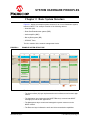
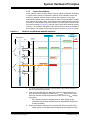
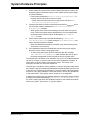
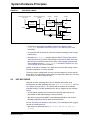
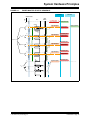
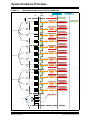
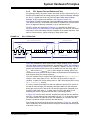
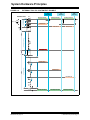
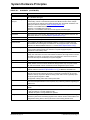
The ECL system test, illustrated in Figure A-3, is described in detail in the
Electrical Control Line Specification [3]. Upon detection of a valid TSI, the device
shall stay in active power state until the completion of the results sequence, then
wait for tPwrSwitchOffDelay, before returning to sleep power state.
FIGURE A-3:
ECL SYSTEM TEST
System Test Initiator asserts ECL
Participants assert ECL
All ECUs trigger test, if necessary
NTSI = 3
PSync
ECL
P1
P2
P3
P4
P5
tSSEnd
tTSI
tTSI
tTSI
E1 O1
E2 O2
Emc Omc
tTestPause
tStartUp
t = 0.2xmc + 0.3 s
System Test
"Start Sequence"
"Parameter Sequence"
"Result Sequence"
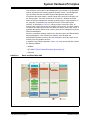
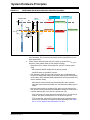
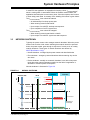
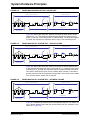
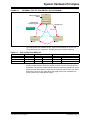
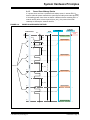
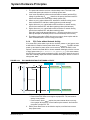
Figure A-4 illustrates the basic system power master initiating an ECL system
test after failed network startup attempts. As specified in MOST INIC Hardware
Concepts Specification [4], the P[1:5] = 00100b is a Stable Lock test. This ECL
system test requires all devices to look for stable lock from the rising edge of
PSync until the end of tTestPause (2.5 s). Even though the existing system only
contains three node classes, the ECL initiator must allow/wait for all possible mc
node classes during the results sequence.
The lock condition can be retrieved from INIC through the INIC.LockState()
function. At the rising edge of PSync, the EHC can query INIC for the lock
condition. If stable lock occurs during tTestPause, INIC can notify the EHC via the
INIC.LockState() function.
If tTestPause expires and stable lock was not achieved, then the ECL device On
bit shall be returned high (not asserted); otherwise stable lock was achieved
during the tTestPause time, and the On bit shall be returned low (asserted) for a
given ECU with node class ’n’. In either case, the EHC shall drive En low,
indicating the device is powered and the EHC is operating properly.
In Figure A-4, both the AuxIn and the Amp devices respond that they both are
alive (En = 0) and that they both saw stable lock (On = 0). If the power master/
HU results indicate no stable lock, then the implication is a problem with the
harness connection between the Amp and HU devices.
Even though the Head Unit is the system test initiator in Figure A-4, the Head
Unit’s results from the test shall be driven during the results sequence during the
node class 1 time slot.
 2013 Microchip Technology Inc.
DS20005241A-page 31