1
RDS Encoder Silver v.1.01.x User Manual – 07/2011
1.1.2.
About RDS and RBDS
RDS, or Radio Data System, was developed in Europe in the mid 1980’s. It is a method of broadcasting a lowrate data stream on an FM stations’ 57 kHz subcarrier.
In many countries around the world, RDS can actually control the receiver in a car, switching it from frequency
to frequency as the vehicle travels; much like a cellular phone switches from tower to tower.
In this mode, the listener can journey from one end of a country to another while listening to the same radio
program, even though the station may seamlessly tune dozens of separate frequencies along the way. RDS
can even cause a receiver to interrupt a CD that is playing to tune in a traffic report, if that is what the listener
desires. The current standards of European RDS broadcasting are reflected in the standard IEC 62106, which
is available on line for research and review, at http://www.rds.org.uk
RDS and RDBS standards are extremely similar, the main difference resides in the PTY code definition (see
APPENDIX B).
RBDS, or Radio Broadcast Data System, is the American standard of RDS data broadcasting, first introduced
into the US in 1993. These standards, collectively known as NRSC-4, are available on line at
http://www.nrscstandards.org.
The data rate for RDS is relatively small. The overall data rate is less than 1,200 bits per second.
A significant number of those bits are used for error correction, so the usable data rate is a mere 730 bits per
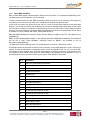
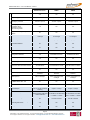
second. The data is transmitted in 32 separate ‘groups’, which are labeled 0A, 0B, 1A, etc. up to group 15B.
The purpose of each separate group of data is rigidly defined, to allow the receivers to know where to ‘look’
for a particular piece of data, and to allow the most flexibility and possibility of future expansion. Here is a
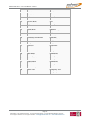
short description of the use of each of the thirty two groups. ODA stands for Open Data
Gp #
Description
0A
Basic tuning and switching information
0B
Basic tuning and switching information
1A
Program Item Number and slow labeling codes
1B
Program Item Number
2A
Radiotext only
2B
Radiotext only
3A
Applications Identification for ODA
3B
Open Data Applications
4A
Clock-time and date
4B
Open Data Applications
5A
Transparent Data Channels or ODA
5B
Transparent Data Channels or ODA
6A
In House applications or ODA
6B
In House applications or ODA
7A
Radio Paging or ODA
7B
Open Data Applications
8A
Traffic Message Channel or ODA
Page 4
Head Office : Parc d’activites Kennedy - 20, avenue Neil Armstrong – F-33700 Bordeaux-Merignac (France)
Tel +33 (0)5 57 928 928 – Fax +33 (0)5 57 928 929 – [email protected] – www.broadcast-silver.com