1
Desmond Users Guide, Release 3.4.0 / 0.7.1
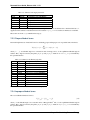
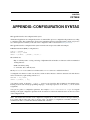
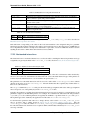
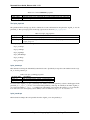
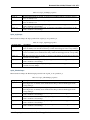
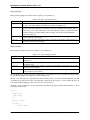
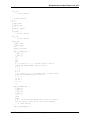
• ordinary differential equations (ODEs) with certain energy and measure-conserving properties,
• stochastic differential equations (SDEs) with invariant measures, and
• stochastic differential equations coupled to feedback control systems
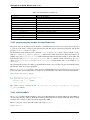
This section describes the supported systems in a mathematically exact and unconstrained form, omitting the details
of the integration method and the complexities of incorporating constraints.
A simulation is evolved according to a dynamical system specified by the integrator.type variable, which is a name.
This name selects the system to be used and is also treated as a key in the integrator section under which the parameters
for the specified system can be found.
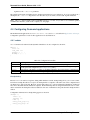
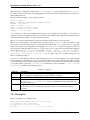
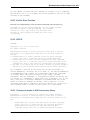
9.6.1 V_NVE: Verlet constant volume and energy
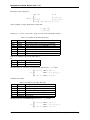
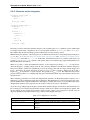
The V_NVE dynamical system is configured as shown in:
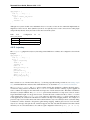
integrator.V_NVE = {}
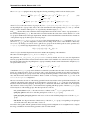
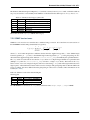
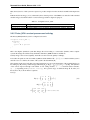
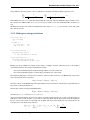
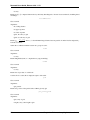
No parameters are needed. The system is the ODE:
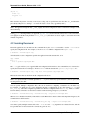
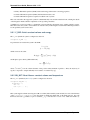
~r˙i = p~i /mi
p~˙i = −∇~ri U (r)
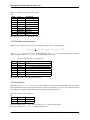
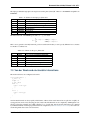
which conserves the scalar:
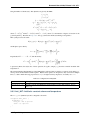
Ho (r, p) =
X
k~
pi k2 /(2mi ) + U (r)
i
and the phase space density (differential form):
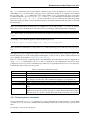
Ω0 =
Y
d3~ri d3 p~i
i
where d3~ri and d3 p~i are the volume elements of the position and momentum of particle i. Thus, the trajectory, if
ergodic, is expected to sample uniformly from a surface of constant H0 (r, p).
9.6.2 NH_NVT: Nosé-Hoover constant volume and temperature
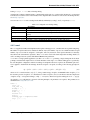
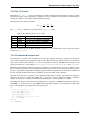
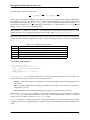
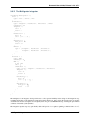
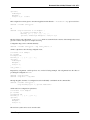
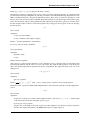
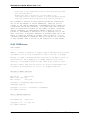
The NH_NVT dynamical [Mar-1992] system is configured as shown in:
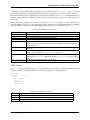
integrator.NH_NVT = {
thermostat = {
mts = m
tau = [τ1 ... τn ]
}
}
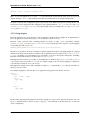
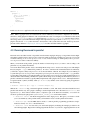
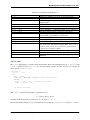
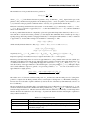
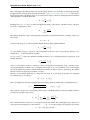
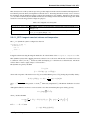
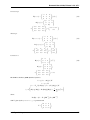
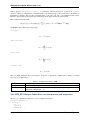
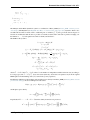
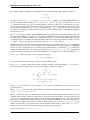
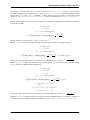
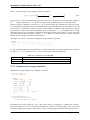
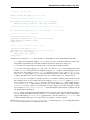
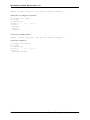
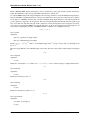
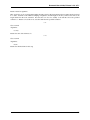
This system supplies a thermostat using a Nosé-Hoover chain (with extended system variables) for each of the elements
of the integrator.temperature list (the length of which must match that of the thermostat list). For each
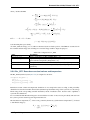
thermostat and each τi parameter, a pair of variables ζi , νi ) is introduced for a total of 2nk additional variables (k
74
Chapter 9. Dynamics